|
Who Is Responsible if an AI Agent Violates a Contract?
|
|
In [the Chain of Thought] article titled Two AI Agents Make a Deal, what happens when one party doesn’t live up to the agreement? Do current laws allow them to sue?
|
|
How do you get them to show up in court? These are kind of rhetorical questions, but nevertheless humorous and serious at the same time. Best Regards.
|
|
– Kevin W.
|
|
|
|
Hi Kevin,
|
|
These are excellent points to bring up, and actually very interesting from a practical perspective. These are actually soon-to-be very real issues.
|
|
First off, U.S. law does not treat an agentic AI as a legal person. I’m not aware of any jurisdiction that does.
|
|
And every company and LLC, for example, must have a registered agent, which is a human or a registered agent service.
|
|
So, to answer your question specifically, yes, current laws allow them to sue. More specifically, the companies themselves can sue or be sued. The AI software itself is not the suable entity. The corporation is.
|
|
Because of this, the legal entity (not the agentic AI) would be served. If the company (the LLC) ignores a lawsuit, the court can enter a default judgment. However, in theory, the agentic AI could be given a court service and attempt to defend itself, most likely with the support of the registered agent.
|
|
In reality, if there was in fact a substantial monetary dispute between two agentic AI-led corporations, the court would almost certainly look to discover the humans that were responsible for setting it up, providing initial funding for it, etc.
|
|
I’m sure that today, most judges would be very skeptical of fully autonomous zero-human corporations, so they will almost certainly look for origin and accountability by some human party/parties.
|
|
Aside from how a lawsuit might actually be managed, the bigger issue will likely be collection of any settlement. Assuming the agentic AI is the only holder of the private keys, and there is no other way to reach any assets held by the agentic AI, collection may be impossible.
|
|
It’s worth noting that this exact problem exists today when entities involved in a lawsuit have offshore entities and/or the company being sued is undercapitalized. There is often no recourse possible, or the expense of collection exceeds the value of the assets to be collected.
|
|
Either way, the courts will soon be forced to tackle issues like these, and there will be legal precedent set regarding zero-human corporations.
|
|
But so long as the law doesn’t recognize an agentic AI as a legal person, these LLCs can enter lawsuits, but the registered human agents will almost certainly be pulled into the mess.
|
|
Thanks for the interesting question.
|
|
“The End of the American Dream”?
|
|
|
Dear Jeff,
|
|
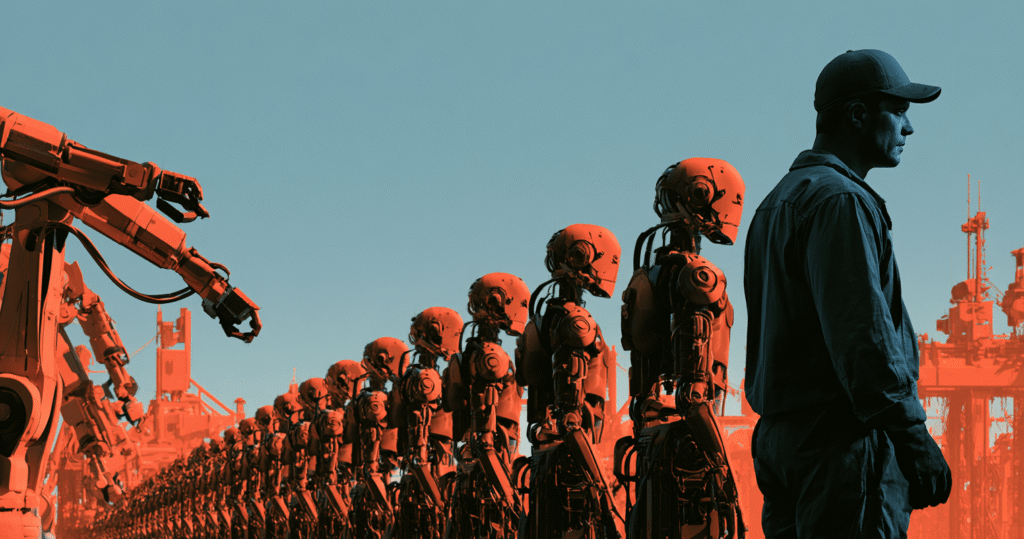
What if, when all this industry has been built, there will be no market for its products because the people have been replaced by robots, and [humans] have no money to buy them? That will be the end of the American Dream!
|
|
– Thomas D.
|
|
|
|
Hi Thomas,
|
|
It’s not unusual to have the kind of feeling that you’ve expressed. That sense that if/when robots can do everything that we humans can do, what’s left?
|
|
But that line of thinking assumes two things…
|
|
First, that there is an endpoint, some kind of static point in time where “all this industry has been built,” and it’s all done. Second, that society and economics will function in the same way that they do today.
|
|
Both assumptions are incorrect.
|
|
There is no endpoint, no static equilibrium for technological advancement.
|
|
Intelligent robots, task-specific robots, and artificial superintelligence are all tools, enhancements for human productivity. These technologies will free up time, allow us to live more balanced lives, enjoy far higher quality of life, and affect an even faster pace of technological breakthroughs.
|
|
Human motivations, drive, and creativity won’t die in that kind of environment, it will thrive. And that’s especially true of the American spirit. We love to improve, to invent, to build, and leave our children with a better life than the one that we had.
|
|
What will happen is that money, as we understand it today, will have less relevance. Advanced technology has a particularly deflationary impact on the cost of goods and services. I’ve written many times about how the cost of any good or service will distill down to the cost of energy and raw materials required to produce that good or service.
|
|
And when automated systems and robots are capable of mining, extracting, and processing raw materials, the reality will become that the cost of anything will be the cost of energy required to produce it.
|
|
Equally important is that new forms of energy like fourth-generation nuclear fission (small modular reactors, or SMRs) and nuclear fusion reactors will eventually result in even lower costs of energy production than the lowest available today. Purchasing power will increase significantly, and future low-income earners will be able to afford things that millionaires can’t afford today.
|
|
Humans who have the desire and motivation to work, be productive, learn, and contribute to society will still have a role in this inevitable future that is racing towards us. And humans who wish not to participate, have no desire to work, and only want to take from others, will have far fewer interesting outcomes.
|
|
Thomas, I would argue that the American Dream is more alive than ever.
|
|
When I look around the world at so many of the policies leading to economic decline, industrial weakness, cultural erosion (or elimination), the elimination of freedom of speech, the removal of personal rights and freedoms, and the destruction of the very fabric that originally made those countries strong…The United States is a bright beacon on the planet for opportunity, freedom, innovation, capital formation, and the staunch support for personal liberties and property rights.
|
|
U.S.-based companies are leaning in and building the future right now. There is nowhere else on Earth where more innovation is happening.
|
|
The American Dream is very much alive for anyone willing to lean in, commit, and contribute. And as long as the U.S. Constitution is defended, law and order are maintained, and the U.S. government maintains policies that support economic growth, the American Dream will stay alive.
|
|
Thomas, I have some suggested homework for you. I recommend reading Isaac Asimov’s Foundation series and the Robot series. Arthur C. Clarke is another one to read. Robert Heinlein is also a lot of fun. And Iain M. Banks and his Culture series are also worth exploring.
|
|
These are all obviously science fiction, but they’ll help bring to life what a distant future might look like when money, in the way that we know it right now, is no longer relevant.
|
|
As long as we (the global population) don’t end up in WWIII of some kind, or we experience some catastrophic event (like a massive asteroid hitting Earth), we are currently headed towards a world of abundance which is being led by U.S.-based companies.
|
|
We have an amazing future to look forward to, as long as we don’t let a small number of evil politicians and lunatics screw it up for all of us. And we the people are going to have to fight to make sure that doesn’t happen.
|
|
We have so much to look forward to,
|
|
Jeff
|
|
|
|
|
|
|
|
More stories like this
|
|
Read the latest analysis on hot growth stocks, and market-moving developments
|
|
| Anthropic’s Push for Regulatory Capture
I was reminded of the medallion crisis – and the nature of competitive dynamics – when it came to the topic of distillation of frontier AI models.
Jul 29, 2026 • 7 min read
|
 |
|
|
|
| Electrical Steel
Everyone is watching the silicon and the zoning fights. But how many investors are watching the steel?
Jul 28, 2026 • 5 min read
|
 |
|
|
|
|
|
|
|
|
|
To ensure our emails continue reaching your inbox, please add our email address to your address book.
This editorial email containing advertisements was sent to punjabsvera@gmail.com because you subscribed to this service. To stop receiving these emails, click here.
Brownstone Research welcomes your feedback and questions. But please note: The law prohibits us from giving personalized advice.
To contact Customer Service, call toll free Domestic/International: 1-888-493-3156, Mon-Fri, 9am-5pm ET, or email us here.
© 2026 Brownstone Research. All rights reserved. Any reproduction, copying, or redistribution of our content, in whole or in part, is prohibited without written permission from Brownstone Research.
|
|
|
|
|