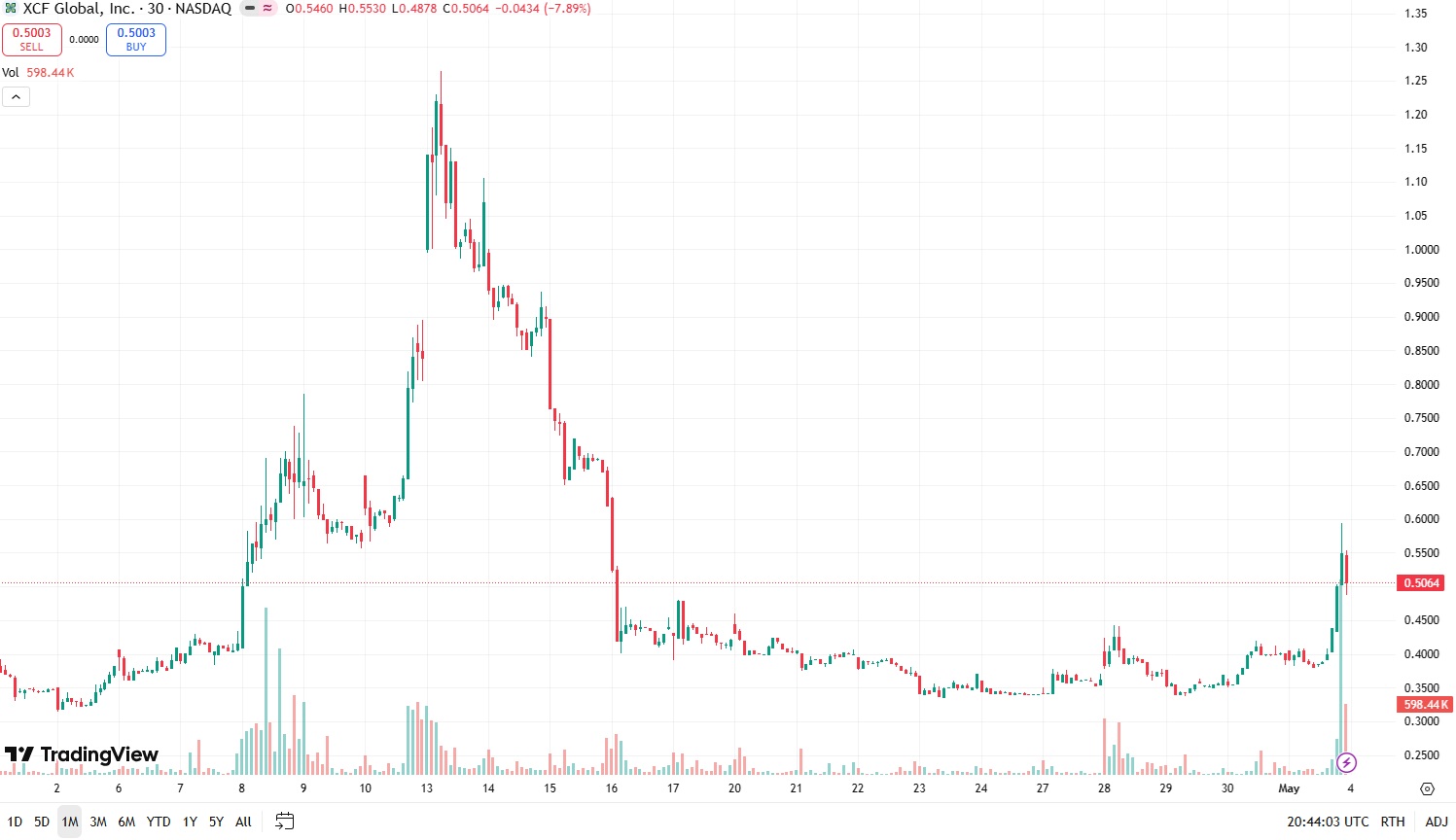
The 1-month chart for SAFX shows a long stretch of consolidation after a sharp mid-period selloff, with price stabilizing in the low-$0.30s before starting to curl higher.
Recently, momentum has picked up with a series of higher lows and a noticeable spike in volume accompanying the latest push toward the $0.50 range.
That kind of volume expansion after a base can signal renewed buyer interest, and if price can hold these gains and continue building above prior resistance levels, it suggests SAFX may be attempting to transition into an uptrend~!
Sky-High Jet Fuel Prices Are Forcing a Rethink—And SAFX Is Emerging as a Timely Solution!
Company Overview:
In a market racing toward decarbonization, XCF Global(SAFX) is carving out a distinct lane in one of the hardest sectors to clean up: aviation.
Sustainable Aviation Fuel (SAF) isn’t just another green buzzword—it’s widely viewed as the only scalable near-term solution to reduce airline emissions.
That puts companies like SAFX in a uniquely strategic position.
What makes SAFX especially compelling right now is the convergence of three forces: rising conventional jet fuel prices, increasingly favorable U.S. policy incentives, and tangible operational progress at its flagship facility.
This isn’t just a concept story anymore—it’s moving into execution mode, and the market is starting to notice!
Full report Here
👇
XCF Global (SAFX) Ignites Momentum in the Sustainable Aviation Fuel Revolution as Policy Tailwinds, Operational Progress, and Strategic Finance Moves Converge into a High-Upside Growth Narrative.
This small-cap disruptor is positioning itself at the center of aviation’s decarbonization megatrend—with catalysts building across operations, regulation, and economics.
Greetings All,
Operational Momentum Builds
Reno Facility Moves Closer to Full Potential!
SAFX’s flagship asset, the New Rise Renewables Reno facility, is quickly becoming the centerpiece of its growth story. Since launching commercial operations in early 2025, the plant has already produced over 2.5 million gallons of renewable fuels, including SAF, renewable diesel, and naphtha.
Now, the company is entering a critical phase: optimization. The facility is undergoing final-stage upgrades designed to improve stability, reliability, and repeatability—key factors for scaling production. Management is targeting a return to operations in June, a milestone that investors will likely view as a major inflection point.
With a permitted annual capacity of 38 million gallons, Reno isn’t just a pilot—it’s a blueprint. If execution continues to improve, this facility could validate SAFX’s model and unlock replication across future sites.
Forbearance Agreement Buys Time and Flexibility
In parallel with its operational upgrades, SAFX has secured a forbearance agreement tied to the Reno ground lease, extending through January 1, 2027. While “forbearance” might sound technical, the takeaway is simple: it gives the company breathing room.
This agreement allows SAFX to stay focused on ramping operations and completing upgrades without immediate pressure from lease-related enforcement actions. For a company in scale-up mode, that flexibility is critical. It effectively aligns financial obligations with operational timelines—a subtle but important de-risking move.
Policy Tailwinds Are Getting Stronger
Credits and RIN Economics Add Fuel
The macro backdrop for SAF is becoming increasingly favorable—and SAFX is positioned to benefit directly.
Recent EPA mandates have pushed renewable fuel requirements to record highs, increasing demand for Renewable Identification Numbers (RINs). XCF estimates that D4 RIN credits alone are contributing roughly $3.06 per gallon in incremental value to its SAF economics. That’s not trivial—it’s a meaningful boost to margins.
Layer on top the Section 45Z Clean Fuel Production Tax Credit, which could provide up to $0.60 per gallon through 2029, and you start to see a powerful economic framework forming.
Even more intriguing: SAFX is exploring a model to generate, verify, and monetize these credits directly, potentially creating a recurring revenue stream beyond fuel sales.
If executed successfully, this could represent a first-of-its-kind integrated platform in the SAF space.
Market Demand Is Heating Up
Jet Fuel Prices and Energy Security in Focus!
Timing matters—and right now, the timing looks favorable.
Jet fuel prices have surged above $3.75–$3.80 per gallon, driven by volatility in global energy markets. That’s putting pressure on airlines and increasing interest in alternatives like SAF, especially those produced domestically.
SAFX’s strategy—using U.S.-sourced, non-food waste feedstocks—aligns directly with growing concerns around energy security and supply chain resilience.
In a world of geopolitical uncertainty, domestic SAF production isn’t just an environmental play—it’s becoming a strategic priority.
Wall Street Is Starting to Take Notice
Analyst Validation and Technology Partnerships!
Momentum isn’t going unnoticed. Roth Capital recently raised its price target on SAFXfrom $0.40 to $1.20, citing operational progress and alignment with restart timelines.
Equally important is SAFX’s collaboration with Axens, a recognized player in refining and petrochemical technologies. Third-party validation like this helps strengthen confidence in XCF’s technical approach and scalability.
For a small-cap company, these signals matter—they suggest that both the market and industry participants are beginning to view SAFX as more than just an early-stage concept.
The Bigger Picture: A Bet on Aviation’s Future
SAFX sits at the intersection of multiple powerful trends: decarbonization, energy independence, and alternative fuels innovation. Its early-mover advantage in SAF, combined with a replicable facility model and growing policy support, creates a compelling narrative.
For investors tracking the future of clean aviation, SAFX is one of those names that’s starting to shift from “watchlist” to “active discussion.”
Bottom line
XCF Global (SAFX) is no longer just telling a story—it’s beginning to show progress. And in a sector where execution is everything, that shift could make all the difference.
As the aviation industry stands at a crossroads between rising costs and decarbonization mandates, SAFX is positioning itself right where those pressures intersect.
With operational milestones approaching, policy support strengthening, and new economic levers like tax credits and RIN values taking shape, the company is building more than just fuel—it’s building optionality.
If execution continues to track and market conditions remain supportive, SAFX could evolve from a speculative small-cap into a meaningful player in the future fuel ecosystem. For investors willing to accept volatility, this is a story that’s no longer just about potential—it’s increasingly about traction. Put the stock on your radar!