
Multiplicity, variety and internationalismThe internationally celebrated artist discusses mythology, ancestry and the power of hybridity in her sculptural practice
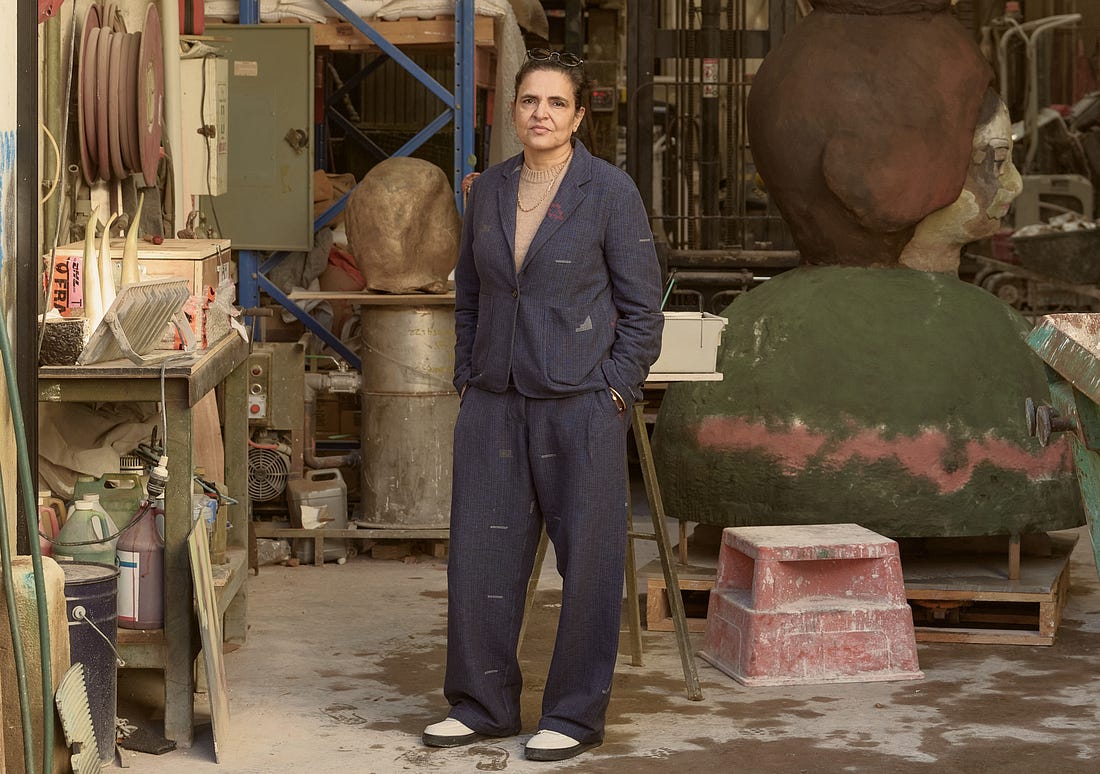
Bharti Kher epitomises an internationalism that we associate with artists like Mark Rothko or Marcel Duchamp, or even Yayoi Kusama, in that their work is recognised by a global audience perhaps more easily than than it would be in their country of origin (Latvia and later, America; France and later, America; Japan and later, America, respectively). In Kher’s case, this is particularly true not only because the general population is typically uninformed when it comes to contemporary artists from their own country, but also because Kher herself is rather unassuming. Born in 1969 in London, she studied and lived in the United Kingdom till her early 20s, when she decided to move to India. Today she divides her time between London and New Delhi. Between 1993 and 2007, Kher mostly displayed her work in India in some of the country’s most significant contemporary art galleries. From 2008 onwards, she began to exhibit in countries like the United States of America, Australia, Switzerland, Denmark and the UK: a trend that continues to this day.
On July 20, the UK’s Victoria and Albert Museum will show a set of works made by Kher, which as the museum website puts it, “explores questions of identity, belonging, memory and transformation, often through powerful reflections on gender and the body.” “Known for her imaginative and transformative sculptural works, Kher creates figures that inhabit spaces between worlds: human and animal, myth and reality, the familiar and the uncanny,” it adds. A new monumental bronze sculpture, Gaia (2026), will be unveiled for the first time on the Exhibition Road Courtyard there: The 13-ft high bronze work depicts a female warrior who carries a house on her head. Part figure and part dwelling, this hybrid Mother Earth goddess embodies ideas of shelter, belonging and home.
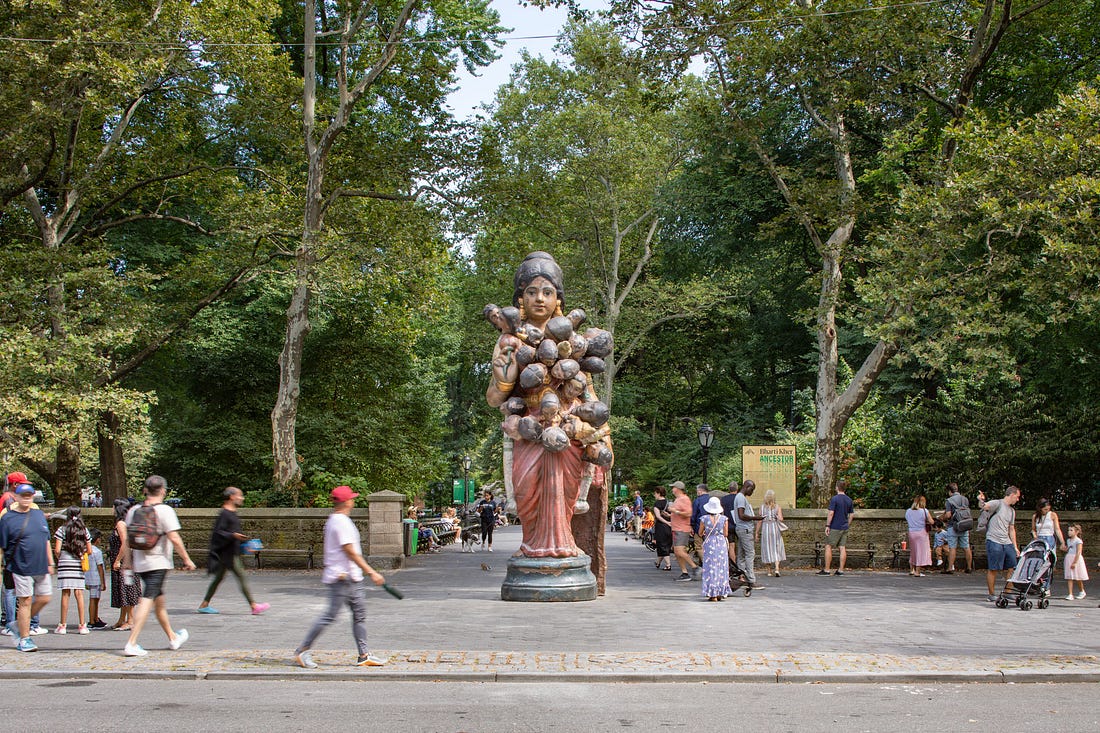
Later this year, in November, the Powerhouse Parramatta Museum will open in Sydney with a piece of public art made by Kher. The land of Parramatta was once home to the Dharugs of the First Nations tribes. Today, it is a locality in Western Sydney with a large population of Indian ethnicity. The seven-foot tall bronze sculpture titled Tree of Life is a “spirit work,” the artist said speaking over a video call from her London studio. Kher imbues her sculptural work with meaning drawn from mythical representations where the tree is centred, generous and wise — a source of life, and interconnected with all other beings — even as she subverts our traditional expectation of its form. Kher’s tree is a totem pole, with heads placed atop each other, each visage hearkening to our ancestors. Multiplicity is inbuilt in Kher’s artistic vision: no two visages resemble one another, and each implicitly nods to the variety of races and backgrounds we belong to. Kher’s internationalism is not a collapsing of time and contexts, a universalising, a generalisation, or a retreat into mysticism. For, Kher does not need to be told we are different. Her internationalism takes our plurality, our histories (and the violence implicit in it) as well as our present-day siloed-off living into account before it offers its take on the world. Kher’s worldview is one where hybridity is fecund. The work can also be viewed as “part of a very long series of [sculptural] works I made called The Intermediaries, where I looked at things as the in-between, not this, not that. You know, not quite man, not female, not God, not secular, not nature, not animal. They suggest an in-between space that is both fluid, constantly in flux, and centred, with a solid core,” the artist says. In 2022-23, her work Ancestor, an 18-ft tall bronze sculpture came up in New York’s Central Park, depicting a universal mother figure (sari-clad, long plaited) with clay heads attached to her body almost as an avatar of a goddess. Another monumental bronze, Intermediary Family, was displayed in 2018 at the Frieze Sculpture in 2018 and later at the Harvard Business School two years later. Three sculptures in one, this piece has many halves — a male form, a female form, and a child’s — of god-like figurines. For Kher, hybridity is the basis of all other forms that emerge. “I suppose the hubris of man is that we think we are the only intelligent creatures. But the entire world and universe is a series of intelligent negotiations, which is what the Buddhists have always said, and which is what spiritualism or even religions have spoken about. So, [when making Tree of Life], I was trying to accumulate this mythology, Indian mythology, ancestry and layer them as one does with totem structures, one on top of another, so that we not only create stories, but also multiplicity,” she said. Will Nawazuddin Siddiqui be able to pull off House? Last January, it was announced that the famed television series, House, starring Hugh Laurie as a doctor named House, will be remade by Banijay Asia production house. Late last week, news dropped that the web series that stars Nawazuddin Siddiqui in the titular role is in post-production. Raghav Ramadoss, the director of photography added it on his website, and we were treated to an interesting bit of news: the new show is called Hassan MD (clearly also a play on Hassan Mohammad, abbreviated as Md). I’m wondering if House can tackle specific, endemic diseases prevalent in India, rather than the globally recognisable ones? Will Lupus still remain the answer to 95% of the mystery diseases in the remade version too? According to Ramadoss, we won’t have to wait too long to find out. Late last month, Cats, the musical, came to India. The Nita Mukesh Ambani Cultural Centre (NMACC) in Mumbai hosted a performance of the Andew Lloyd Webber musical that opened on Broadway in 1981. Cindy-Ann Abrahams, who played Grizebella (the outcast cat), told Vogue India that Cats is the “Olympics of Broadway musicals” — an exaggeration with some truth to it. Abrams’ singing was out of the world, her rendition of Memories, the musical showstopper, rivalled some of its previous performances, including ones by Sarah Brightman and Celine Dion. (No kidding.) The show ended on June 28 in Mumbai, but at least two new productions, in New York and London, show us that the Jellicle Cats are here to stay even 45 years later. In the case of the former, a reimagined version opened at Broadhurst Theatre in April; a new version opens at Regents’ Park Open Air Theatre on July 25.
If anything marred the Mumbai performance, it was audience members who had no idea of etiquette: the musical was soundtracked by incessant conversation to my left and right. Still, Abrams’ singing made me forget the world and its woes for a full four minutes, and that, as the practical cats of T.S Eliot (on which this musical is based) would have said, was the long and short of it. Dhamini Ratnam is culture editor at Hindustan Times. Ways of Seeing is her fortnightly newsletter that takes you through only the most important cultural happenings you need to know of. You can write to her at dhamini.ratnam@htlive.com or comment on this newsletter below. Thanks for reading Ways of Seeing! Subscribe for free to receive new posts and support my work.
|