|
Amazon’s acquisition of Globalstar raised the hair on the back of the necks of the MNOs. They realized that both SpaceX and Amazon could now become wireless competitors to terrestrial mobile network operators.
|
|
Some are concerned that SpaceX, or Amazon, will become a mobile virtual network operator (MVNO) that competes directly with other wireless operators under the Starlink or Amazon brand. This would require SpaceX or Amazon to strike a deal with one of the terrestrial wireless operators to use their wireless network for their service in areas that already have wireless coverage.
|
|
Examples of MVNOs in the U.S. are companies like Mint Mobile (runs on T-Mobile’s network), Xfinity Mobile (runs on Verizon), or Cricket Wireless (runs on AT&T).
|
|
These companies are basically marketing companies that offer discounted services utilizing one of the big three wireless networks in the U.S. MVNOs exist everywhere around the world.
|
|
SpaceX Starlink, and eventually Amazon, bring a lot more to the table as an MVNO. They bring valuable spectrum and satellites that enable the D2D services which will give them more leverage in any future negotiations with MNOs.
|
|
But that’s not the largest perceived competitive threat.
|
|
What the wireless operators are really worried about is that SpaceX Starlink will become its own nationwide wireless operator and circumvent the three MNOs in the U.S. entirely.
|
|
With the spectrum that SpaceX now owns, this is technically possible, but with shortcomings.
|
|
D2D technology only works outside and with direct line of sight to the satellites. Obviously, being able to use your mobile phone indoors is important to us all. The only way that happens is if a mobile phone connects to a Wi-Fi network. That would enable calls over the Wi-Fi network as opposed to the Starlink constellation of satellites.
|
|
For subscribers who know that they will always have Wi-Fi access whenever indoors, this kind of service would be sufficient.
|
|
But for those who are on the move and frequently visiting new places, it would be problematic.
|
|
But SpaceX poses enough of a threat to Verizon, AT&T, and T-Mobile that the three are willing to band together. It’s all about protecting the business they already have.
|
|
And it will almost certainly backfire.
|
|
‘Betting on David’
|
|
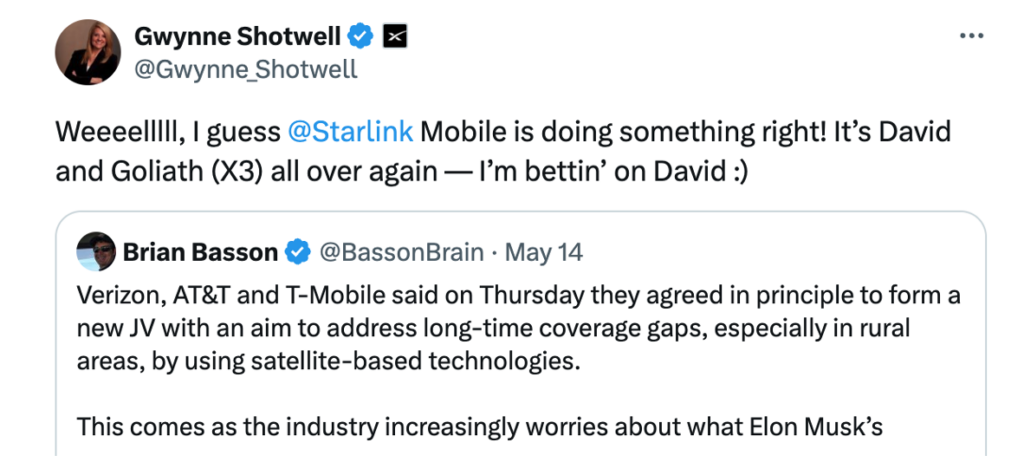
After the announcement, the president of SpaceX, Gwynne Shotwell, implied that the three wireless operators were trying to box out SpaceX’s Starlink D2D service from the U.S. market.
|
|
|
|
Source: X.com
|
|
The irony is that the JV will almost certainly help create what it’s designed to stop – SpaceX as a real competitor.
|
|
Think about it.
|
|
Had the wireless operators partnered with SpaceX for D2D services and leveraged its Starlink direct-to-cell satellites, they would have received best in class services from the largest and most advanced satellite communications network in history.
|
|
By boxing Starlink out with their JV, they will force SpaceX’s hand to offer services directly to consumers rather than in partnership with the wireless operators. That’s exactly what the MNOs wanted to avoid.
|
|
It’s foolish, old-school thinking by the heavily indebted legacy incumbents. And it will cost them dearly.
|
|
SpaceX and Amazon have both the technology and the spectrum. Just as important, they have the cash to build a competing business.
|
|
They can. And they will.
|
|
Jeff
|
|