
✘ Deep listening in the red strobeAnd: Sowing the seeds of change; A citizen's thought on AI risk; Talkie, a vintage language model from 1930; What your artist manager wishes you knew.
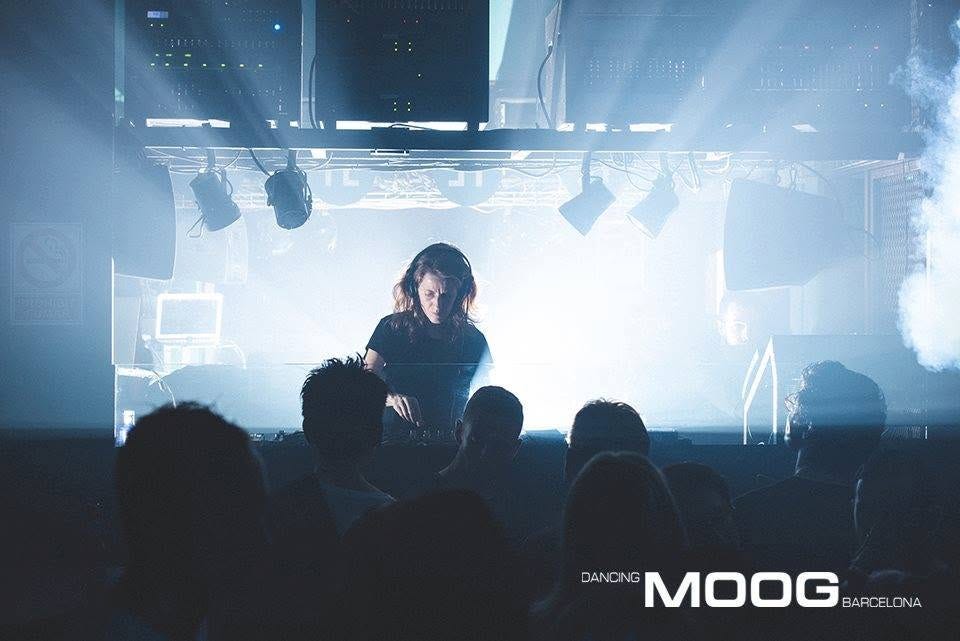
There is a dancer who lives on Kaltès’s permanent guest list, and he has no idea. She was playing a closing set at Tresor, and through the red strobe she could only make out his shadow, bending himself backward and forward so hard and so fast that, as she puts it, “it seriously looked like an exorcism was taking place.” Tresor as a room full of machines and sub-bass became a space where this body could shed something it had been carrying. I love this scene from my interview with Kaltès. Partially because I recognise myself in the dancer. Also, because it answers a question I often think of. How does sound with no words in it, made largely from drum machines and processed noise, reach into a person and fully rearrange them? Kaltès has spent a career chasing that, across jazz, musique concrète, steely Berlin techno, ritual, and the curation of ravers’ nights. When I asked her what the thread was between all this I was expecting an answer around genre or maybe gear. Instead, she said it’s all “an exploration of sound and emotional, physical space.” How did she learn to listen this way?
Deep listeningBefore Berlin, there was Brussels, where Kaltès studied jazz and improvisation. The regular imaginary of this training will trigger something about scales and changes and how to solo over them. Her take is much more interesting. Improvisation, she says, “told me how to really listen and also to experiment beyond the frame of classical composition.” This kind of deep listening
In a few words, she reframes what music is. For Kaltès the basic unit is not the note but the sound. A cello, for example, is not a set of pitches you arrange in time. It is a body of wood and string and rosin that scrapes, knocks, hums, and rings, surrounded by the air of whatever room it is in. Once you hear instruments that way, the wall between an acoustic source and an electronic one stops meaning very much. This reminds me of what Sarah Hicks wrote about in MUSIC x around conscious listening. Sound design became for Kaltès a collection of sources, waiting to be heard for everything it contains. So for her, the Shruti box she carried back from India, with its circular drone, sits in the same practice as a field recording or a synth. As Sarah wrote: “When we engage with music by actively listening and being aware of the present as it unfolds … we are practicing a skill.” From Sarah’s focus on mindfulness to Kaltès’ focus on hearing sounds for what they are, physically. It’s all forms of deep listening that open worlds. Have it allPerhaps on paper an orchestral library is a long way from the mechanical, club-oriented side of the spectrum where Kaltès mostly lives. Not for her, though. “I am never against tools,” she said. “I am not one to debate about digital vs analogue, vinyls vs CDJs, instruments vs VST.” Her position is closer to a shrug and a grin: “Have it all. The more the merrier? Any sound source is a new world of potential.” I have argued before, in Recalibrating our digital system, that the splits she waves away are not neutral facts about gear. Analogue versus digital, software versus hardware, human versus machine. These come down to us from a Cartesian dualism that taught us to treat information as a thing separable from the body that senses it. The history of computing has fully leaned that way, drifting from cybernetics, which in Simon Penny’s words “was concerned with the interaction of an agent or artifact with its environment,” toward an artificial intelligence where “the move to symbol manipulation retreated from engagement with the world.” I ended that piece on the idea that intelligence is “adaptation and the power of sensation” rather than logic running on a binary grid. Kaltès asks what a sound does to a body in a room, and leaves the question of whether it is real or synthetic to people with time to waste. That is that recalibration made flesh on a dancefloor. And, it is why a string library and a drum machine and a field recording can stand on equal footing for her. All are raw material for the senses, ranked only by what they can be transformed into. This is becoming the central argument across this series of Orchestral Tools Microgrant artists. A sample library is another world of potential, and the question is only what you do once you are inside it.
She draws a hard line on craft. For Kaltès, the project, she never uses these sounds straight out of the box. Orchestral and acoustic textures are “great to use as a base for experimentation,” rich in harmonics and built to be transformed by resampling, stretching, and effects. The library is a starting point, never a finished thought. She keeps a separate project, Sabaka, for more traditional singing and songwriting, where she leans on libraries more directly, mostly for strings. The tool, then, does not decide what the music is. The listening does. IddaHearing the world as raw material is a kind of freedom. Keeping the right to use it is another. Kaltès founded Aetna Records after releasing on other labels, and the reason is blunt: “I haven’t seen a single cent from streaming royalties for the music I’ve released over the past years.” A label of her own means she chooses where her music lands. It might not be optimal, she admits, but at least it is independent. The same instinct runs through her curation. She has hosted female:pressure nights at Tresor since 2013 and ran a “New Faces” concept to book artists who get fewer chances. She has absolutely no patience for the standard alibi: “the old tired excuse that you can’t really find that many good finta artists is just the excuse of those who don’t do the work.” There is an ocean of talent out there, she says, and the only barrier is the research nobody wants to do. The name carries the rest. Aetna is the Latin spelling of Etna, the Sicilian volcano her father’s family lives beside. In the old myths the mountain is a female entity, spoken of as “Idda,” and the word itself, from aithō, means “I burn.” A personal force, a creative energy, an inner fire. The volcano is the perfect emblem for an artist who treats every sound as something to be melted down and reshaped. Everything is fuel. So back to the dancer in the red light, because that is what all the listening is finally for. Kaltès does not want you to leave with a message. She wants you to leave with a sensation: “a memory, a feeling, a new way of hearing something.” Ask her what holds jazz, concrète, techno, ritual, and curation together and the answer is that if you listen deeply enough, sound can shift perception and move a body it has never touched. The orchestras and the rain and the drum machines are all just sources. What she is really handing you is a chance to be transformed, and more free, even briefly. LINKS🌱 Sowing the Seeds of Change: assessing the transformative potential of niche initiatives in a music ecosystem (Frank Kimenai et al)“In our research we therefore focus on the transformative potential of a seed, its latent capacity to initiate transformative change toward a desirable future of the music ecosystem. We argue that this transformative potential can be assessed through applying two analytical frameworks, leverage Points (Meadows 1999) and amplification strategies (Lam et al. 2020, 2022), in combination with our inductively developed concept of impact strategies. Together they make up our Seeds of Change framework.” ✘ How to shape the future of music? It’s a question that I hear so, so often at conferences. Leave it to the researchers to actually create some data around how to impact a desirable future. Start with seeds and provide cross-sector support to affect ecosystem-level change. This is a funding thesis as much as anything else. 💭 Extinction-level capitalism: A citizen’s thoughts on AI risk (Matthew Butterick)“Technological choices bear directly on the “public order” at large. When we don’t take those choices seriously—or we’re persuaded to ignore them by those insisting that technology is just a neutral tool—we risk political consequences.” “In sum—as new technology, AI acts as a creator of new risks; as a capitalist instrument, it acts as an amplifier or accelerator of existing risks and trends in the capitalist system.” ✘ Yes, two quotes. It’s a great piece, and I’m sure I’ll go back to it over time. Matthew does a great job of explaining risk, how it grows, where it comes from, and what its results might be. 📞 Introducing talkie: a 13B vintage language model from 1930 (Nick Levine, David Duvenaud, Alec Radford)“Vintage language models could also teach us about the impact of data diversity in AI development. While modern models vary in disposition, capability, and behavior, they are all closely related to one another by having been trained, whether directly or indirectly (via distillation and synthetic data), on the web. How does this shape and constrain what they are? How much of what we think we know about LMs is about human language and culture in general, or about this one dataset—the web—in particular? Training on different sources may lead to very different kinds of models being created. Studying the ways in which they are similar and different could improve our understanding of language model personas, behaviors, and dispositions.” ✘ This is a lot of fun to play with. Start asking it questions and see what you get back. I had a conversation about cybernetics and boolean logic which ended up being about maritime navigation strategies. 🙋🏾♀️ What your artist manager wishes you knew (Meg Adams)“Managers aren’t gatekeepers, they’re translators: When they slow something down, it’s protection, of the artist, the partner, and the opportunity itself. Independent managers are often doing five jobs at once without a department behind them; treat them accordingly.” ✘ Great read around the kinds of challenges artist managers face and what they think could help them remove those hurdles. There’s also a whole piece about the necessity for clear information, but this part about managers being translators was something I hear a lot, too. MUSICI absolutely love the Protest EP from Kaltès and Nene H, but since this interview, I’ve been rinsing La pluie d'été. It brings to your ears the creative energy I associate with Kaltès and now I know it really burns inside her. Headphones on and enjoy the sound design.
MUSIC x is free today. But if you enjoyed this post, you can tell MUSIC x that their writing is valuable by pledging a future subscription. You won't be charged unless they enable payments.
|