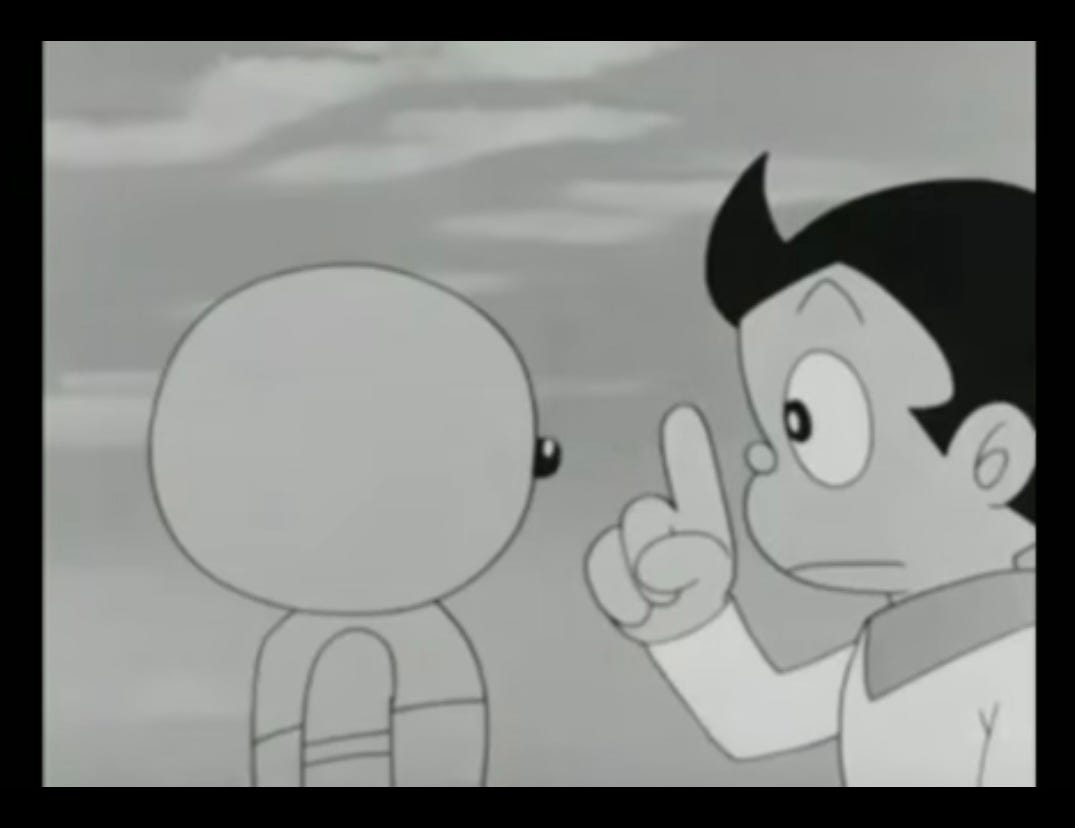

Growing up in Mexico, my siblings and I would sometimes watch El Hombre Par, the Spanish-language version of the Japanese cartoon Perman, created by the manga duo Fujiko Fujio in the 1960s. The series followed Mitsuo Suwa, an ordinary schoolboy who secretly became the superhero Perman. In order to preserve the appearance of ordinary life, Mitsuo would leave behind a robotic double—the Copy Robot—to attend school, interact with his family, and maintain his daily routines while he departed to perform heroic missions elsewhere. The robot was convincing but imperfect, producing comic misunderstandings that exposed the instability of identity itself. Looking back, I realize how deeply this premise shaped my imagination. The idea that one might delegate aspects of oneself into a surrogate identity—part performance, part protection, part displacement—would later become uncannily relevant to my own artistic life. 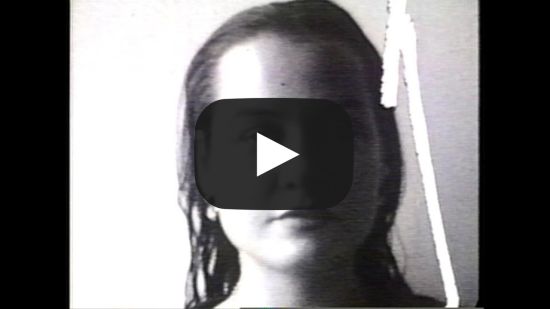
Ever since I began exhibiting publicly in the 1990s, I have had to contend—as many immigrants do—with the feeling of not fully belonging, with being cast as “the other,” and with the question of what it means to inhabit that position. How does an externally imposed perception of otherness begin to shape one’s own sense of self? In grappling with this, I often thought of Meursault in The Stranger, when he says, “I opened myself to the gentle indifference of the world.” I wanted to resist that imposed indifference and, as an artist, reverse the gaze. Looking at how Americans anthropologized and ethnographically framed Mexicans, I wanted to become a “Mexican ethnographer of Americans.” For my first solo exhibition, Parking Zones (Mexico City, 1998), I created a group exhibition featuring fourteen fictional artists from different ethnicities, genders, nationalities, and aesthetic tendencies. 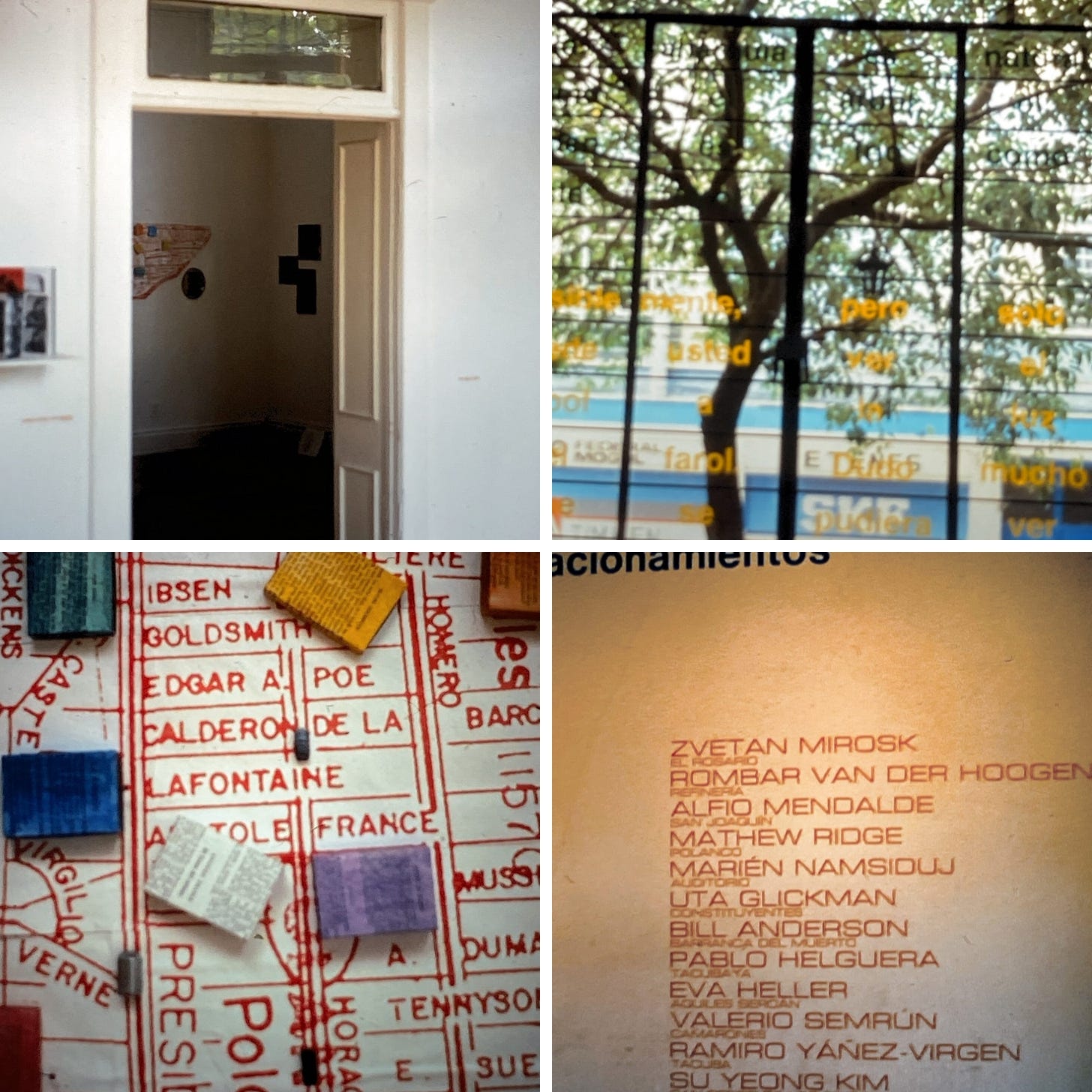
Works in "Estacionamientos"( 1998) a "group exhibition" with the works of 13 fictional artists (and my own). Tallería Espacio cultural, Mexico City
At the same time, there has been an increasingly vigorous debate around the ethics of embodying identities other than one’s own, particularly when artists or writers represent people from marginalized groups. At the center of this debate lies a genuine paradox. To prohibit artists from imagining lives unlike their own would seem to negate one of art’s oldest ambitions: the attempt to cross the boundaries of the self through empathy, projection, and invention. Literature, theater, and cinema have always depended on acts of imaginative ventriloquism. Yet history also offers countless examples in which this imaginative crossing became caricature, appropriation, or erasure, particularly when those doing the representing belonged to groups already holding cultural power. I fully recognize that inhabiting lives from a position of privilege can be deeply problematic. At the same time, I subscribe to Kwame Anthony Appiah’s warning against what he calls “identity enclosure”: the idea that cultural authority belongs exclusively to one’s own race, ethnicity, or lived experience. This does not mean abandoning accountability or ignoring unequal histories of representation. We should continue to question acts of appropriation or reductive claims to another person’s reality. But we also stand to lose something essential if artistic imagination is confined within fixed identity boundaries. The most meaningful works approach difference not as possession, but as conversation. This question has long mattered to me personally. My desire to embody others has never come from a wish to appropriate or possess their stories, but from an attempt to understand their dilemmas, contradictions, and ways of inhabiting the world. What interests me in these acts of imaginative crossing is not cultural ownership but the possibility that engaging seriously with another life may enlarge our understanding of human experience itself. Historical figures often become instructive avatars through which I can think indirectly about personal or philosophical problems. The projects that emerge from them create a productive distance from autobiography, allowing private concerns to become shared questions rather than confessional disclosures. I have long been fascinated by biography, particularly the seventeenth-century book Brief Lives by John Aubrey. Aubrey had originally been hired by the Oxford scholar Anthony Wood to compile marginal biographical notes for a larger scholarly project, yet his sketches became so vivid and psychologically alive that they evolved into a book of their own. What fascinates me is not simply the historical information they contain, but their method: approaching lives through fragments, anecdotes, contradictions, and peripheral details rather than monumental narratives. 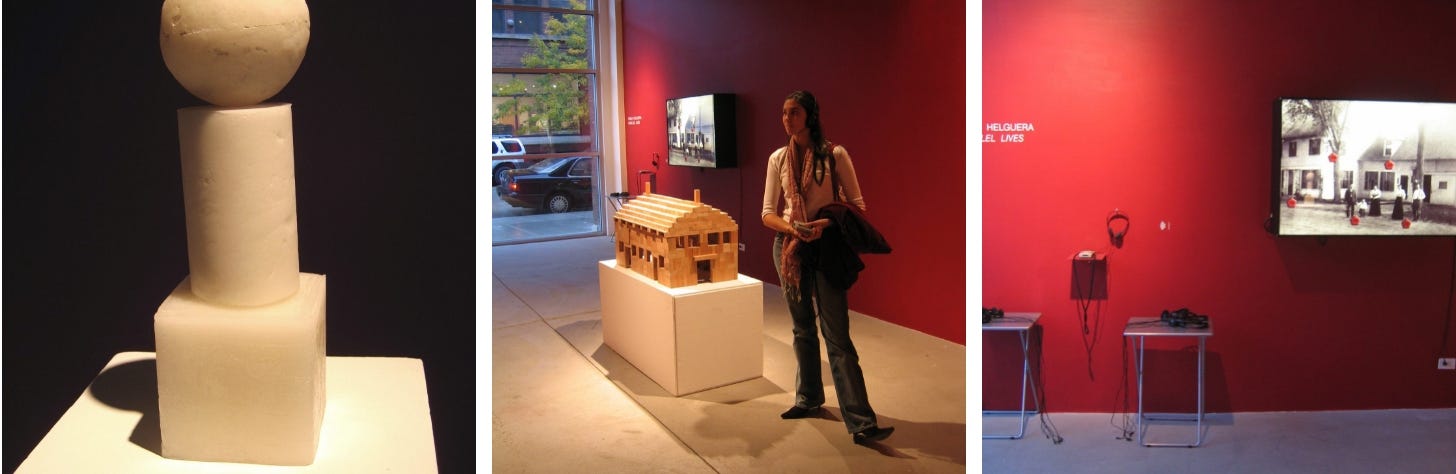
Parallel Lives, exhibition at Julia Friedman Gallery, Chicago, 2003. An acoustic guide narrated by artist Fred Wilson offered 5 biographical alternative readings to each of the objects in the exhibition.
In 2003, I created an exhibition titled Parallel Lives, in which I constructed a web of connections among historical figures who had long fascinated me, including Florence Foster Jenkins, Friedrich Fröbel, and Giulio Camillo. Although these figures emerged from radically different worlds, I came to see them as united by a shared relationship to artmaking, knowledge, and visionary thinking. Florence Foster Jenkins represented for me the paradoxes of performance and the irrepressible need to create. Though considered a terrible singer, audiences remained captivated by her conviction and presence. Giulio Camillo embodied the utopian dream of total knowledge through symbolic interfaces, becoming a distant precursor to the search engine. Friedrich Fröbel proposed a spiritual and play-based philosophy of education that would later shape modern art. None of these figures triumphed in a conventional sense, yet contemporary culture has profoundly benefited from their eccentric visions. They became for me models of how marginality and even ridicule can coexist with lasting cultural influence. I have often reflected on how best to describe the role these historical avatars have played in my artistic investigations. They were never simply subjects of research, but intermediary figures through whom I could approach questions that felt difficult to confront directly. Looking back, I realize that the historical figures in my projects often functioned like Perman’s surrogate: proxy selves through which I could displace anxieties, contradictions, and unresolved questions while maintaining a critical distance from autobiography. They were not masks behind which I disappeared, but mediating devices that allowed difficult realities to be approached indirectly. Episode 324 of Perman, titled “Push the Nose of the Copy Robot,” crystallizes the emotional tension at the center of the series. Mitsuo places his robotic surrogate in charge of ordinary life—going to school, interacting with family, maintaining appearances—while he departs to inhabit another identity as Perman, the masked hero charged with saving the world. Yet the copy robot is always an imperfect substitute. Its awkward misunderstandings and social blunders generate much of the comedy of the show, exposing the fragility of performed identity itself. Today, the copy robot’s mistakes feel strangely contemporary, resembling the “hallucinations” of artificial intelligence systems that inadvertently expose the limits of the technologies we increasingly depend upon. But beyond this accidental anticipation of AI, the series proposes something more enduring: that we often come to understand ourselves indirectly, by delegating aspects of ourselves into other figures, masks, avatars, or surrogate selves capable of confronting situations that our ordinary identities cannot easily navigate. In this sense, the copy robot is not merely a comic device but a metaphor for artistic projection itself. We construct intermediary identities in order to test possibilities, inhabit contradictions, and engage realities at a manageable distance. Knowledge, the series quietly suggests, is not produced through a unified and stable self, but through a negotiation among performed selves, projected selves, and aspirational selves. Erving Goffman would likely have appreciated Perman. In The Presentation of Self in Everyday Life, he argued that the self is “a dramatic effect arising diffusely from a scene that is presented.” Mitsuo’s Copy Robot literalizes this idea: identity becomes delegated, staged, and socially negotiated through performance. The series transforms Goffman’s distinction between “front stage” and “back stage” into a children’s cartoon about surrogate selves. This, ultimately, is what I find most useful in the artistic process: our ability to discover stand-ins, surrogate figures, or historical avatars that allow us—precisely because of the distance and perspective history affords us—to crack open complex social, political, or existential problems. These figures become cognitive instruments through which difficult questions can be approached indirectly, without reducing them to autobiography or ideology. Looking back, I realize that I had a deeper, personal Perman problem of my own. For nearly three decades I inhabited two identities that did not fully reconcile: the artist and the museum employee. One self attended meetings, managed programs, and spoke the language of institutions; the other pursued speculative questions, improbable ideas, and aesthetic risks. Yet over time I became less certain about which was the “copy” and which was the “real” self. The two identities depended upon one another, each enabling and destabilizing the other in turn. The copy robot in Perman can imitate another self, but it cannot escape the DNA of the person who activated it. Its gestures, failures, and distortions still bear the imprint of its maker. In much the same way, the avatars we construct through art are never fully autonomous beings. They are imperfect doubles through which we attempt to negotiate reality, think through contradiction, and confront questions too difficult to face directly. Perhaps this is precisely what artistic avatars are for. The split they embody is not a flaw in artistic practice but one of its conditions. Gustave Flaubert famously declared, “Madame Bovary, c’est moi.” Every figure we create carries traces of ourselves within it—our obsessions, anxieties, contradictions, and imperfections redistributed into other forms. And perhaps that is the most unsettling question the copy robot leaves us with today: after so long delegating fragments of our humanity into surrogates, systems, and artificial selves, one cannot help but wonder when the switch might finally occur—when we become the copy robot ourselves, dutifully maintaining appearances while the surrogate permanently takes our place outside, leaving us locked away in the closet, indistinguishable from the original we once believed ourselves to be. You're currently a free subscriber to Beautiful Eccentrics. For the full experience, upgrade your subscription.
|