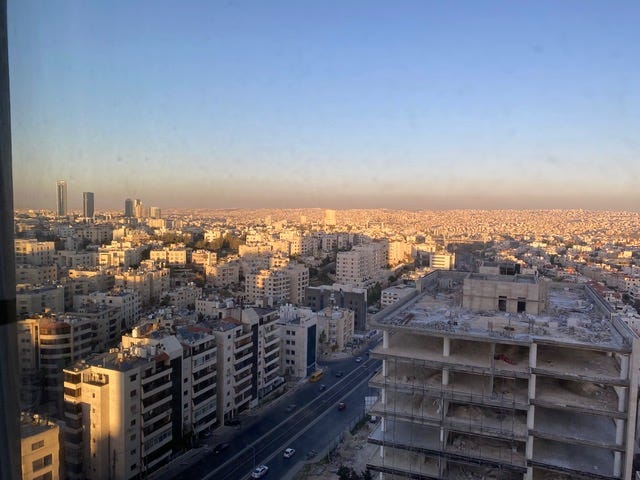
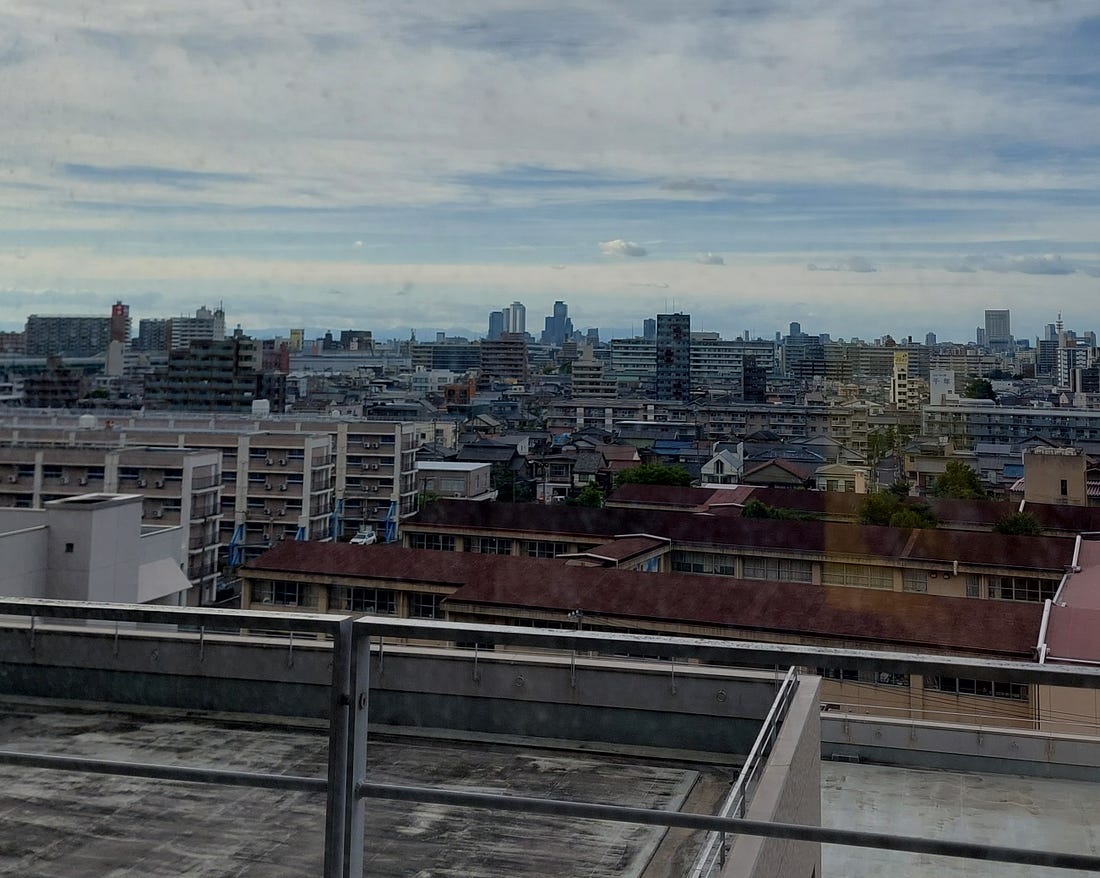
(For the View From Your Window contest, the results below exceed the content limit for Substack’s email service, so to ensure that you see the full results, click the headline above.)
Highlights from this week’s write-up:
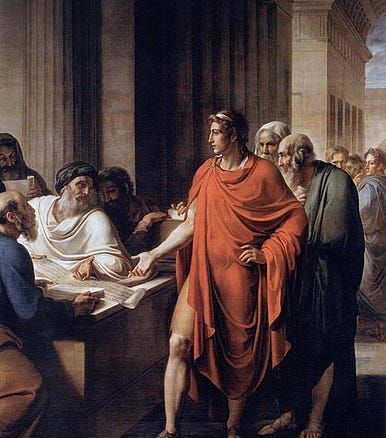
A previous name of this city was inspired by sibling incest
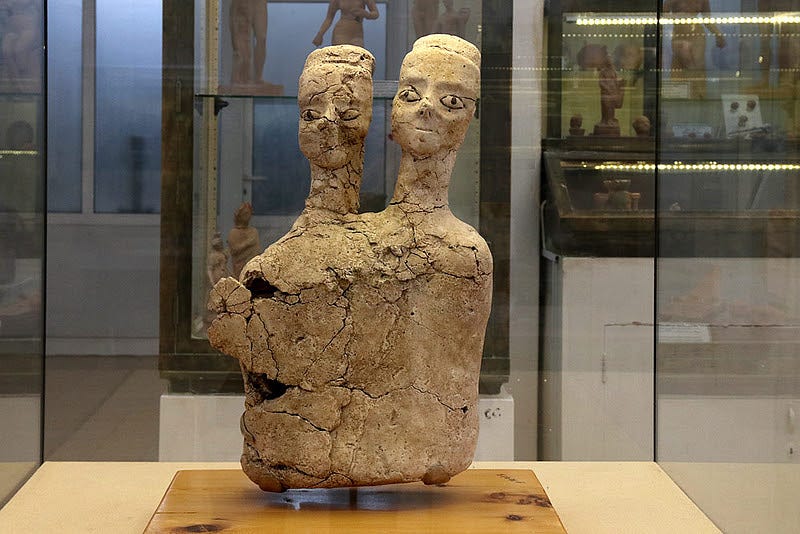
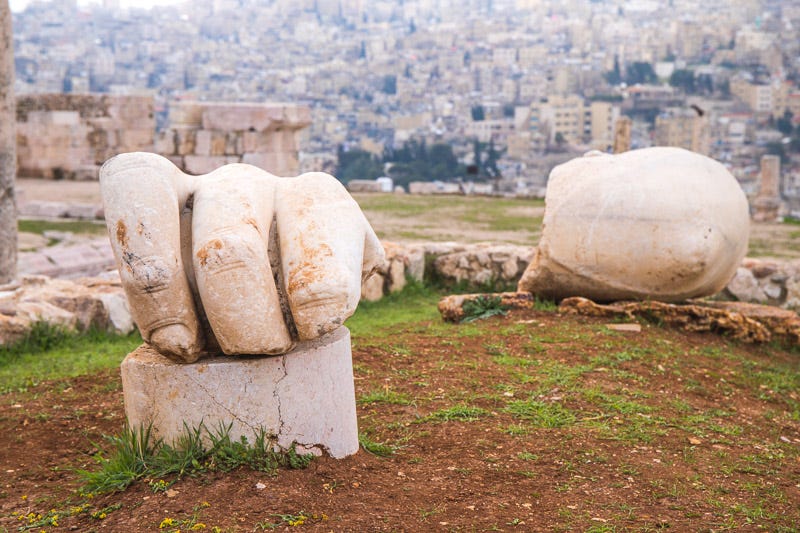
A mysterious ancient statue
A Mideast king with a cameo on Star Trek
Masterplans for rebuilding Gaza
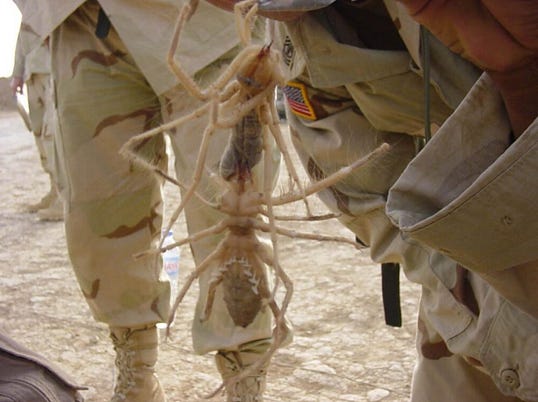
The creepiest creature we’ve featured in 500 contests
Wonderful news! Thank you, Chris. I’d like the book, please.
Here’s a followup from our super-sleuth in Alexandria:
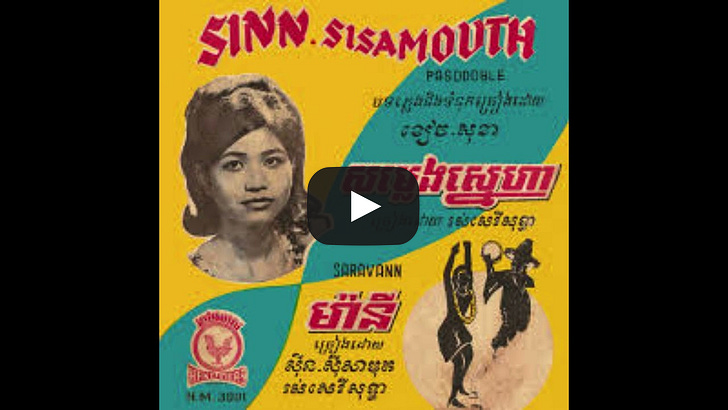
Related to last week’s entry about the band “CBC” in Vietnam, Cambodia also had a bunch of banging bands in the 1970s — before the Khmer Rouge killed anyone displaying Western influences during the civil war. The biggest star was the beautiful Ros Serey Sothea — a poor farm girl who got her start singing ballads with a few bands and eventually on the radio in Phnom Penh. She later sang together with heartthrob Sinn Sisamouth, and their songs were very popular. Sothea combined traditional Cambodian song elements with guitar-solo psychedelic American and French rock influences.
I love this one:
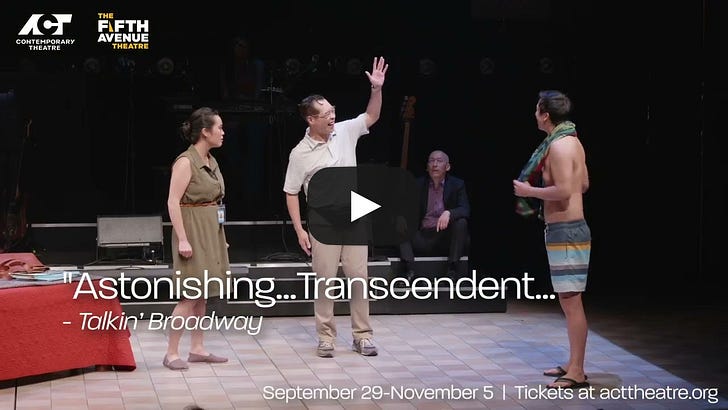
The current band Dengue Fever is keeping Sothea’s tradition alive by combining American and Cambodian styles, singing in both languages. The musical “Cambodian Rock Band” uses Dengue Fever’s music to tell Sothea’s story. I saw it here in DC at the Arena Stage and loved it. Don’t miss it if you’re a fan of Cambodian culture:
Sothea disappeared during the Khmer Rouge/Pol Pot times when she was 28 or 29, along with an estimated two million other Cambodians. I’m glad that her music is being rediscovered. Thanks for letting me shine a bit of light on her life.
Another followup comes from our CO/NJ super-sleuth:
Well, I was positive that contest #500 was going to be hideously hard. Turns out it was not so bad. But before I get to this week, a couple quick sidebars.
First, I was thrilled to see Campgaw Mountain mentioned by the Ski Nerd in contest #498. Fifteen years ago, Campgaw was part of the NJ ski racing association, when my oldest kid started out. In fact, one of her very first races was there. It’s not much of a hill, but it was close and convenient and a great training ground for 6-year-old budding racers. But, as the Ski Nerd pointed out, it was dreadfully crowded and the customer service was, shall we say, neither customer nor service-focused. I recall being there for a race one day and our little group of ski parents plugged in a crockpot. We were quickly dressed down and told that stealing electricity would not be tolerated. Ha!
Second, you asked the sleuths to share their favorite VFYW memories for the 500th contest. There are so many great ones, it’s difficult to single out any one thing. But for me, I would have to say: the thrill of finding the object of your desire after hours of toiling in seeming vain. While there have been many failures, those successes make it all worthwhile. Standing out in my mind is #377 (Shirakawa, Japan), #385 (Ikitake, Franch Polynesia) and, quite recently, #496 (Bogota, Colombia).
This contest does not get old and continues to be one of the highlights of every week. Thank you for all you do, Chris!
From our super-sleuth in Brookline:
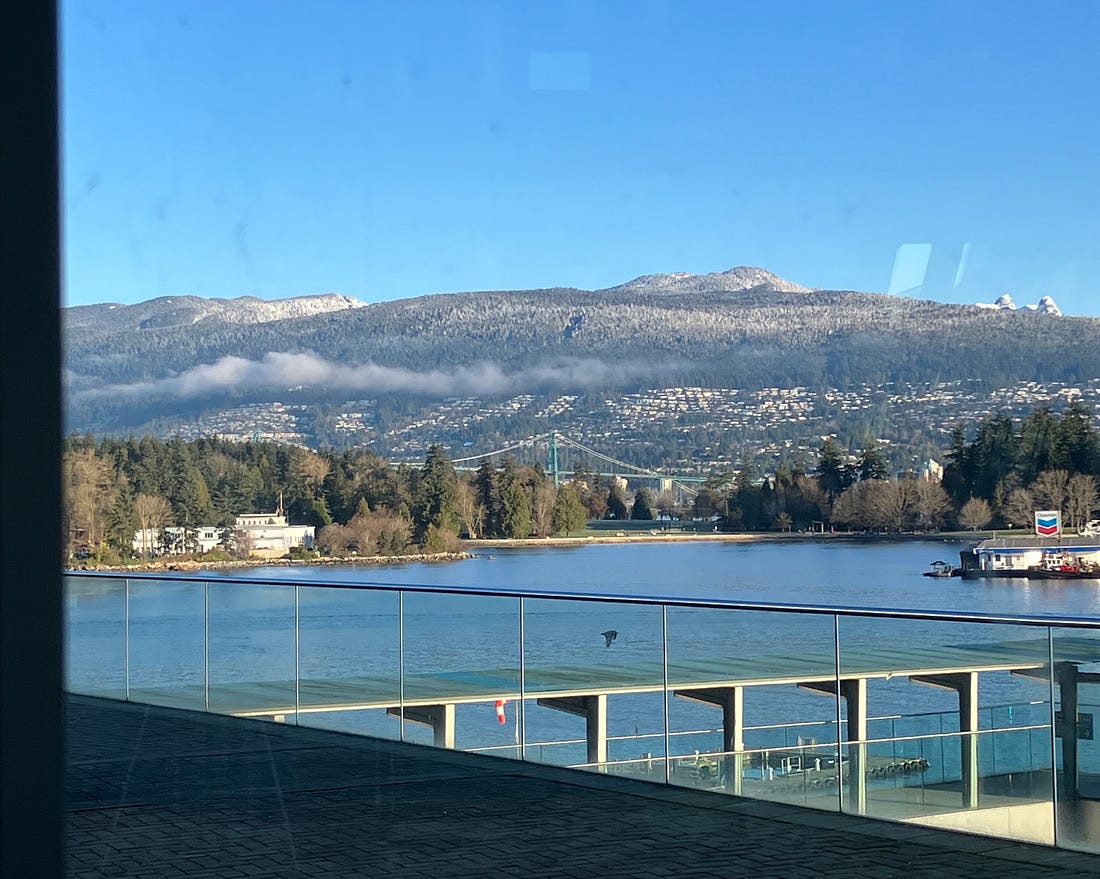
I’m back from my conference in Vancouver, where unfortunately I didn’t have time to take in more of the gorgeous scenery or to sample more of the excellent food. The view from my room at the Hyatt Regency Vancouver (yes, yet another Hyatt) wasn’t terribly interesting, so below is a shot from inside the Vancouver Convention Centre showing the floating Chevron gas station in Vancouver Harbour with Lions Gate Bridge in the distance. Not visible in the photo is a seaplane that had just taken off and was buzzing around over the water.
It was a peaceful scene:
This week’s contest took us into a grimmer part of the world.
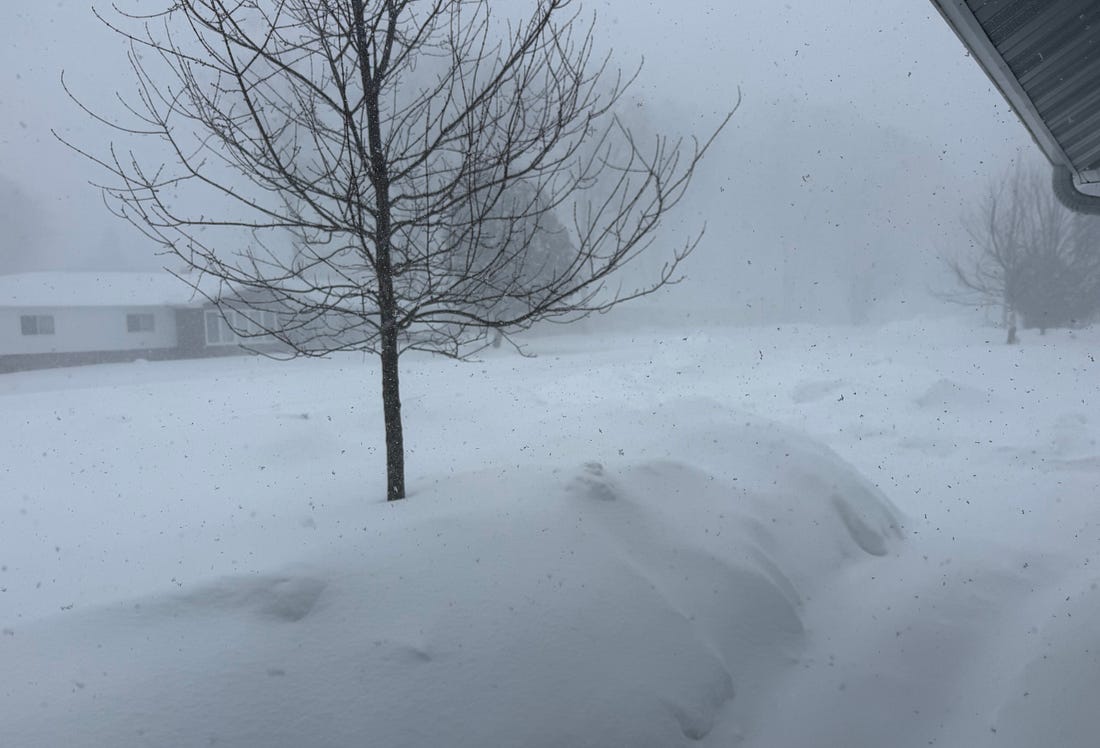
But first, another sleuth sends a window view of a “full-on blizzard in Iron Mountain, Michigan” — even more white than this week’s view:
Next up, our super-sleuth in Prince George (who wrote last week, “I’m in the middle of a couple of projects that are keeping me a little too busy and, while I like to take a VFYW break, time is a bit extra-precious at the moment!”):
I’m finally reading through last week’s write-up and saw your note: “Sounds like our super-sleuth in Prince George could use a drink [from the cocktail sleuth on Park Avenue].” I’m so far behind that I came into the office to work on Saturday. Having received your clear recommendation, I’m shutting off the computer, going home, and maybe trying out that Vietnamese Espresso Martini.
Have a great week and I hope this week’s contest goes well for you; I know you're going to be piling through a tonne of emails for contest #500. So many people wouldn’t write and share as much as they do if they didn’t love you and the community you’ve built. Enjoy all the entries for #500 — even if you can’t get through all of them!
He was also the first sleuth this week to send a correct entry. Here’s a nice note from our super-sleuth in Sydney:
Congratulations on 500! I speak for many who say this contest provides a welcome distraction from a seemingly chaotic world, and you’ve created a unique global community that leads to a simple truth: looking out a window reminds us how big a world it is and yet how our common humanity overrides our differences.
I know it takes a lot of work (maybe AI can help you?), but the weekly VFYW is a highlight of my inbox.
I’m holding out on using AI as long as I can. Here’s the inimitable sleuth known as A. Dishhead:
Happy VFYW #500! Wow, what a milestone! After all these years, I still get an electric rush when the clues come together and a window comes into view. And contributing is all the more fun thanks to the community you’ve built over the decades(!) from the Daily to the Weekly Dish. Thank you!
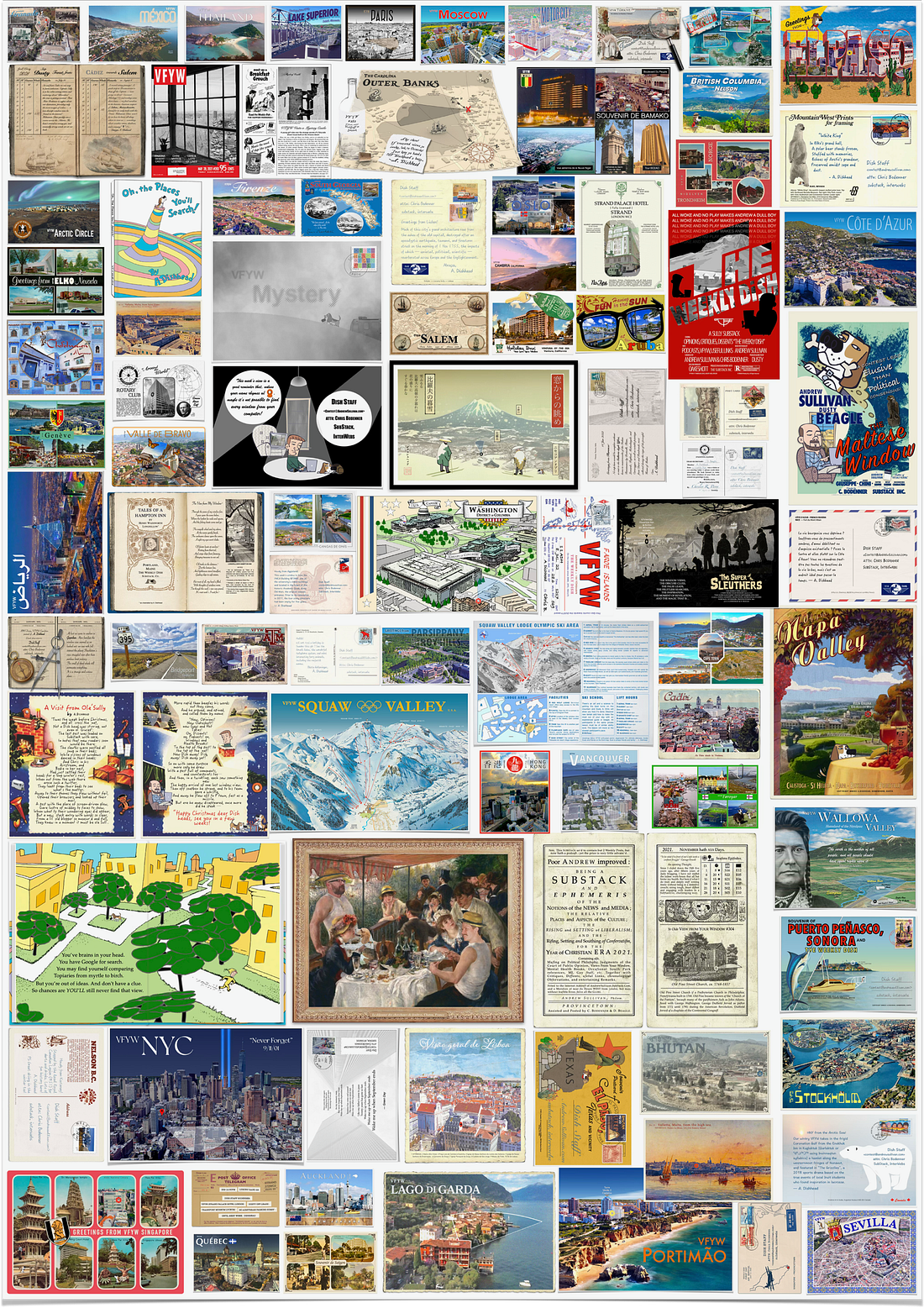
In honor of this momentous occasion, I made a collage of A. Dishhead postcards and miscellanea — from movie posters and magazines to maps and almanacks (uh, I mean substacks). I’m low-key impressed how much content I’ve submitted over the years : )
Here’s to 500 more?!
Here’s Giuseppe, our super-sleuth in Rome:
My first contest was #204 (Colombo); and I won #220 (Manzanillo). By then I was hooked, and for good reason: the jolt when you suddenly recognize the spot you are looking for after a long chase; using half-forgotten skills, learned in school long ago, to try to locate the right window; finding out that Chris posted your message; or even better, receiving the kind email he often sends when he didn’t post it.
Then there are the targets you set for yourself — the streak of correct guesses, or the sum of correct ones — and the satisfaction when you achieve a new silly personal record. These are all small joys, sure, but aren’t small joys more constant and much less subject to disillusionment than big ones?
Then, abruptly, it all ended in February 2015, when the Daily Dish retired. I was a little sad for a while, and I thought back to the VFYW contest as a source of great fun, but gone for good.
So, what is my favourite moment of the contest? When, against all hope, it came back after five year — and felt like only a week had passed.
Giuseppe’s prowess for sleuthing is matched by Berkeley’s diligence and attention to detail. The latter dissents:
Last week you wrote, “None of the sleuths this week got the arrowed window.” That’s a rare phenomenon, but it has an explanation covered by a rule that was established in contest #343: if Giuseppe indicates a window (and I assume this time he did), and if Giuseppe’s choice disagrees with that of the submitter (and presumably this time it did), go with Giuseppe’s choice.
You mentioned that the red arrow and circle in the submitter’s illustration were a bit ambiguous, what with the circle touching parts of four windows without clearly establishing a bullseye. The ambiguity doesn’t really matter, though, because none of those four windows were within a dozen yards of the right one.
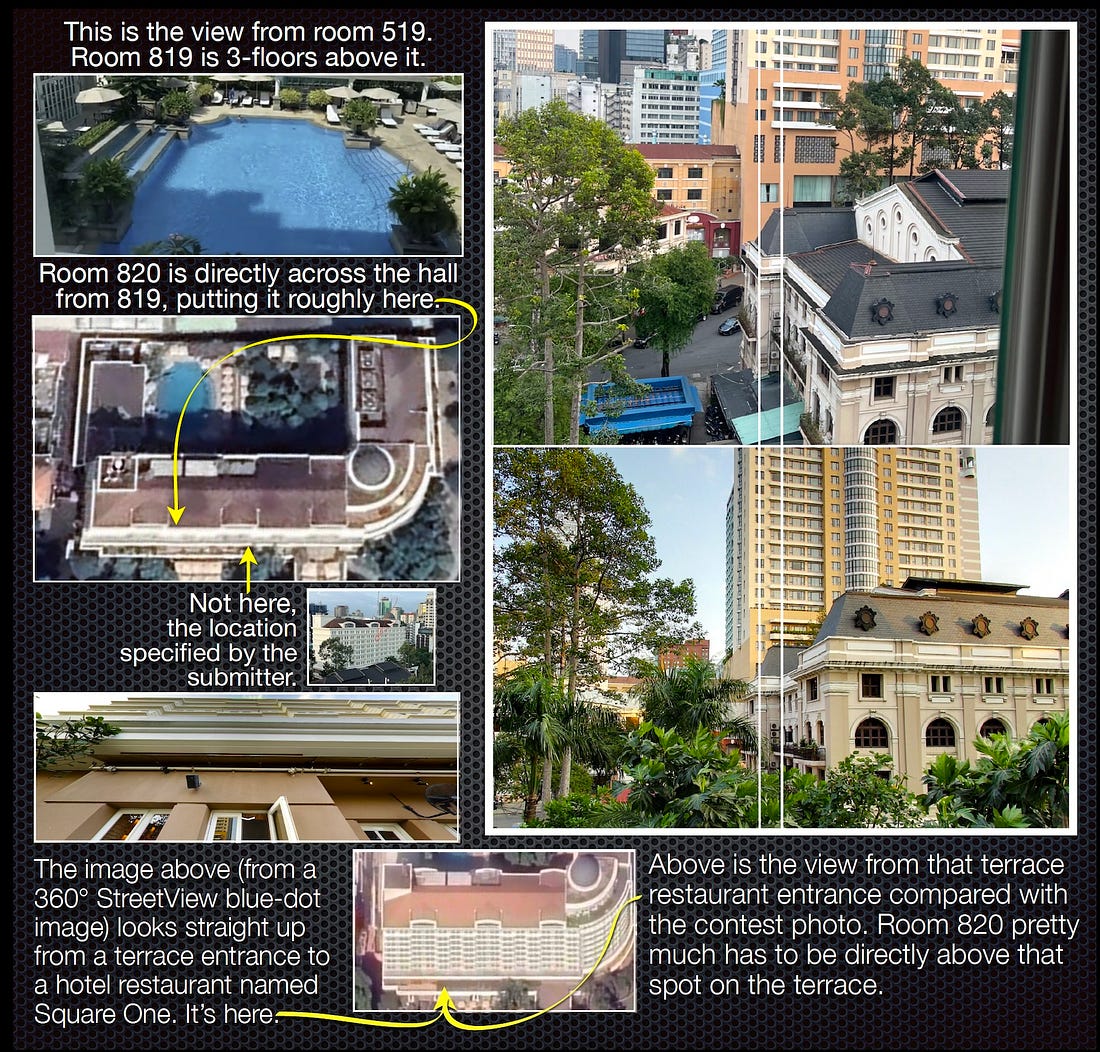
Contrary to how it must seem, I’m not always looking for opportunities to be a noodge, but here I go again. I tried to put in writing why I’m sure the submitter’s window identification can’t be right, but without pictures it got too convoluted, so I worked up an illustration (which itself may be too convoluted):
Also, our view over the back wall of the opera house is acute enough that the nearest ell hides half of its six windows. If we were looking out of one of the red-circled windows, which are almost dead center along the hotel wall, at most two but probably only one of the opera house windows would be hidden from us. Problems with the red-circled windows are also raised by the positions of a few trees relative to each other and to the blue roofed structure, but that would require another illustration and I’ve already given this too much thought.
Berkeley is the chief obsessive of the VFYW, and wonderfully so. Also, for the record, here is last week’s window guess from Giuseppe — spot-on with Berkeley’s dissent:
Back to the window search this week, here’s the other half of the married team in Mableton, GA:
Hi Chris! For once I actually have a guess, however tenuous, for the city. It seems appropriate to make my first guess for #500. And if I’m wrong, I’m happy to provide material for the top of your write-up …
But in another sense, this is not really my first guess. For I am the Cuddly Hubby of the super-sleuth in Mableton, and we collaborated to win contest #386 in Copenhagen. But she deserves the credit! (My Awesome Sweetie Wife says “hi!”) Life has been very busy and gotten in the way of contest entries, but we read the VFYW and the main Dish every week. She says she isn’t good enough as a sleuth to claim the title of super-sleuth, but I say she meets the criteria and clearly deserves it!
I hope you’ll forgive me if my favorite contest memory — out of legions of fond ones — is self-serving: winning #386, on her 38th try, in the one place outside the US she has traveled, on what would have been her late mother’s 81st birthday. Ya can’t make this stuff up.
This week I’m guessing Karachi, Pakistan. And how did I get to Karachi? The quick’n’dirty way:
Conifers + palm trees = mid-latitudes?
Possibly Islamic architecture = probably not the Western or Southern Hemispheres = maybe vaguely near the Silk Road?
Photos of cities in that region = Karachi looks plausible?
Eh, good enough to enter. I like to say the contest is really five contests: right region, right city, right neighborhood, right building, right window. (The fivefold path of the contest?) We’ll see if two out of five ain’t bad — or if, to quote from Caddyshack, I’ll get nothing and like it!
Thank you SO MUCH for all of your hard work to make this contest a sparkling jewel of the interwebs. Best to you and Andrew, and we raise a glass to 500 more!
Our super-sleuth in Tewksbury spots a key clue in the distance:
Palm trees and the general vibe suggest somewhere from North Africa to the Middle East, probably near-ish to the Mediterranean. Searching for “white cities” (or something like that) turned up a few options ... then I had to check each city for the one white building that stood out from the rest — this wedding-cake/collapsible spyglass/air-hockey-paddle-looking thing:
That eliminated Algiers and one other place I tried before I landed in [city redacted].
Identifying that building — and the region — is our super-sleuth in Roberts Creek:
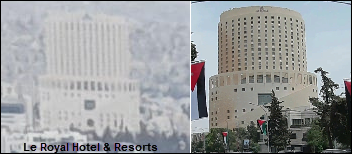
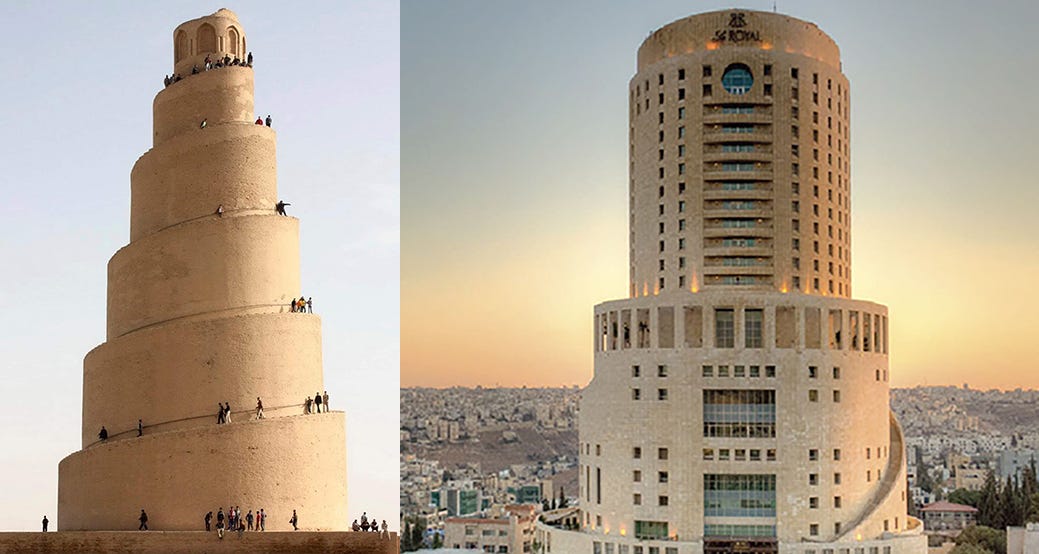
This took me some time, although I guessed from the start it was somewhere in the Middle East. The big breakthrough was identifying this blurry building in the distance as Le Royal Hotel:
From there it was just establishing that the view direction was eastward, since the faint logo visible on the top of the hotel faces west.
Here’s part of the process from a previous winner in Toronto:
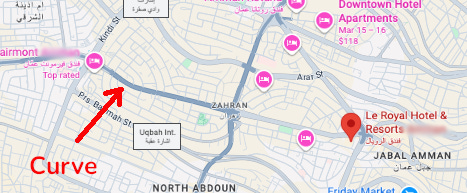
I decided that the most useful feature is the major divided road along the right side. As the road appears to curve to the left after the stylised-number building, I anticipated that it probably curves until it passes right by, or near, to the Le Royal Hotel. Therefore, I went back to Google Maps and in satellite view looked for major arteries not too distant from the Le Royal that curved in a similar manner, and identified this:
From our super-sleuth in San Mateo:
This week there are three key clues: the monochromatic nature of the city and several other building factors; the distinctive building in the left distance with a cylindrical tower topped with a crown-like structure; and the “30” logo on the building in the center middle.
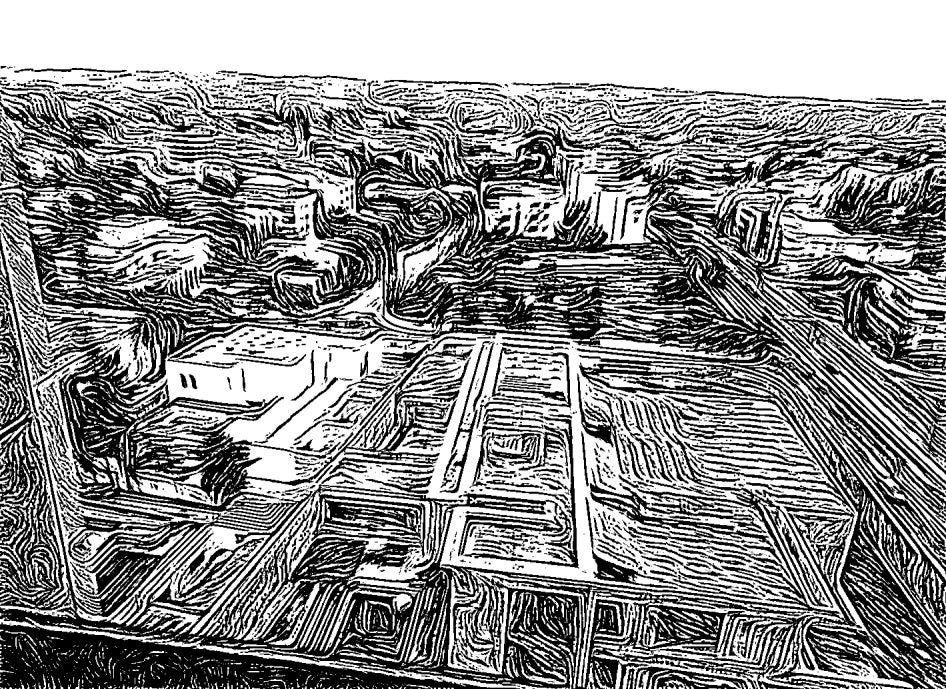
Given the nearly monochromatic nature of [city redacted], this week’s Reimagined will take that to an extreme — removing all colors and reverting to black and white. And in recognition of this city’s long history, going back 9,000 year into the misty Neolithic period, we’ll introduce a dreamy quality:
The super-sleuth in Riverwoods asks:
What is going on in the horizon? Are those endless buildings? Is Tel Aviv this white city?
That’s what Alexandria also guessed:
Happy 500! Pretty amazing that the Views have been picked apart, analyzed, and cherished for so long … thanks for keeping it alive.
I’m guessing this week’s view is somewhere in Tel Aviv, looking east away from the water, in Jaffa someplace, with all of those low white buildings. I couldn’t zoom in tightly enough to read any of the signs, but I did see some circular blue road signs that indeed can be found in Israel (thanks Google).
The long, rectangular, white license plates apparently are there, too, as on the cool-looking blue car on the right. Combined with the flat, dry-looking landscape and the dark green trees, that’s the best I can do. I searched around for the logo on the tall building in the middle of the photo, but no luck.
Our super-sleuth in Berkeley also looks at the “cool-looking blue car on the right”:
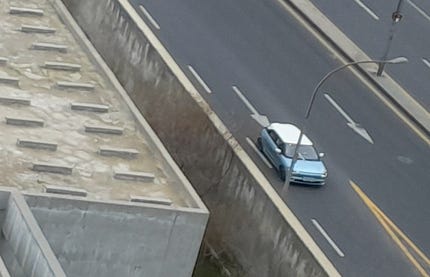
This week I learned about Dongfeng Motor Corporation Ltd., which according to Wikipedia is a “Chinese central state-owned automobile manufacturer headquartered in Wuhan, Hubei, [which was] founded in 1969 [and] is currently the smallest of the ‘Big Four’ state-owned car manufacturers of China.” The unfamiliar-looking, blue-and-white car cruising along the thoroughfare at right in the photo is a Dongfeng Nammi e-vehicle:
Dongfeng’s market outside China is a bit limited (they certainly aren’t sold in my neck of the woods or anywhere in the US, anyway), but they seem to be expanding rapidly throughout the Middle East, which is where the city in our photo obviously was located. So I guess identifying the car didn’t really help all that much.
Here’s some help from Chini, circling the right spot:
From our super-sleuth on Park Avenue:
Took me a while to get to [city redacted]. Looks like the Middle East or North Africa, and the area certainly is somewhat topical at the moment. With all the white buildings, I thought that it was Muscat, Oman. I had seen a video recently from a plane coming into land there, and it looked like it was the place — and I spent a long time before I decided it wasn’t.
Another gut feeling comes from our super-sleuth in Sagaponack:
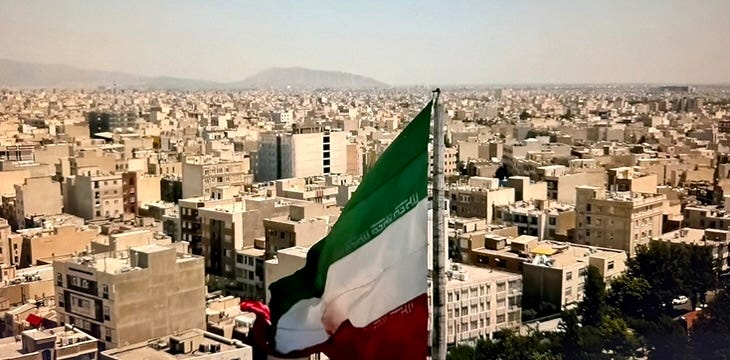
At first glance, this week’s View looked a lot like the panorama shots of Tehran they kept showing on the Apple TV show called Tehran (and it did seem like you might go for a location much in our thoughts these days):
My second guess was [city redacted], so I was pleased when the search tools pointed that way. Plus I’ve actually been there, so it would have been annoying to get it completely wrong.
Our super-sleuth in Warrensburg spots another important clue:
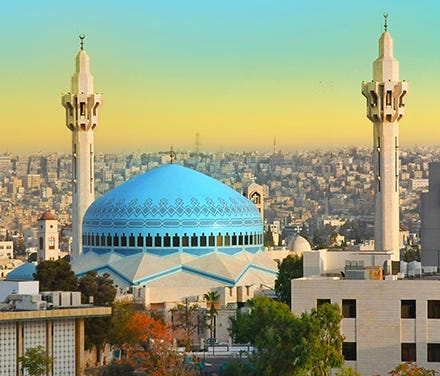
I struggled on this one for a while before noticing the mosque on the left. I then googled images of “light blue dome mosque,” and several rows down I ran across the King Abdullah Mosque in [city redacted]:
From our super-sleuth in Bethlum:
Having just read last week’s write-up, I have to mention that I think it feels like a classic VFYW coincidence that the super-sleuth in Malvern found a two-minaret mosque of use in locating last week’s window — as I did in this week’s contest. Serendipity indeed.
The A2 Team in Ann Arbor names the right country:
For this contest, the VFYW on the Dish’s main page last week helped:
Having recognized a Mediterranean or Middle Eastern landscape and architecture (e.g. the use of natural stone), I was about to check out Tel Aviv, when the view of that city in the main Dish told me that the solution had to be in the area, but not Tel Aviv. Syria and Lebanon could be ruled out, Egypt as well, so Jordan was going to be the most likely. And then the mosque in the far left of the view confirmed it, which turned out to be the King Abdullah Mosque.
Our Burner super-sleuth names the right city in Jordan:
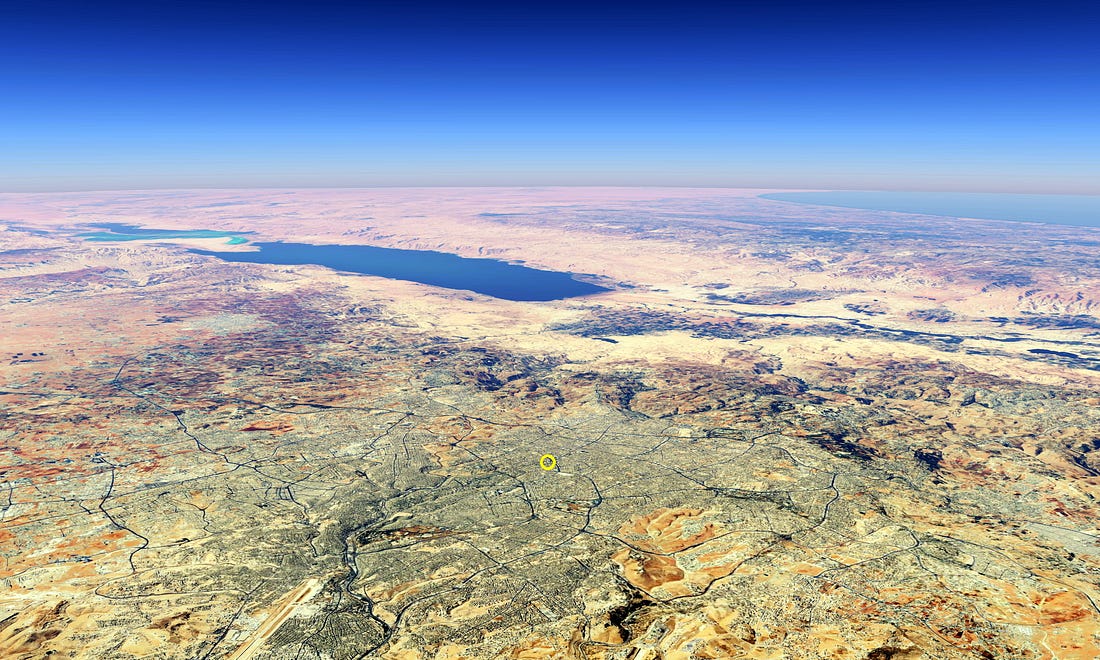
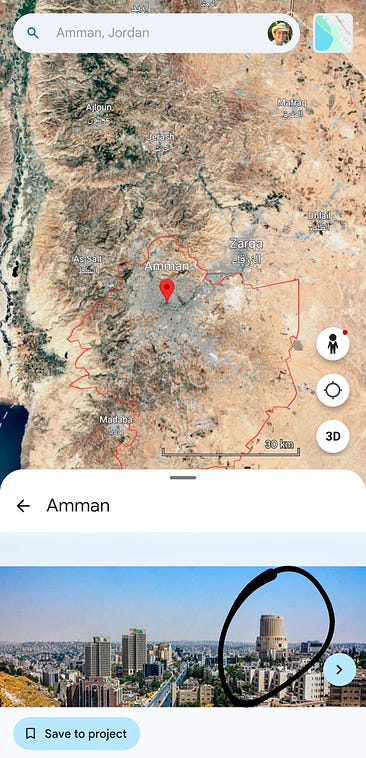
At first glance the view reminded me of Jerusalem, but I knew that couldn’t be right. The unique building in the distance seemed distinct enough to be a key to solving this window. I’ve been to Jordon, so I thought why not start there. I opened Google Earth and look what’s on the landing page for Amman!
This is the second time this has happened in the contest; the first time was the Deloitte building in Kigali, Rwanda.
He adds a lovely note about #500:
What a milestone! You’ve brought a lot of joy (and frustration) to people all over the world with something as simple as a window. Plus, it’s created friendships and bonds in people who haven’t met in person. I’m honored to play a little part in this community!
A few entries above, Bethlum noted a serendipitous moment with mosques. That theme of serendipity has always been my favorite part of the VFYW (a classic example here), and contest #500 yielded a personal example. Last Thursday, I drafted this week’s view from Amman. The following day, I got an email from an old friend from our NYC days in the mid-aughts. I hadn’t heard from Alex in about four years, and later that day I was coincidentally heading to a bar (The Green Zone) to catch up with two of our mutual friends I hadn’t seen together in years.
Serendipitous enough. Even more so was the news that Alex shared: he and his wife and daughter had been in Amman when the war broke out on February 28. He wrote about the experience on TravelBlog:
It’s incredible how much can happen in a week.
Not long ago, we were driving south from Amman toward Wadi Rum, the desert stretching outward in every direction, immense and timeless. The light was cinematic — that molten, honeyed Middle Eastern glow that makes the horizon feel infinite and ancient all at once. Sand and stone folded into one another like memory itself. The air was still, vast, almost reverent.
We were headed toward Petra and Wadi Rum — toward rose-colored façades carved into cliffs, toward sleeping under a canopy of stars so dense it feels like a second sky pressing down on you. It was supposed to be simple — a family weekend sewn neatly onto the edge of a long, demanding, deeply meaningful month. The calendar may have called it the shortest of the year, but it had carried the weight of something much longer.
(Photo by Alex, at work in Madagascar)
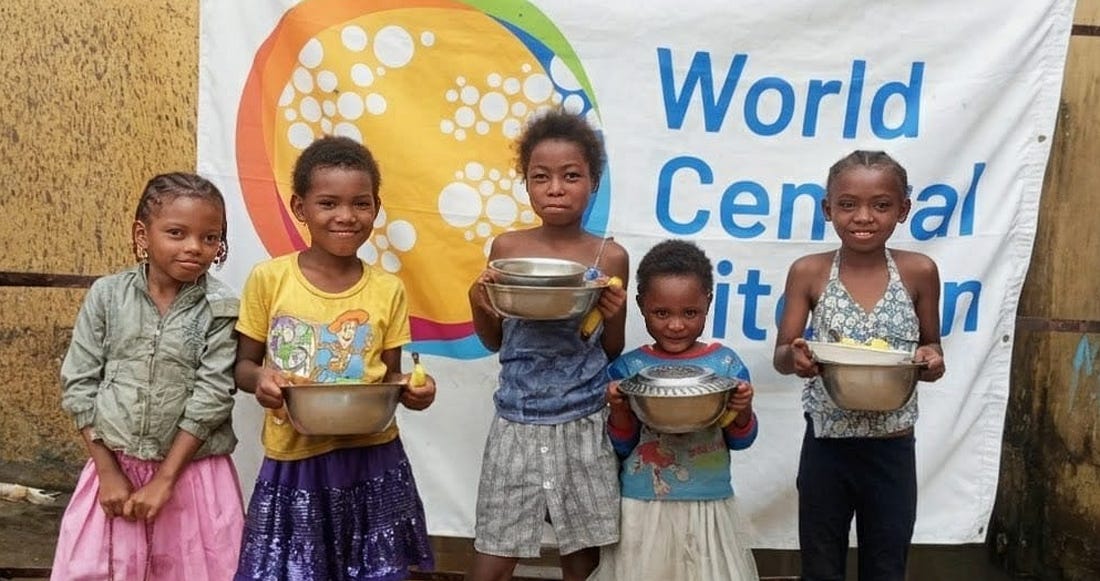
I had been in Jordan on assignment with World Central Kitchen, the organization I work with, which operates on the front lines of crisis and conflict to provide fresh meals to communities in need — the latest stop in a month that had already stretched across continents and emotions. […] Jordan was meant to be the final chapter before a pause […]
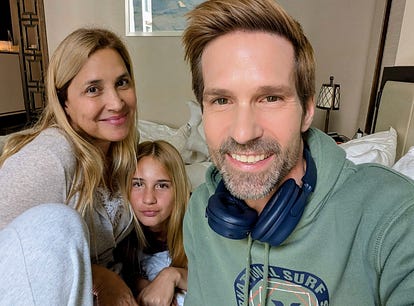
That morning, driving toward the desert, we were laughing. Amélie had her headphones on but kept slipping one earcup off to fact-check something she’d just heard about Petra. […] The road stretched out ahead of us, the landscape widening with every mile. And then my phone started buzzing. At first, the language was careful. “Monitoring the situation.” “Heightened tensions.”
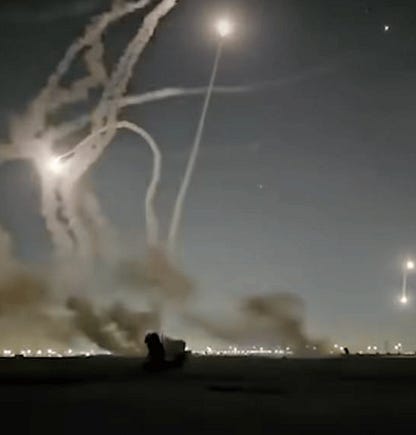
Not wanting to risk things, they turned around, back to Amman, to catch a flight home to Paris. But the first flight available was to Doha, so they grabbed it, not knowing if it would be the last plane to leave. In Doha they boarded a flight to Paris, but mid-flight, the captain had to turn the plane back to Doha because of airspace closures. That night, from the view from their hotel window, Alex and his family watched missiles being intercepted in the night sky:
Their ordeal continues here, with several twists and turns in a few more countries. They eventually made it home to Paris:
Our super-sleuth on the UWS shares her own moment of serendipity:
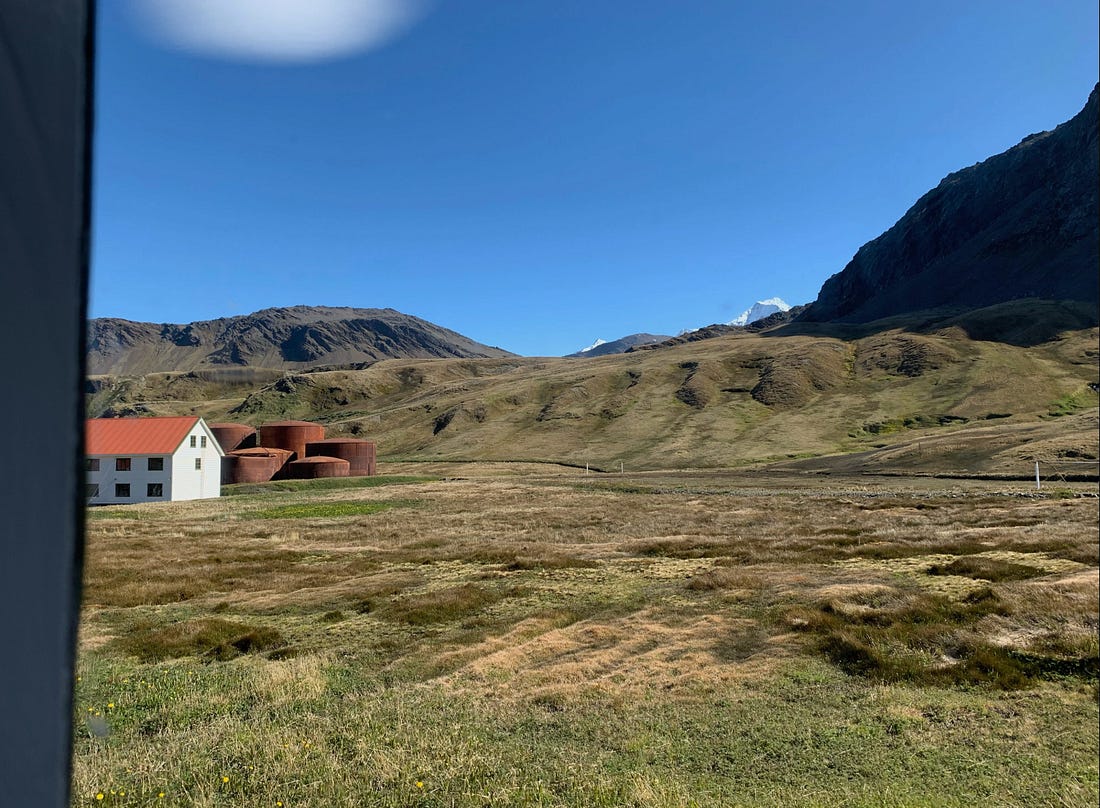
My favorite moment from the contest was when I won #312: Grytviken, South Georgia, Falkland Islands. Not just because I won (though there is that!), but because it was so utterly random in all regards. We were still in COVID times, and I was on a weekly Zoom call that my two sisters and I had established. For the first time, I showed them the View I was working on:
Grytviken, South Georgia, Falkland Islands
The very next day, my sister who was active on Twitter saw a post from the BBC that looked interesting to her. She checked it out, then followed the link to an article ... only to see exactly the same View I’d just shown her the night before. I thought for sure the submitter of our View had to be the photographer for the BBC article, but no. Random, random, RANDOM!
Back to the window hunt, a sleuth in Calistoga writes, “I can’t be sure of the room, but this looks very much like a photo I took from the St. Regis Hotel in Amman three years ago”:
Another hotel is picked by this previous winner:
The clues were lots of hills, white stone buildings, flat rooftops, olive trees, and dried vegetation. All of which seem very Middle Eastern — an area I know well.
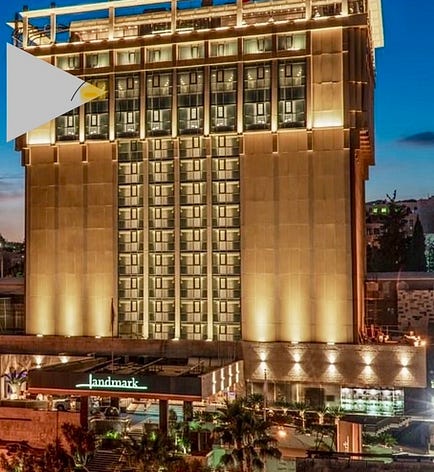
I think the photo was taken from Landmark Amman Hotel:
Here’s the triumphant return of Team Bellevue, naming the right hotel:
It’s been a while, and we’ve missed you all! But just like Patrick Swayze’s Bodhizafa couldn’t miss the 40-year storm, Team Bellevue couldn’t miss the 500th VFYW! Congratulations on this milestone!
Our search this week started off slowly, since we were a bit rusty and struggled. A curious water tower here, a pharmacy sign there, but not much to go on. But after a bit, we managed to zero in on what appeared to be a cylindrical building, with distinctive stepped architecture. Myriad queries on Google with ultra descriptive terms like “white” and “middle eastern” didn’t get us anywhere, but with brute force scrolling down endless screens of round high-rises, we finally stumbled across Le Royal Hotel in Amman, Jordan ... our first big breakthrough!
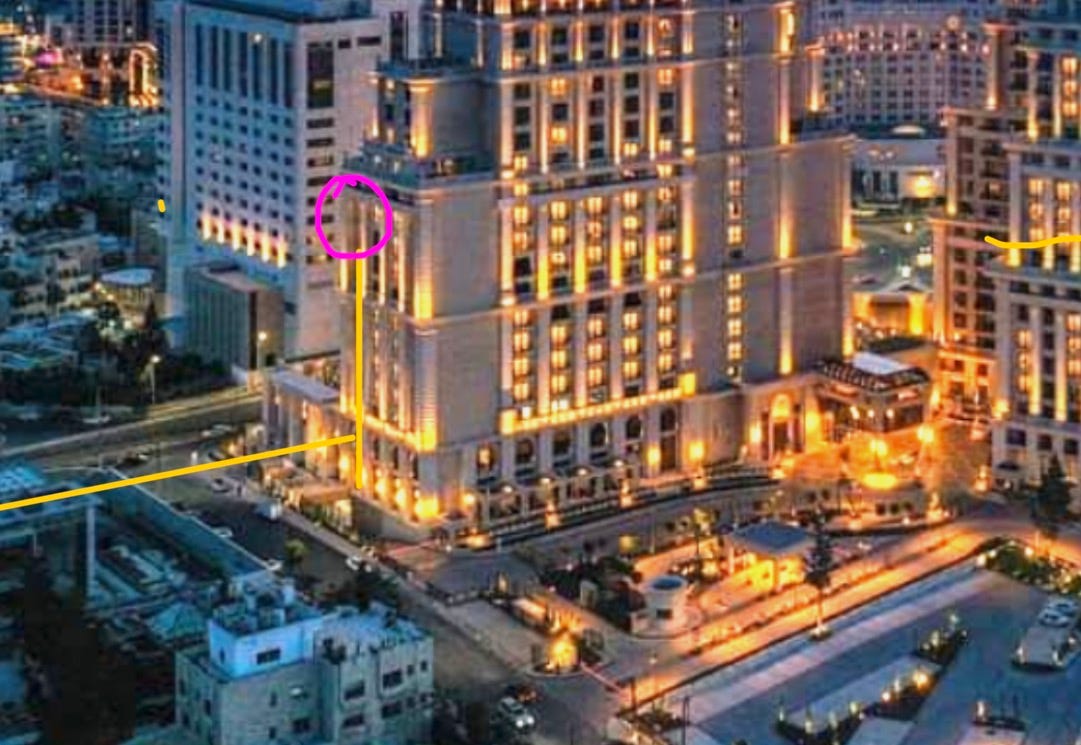
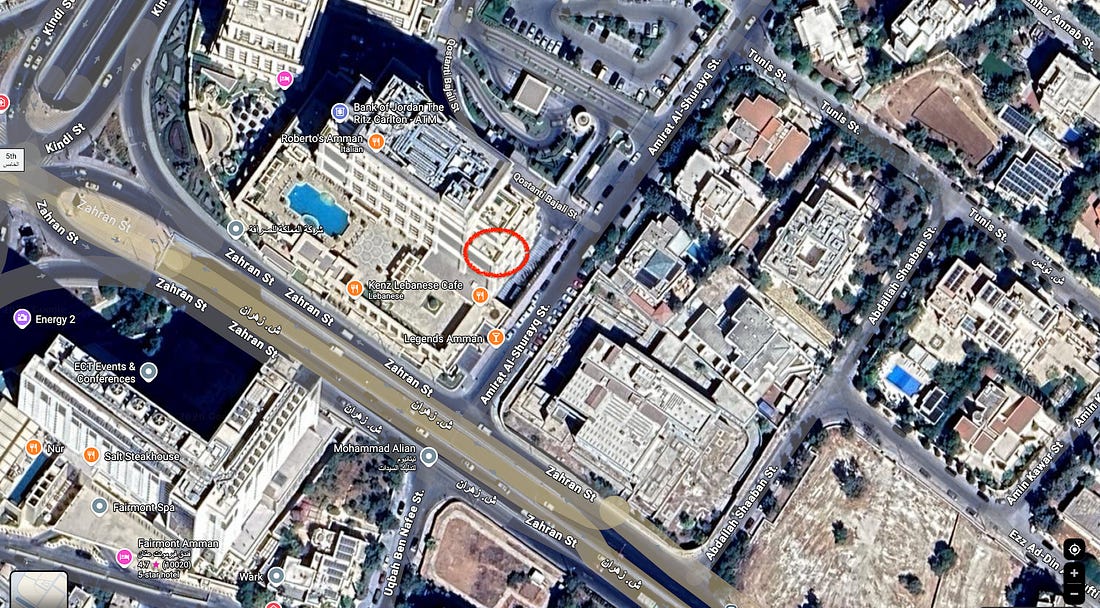
Once in the right city, the blue dome of the King Abdullah Mosque quickly got us oriented. Now things get a little tricky. It seems our “window” is in a building that is newer than much of the Google satellite / street-view data sets. Hmmm ... we can see it’s the Ritz-Carlton Amman, and fortunately the Ritz has its own Instagram yielding a fantastically helpful image.
A bit of back-of-the-envelope triangulation (yellow lines) has us believing THIS WINDOW (circled in pink) is our target!
Congrats again on 500! Excited to be the tiniest part of this milestone!
Here’s the address via Ridgewood:
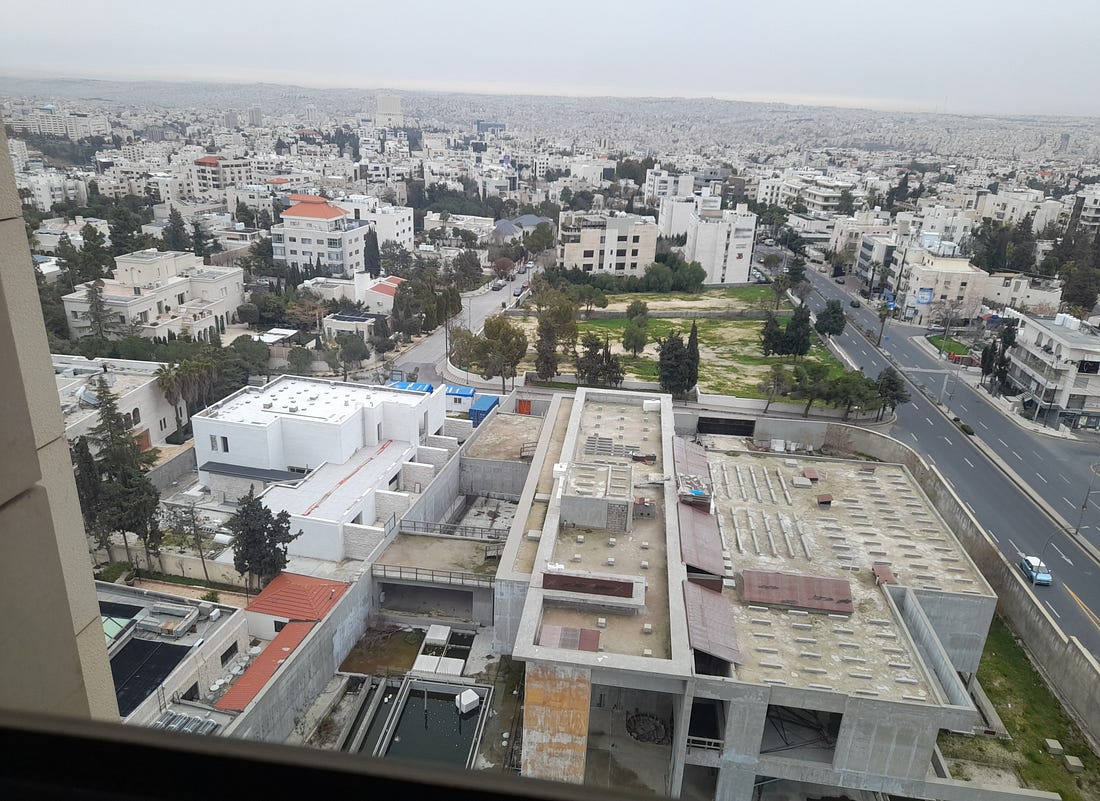
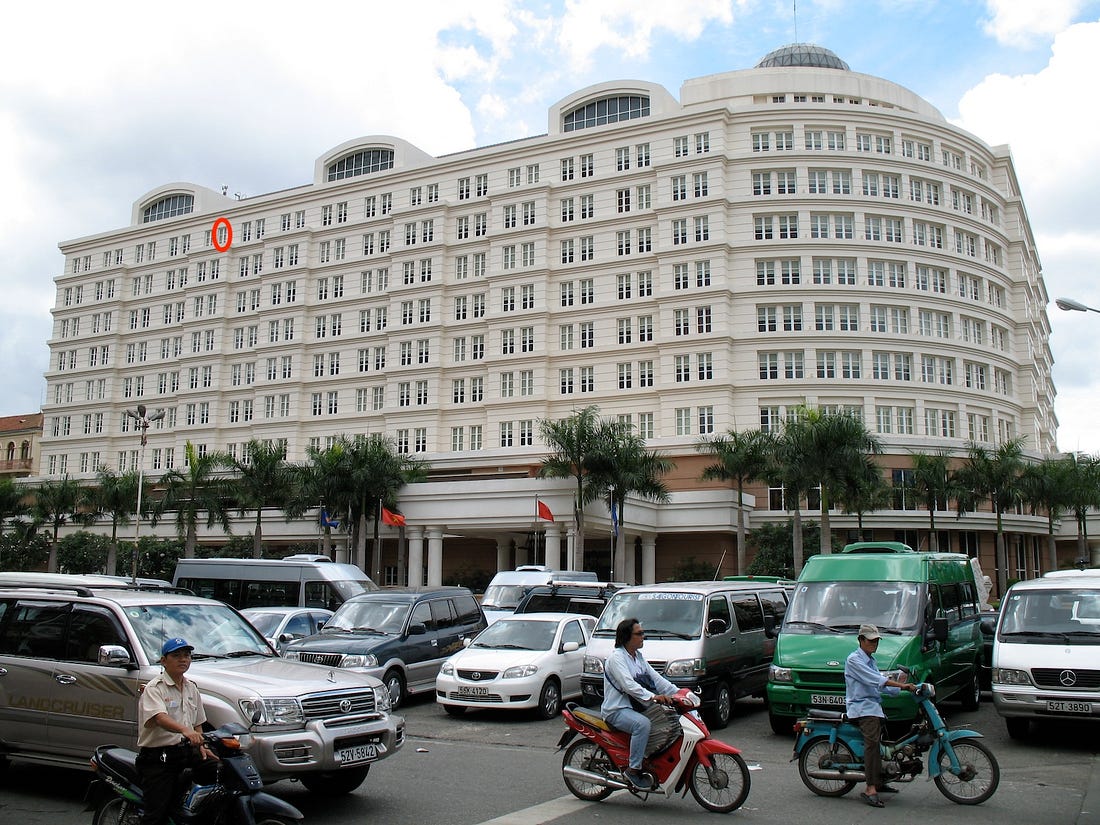
They don’t call it the “White City” for nothing! This week’s window view was taken from the Ritz-Carlton Amman located at 5th Circle Amman, Zahran St, Amman 11892, Jordan. This contest was a bit challenging, since the city is large but the Google Earth coverage is not great.
Our ski-nerd sleuth peeks inside the Ritz-Carlton:
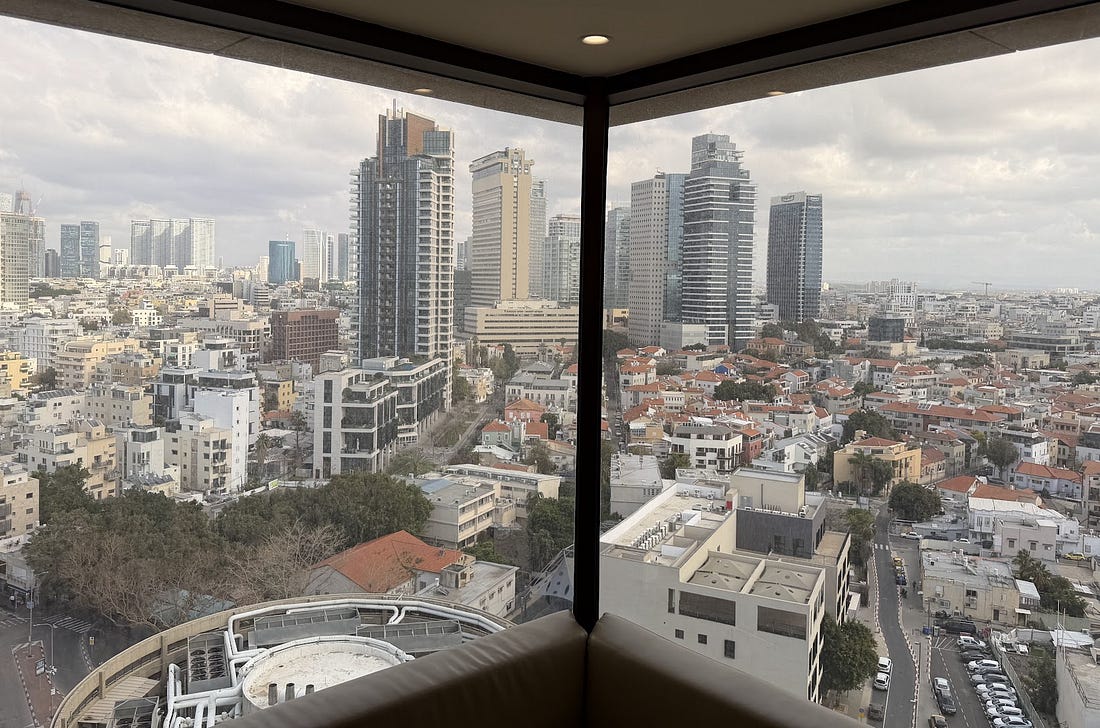
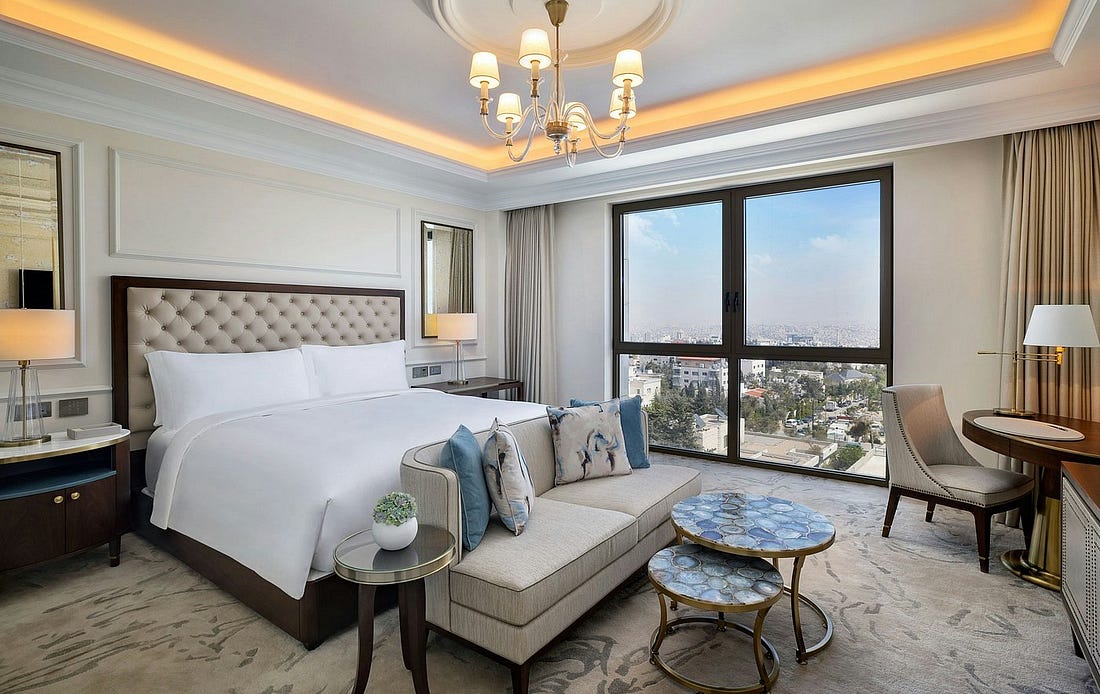
Here’s a room in the hotel looking out on the same buildings, on a nearby floor:
Eagle Rock circles another window:
The hotel’s website displayed a red warning popup that’s a masterclass in understatement:
Alert! Update on Middle East Hotel Reservations. Possible disruption across our Middle East Hotels.
And here’s my guess:
I’m so curious to hear from the sleuth who submitted the photo. I hope it wasn’t a very recent trip.
It was recent, but before the war broke out: February 6. Here’s another window guess, from our super-sleuth in Tewksbury:
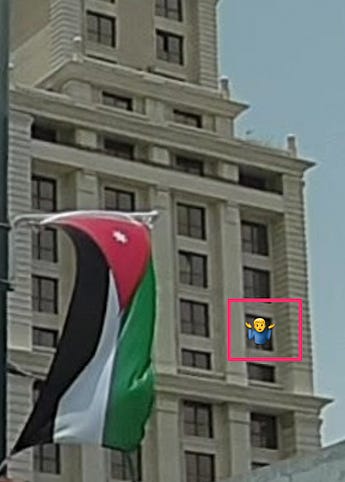
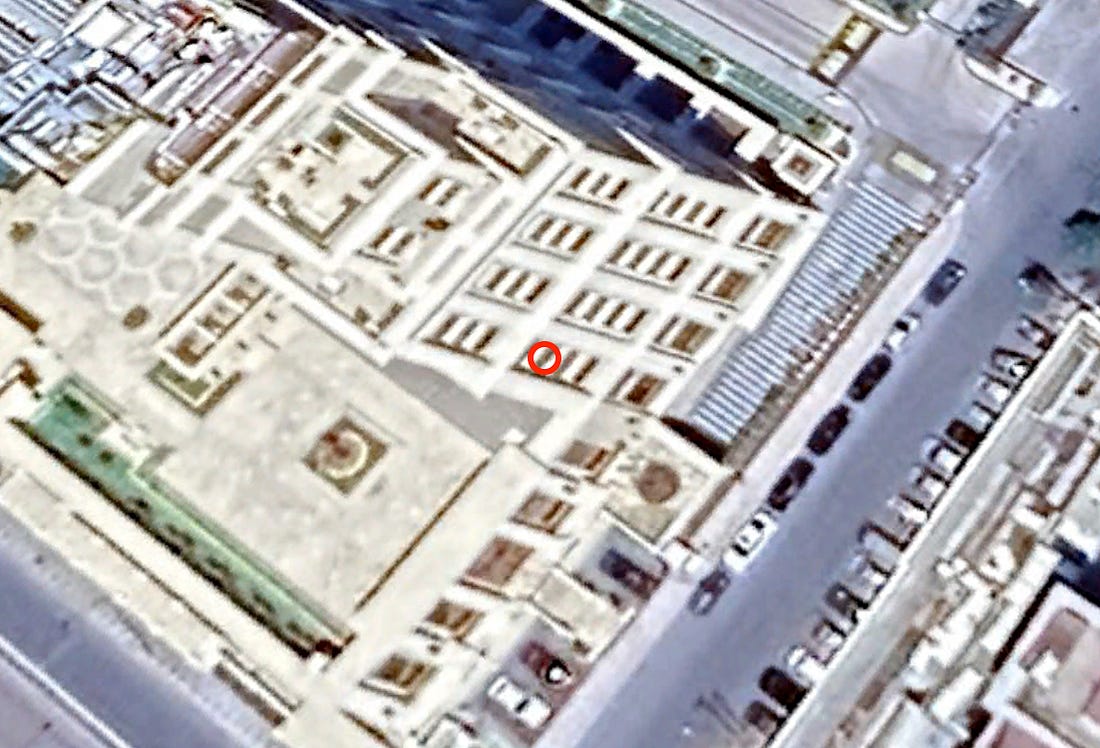
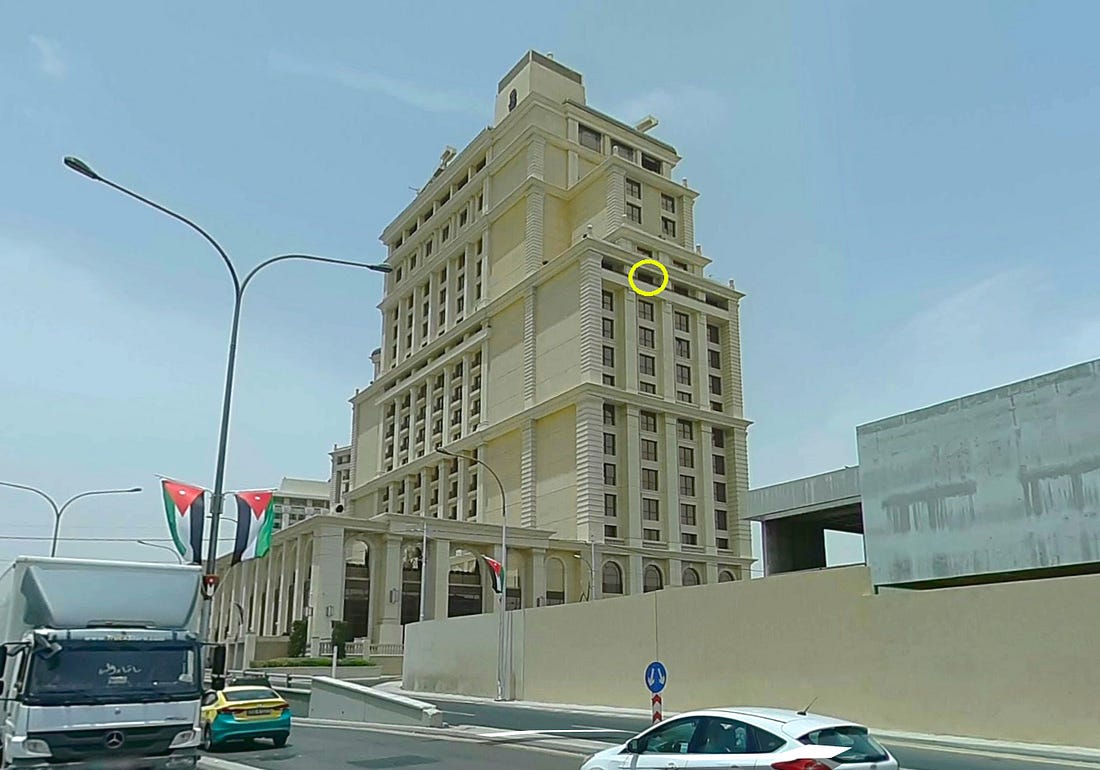
Well this was an interesting one! I’m confident that the view was taken from a SE-facing window of the more southern building of the two towers that make up the new-ish Ritz Carlton Amman. Which exact window is not something I could figure out, but I do feel confident it’s in the right-most column of windows you see when you face that facade. Here’s my best guess:
From the submitter of this week’s window:
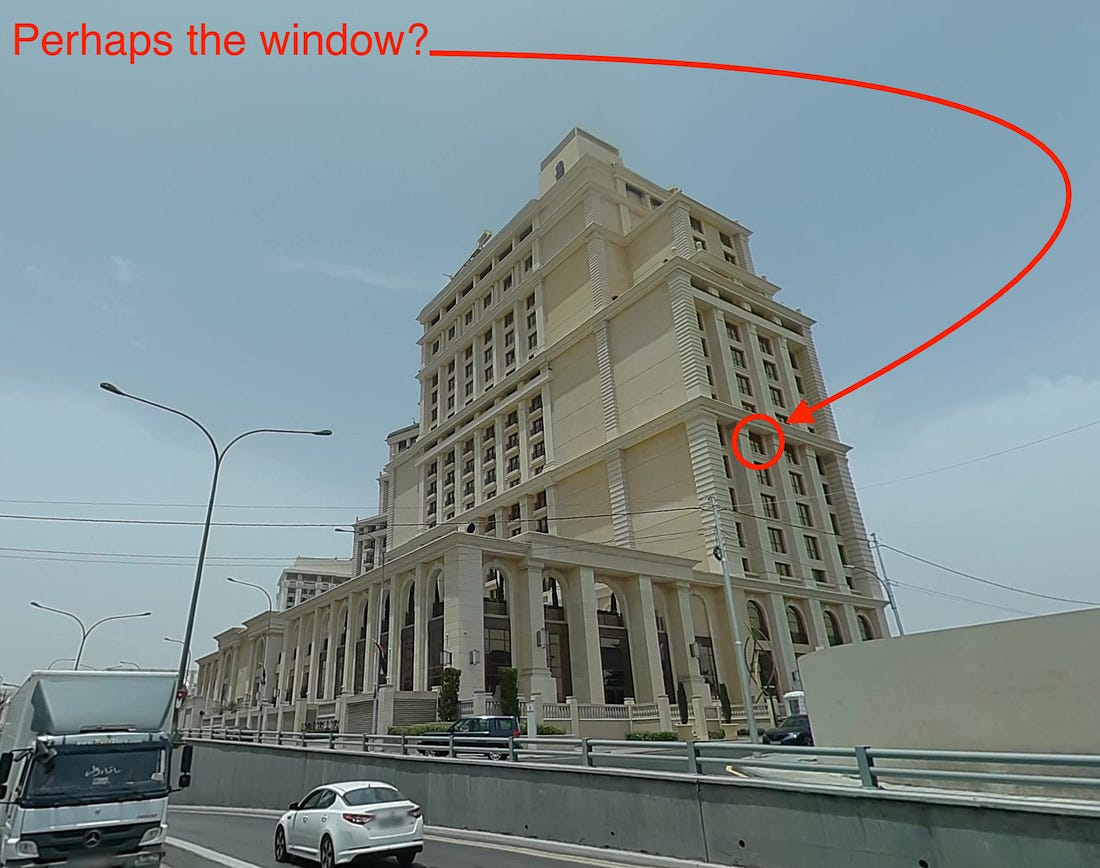
I’ve attached a photo I wanted to submit as a VFYW, but unfortunately I wasn’t able to take a photo of the outside of the building! It’s from Amman, Jordan, at the Ritz-Carlton hotel, 5th Circle. If you do use it, I presume you’d remove the metadata from the image?!
Yep, I always do (after learning the hard way when the contest launched in 2010). The submitter follows up:
Really happy you’re using it for the 500th contest — what an honour! Thanks for the six-month subscription extension as well. It’s a shame I didn’t get the outside photo, but I’m really pleased you’re using it. I think it was about the 10th floor. I’ll look for any confirmation, but not found so far, sorry.
Looking forward to the competition and how many locate it! Will be fascinating to see how people work on it.
Giuseppe’s guess is giving me vertigo:
Here’s the great and powerful Chini:
Even though we don’t have a definitive window from our submitter, no matter: there was only one sleuth this week to get to the Ritz-Carlton who hasn’t already won the prize — and a newcomer to the contest:
I’m guessing a room on the 7th floor of the Ritz-Carlton in Amman, Jordan:
I know it’s highly unlikely I’ll be the closest here, but it was fun hunting!
Proximity counts! Sagaponack serves up a handful of fun facts about Amman:
The White City mandate: Our view is dominated by a strictly enforced, century-old building code. To maintain Amman’s famous monochromatic glow, almost every structure must be faced with local white limestone — a rule that turns the hills into a shimmering cubist landscape at sunset.
A height hierarchy: There is a “ceiling” on the skyline. No building in the city is permitted to stand taller than the nearby Amman Rotana in the Abdali district, ensuring the “New Downtown” maintains a specific architectural crown.
Architecture as a wedding cake: That tiered, cylindrical silhouette in the distance belongs to Le Royal Hotel. Standing at 108 meters, it was designed to mimic the 9th-century spiral minaret of Samarra in Iraq, though locals affectionately compare it to a giant tiered cake:
Rome of the Middle East: While Amman was originally founded on seven hills (Jabals) to mirror the layout of Rome, the modern urban sprawl we see has since “over-proofed” like rising bread to cover more than 20 distinct hills.
9,000-year-old neighbors: Somewhere in the soil beneath these modern high-rises, the world’s oldest human-form art was discovered. The ‘Ain Ghazal statues date back to 7200 BCE, making this skyline one of the oldest continuously inhabited places on the planet:
A city of “Circles”: We are perched right at the 5th Circle. In a city where street names were historically ignored or non-existent, these eight numbered traffic circles serve as the primary navigational spine for everyone from taxi drivers to diplomats.
GPS vs. Tradition: Even with the rise of modern tech, the most reliable way to give directions from this window is to reference the nearest “Circle” or a well-known pharmacy — a local quirk that remains more accurate than a street address.
He adds:
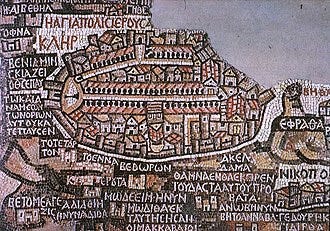
Our mural this week wraps all those facts together and is rendered as a mosaic in the Byzantine-Madaba style — a tribute to Jordan’s ancient “City of Mosaics” and the world-renowned 6th-century Madaba Map:
Constructed from thousands of individual stone tesserae, the scene utilizes a natural palette of desert ochres, deep reds, limestone whites, cobalt glass paste, and azurite sourced directly from the Jordanian landscape.
Here’s San Mateo again:
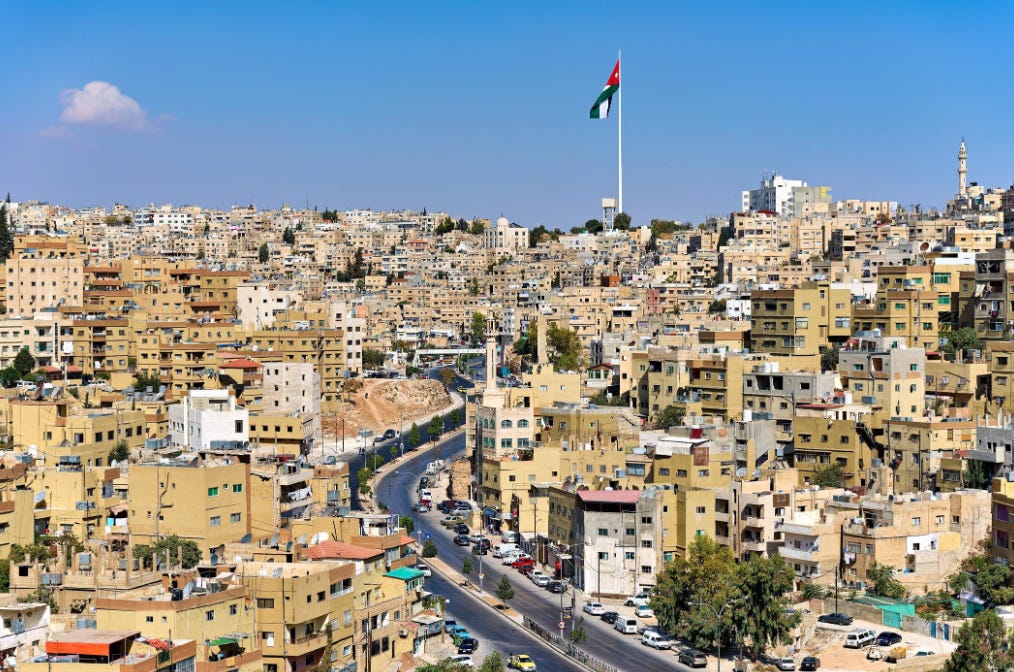
One of the first things you notice about Amman is the color. Most of the buildings are made from light limestone, so the whole city ends up with a soft beige tone. When you look out across the hills, the buildings all blend together into one stretch of pale stone.
Another thing you notice is how hilly the city is, so neighborhoods rise and fall in every direction. Streets wind around the slopes, and you’re often either looking uphill or seeing a wide view of the city from the top of a ridge.
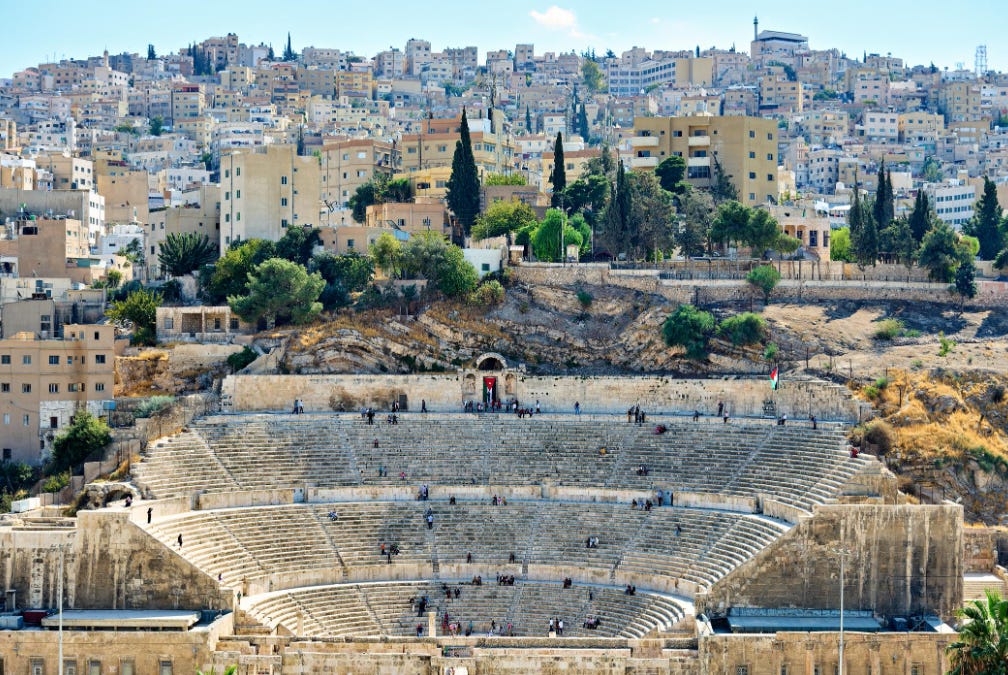
Another thing that stands out about Amman is how old history is right next to modern buildings. The city has been inhabited for thousands of years, and you can still see traces of those earlier periods today. In downtown Amman, there’s a large Roman Theatre that was built almost 2,000 years ago. Not far from it is the Citadel, a hill with ruins from several different historical periods. From the top you can look out over the modern city and see how far it spreads across the surrounding hills.
Amman has a strong cafe and street culture. Places like Rainbow Street are full of small restaurants, coffee shops, and spots where people meet up with friends or sit outside in the evening. Many neighborhoods stay lively well into the night. Markets sell bread, sweets, spices, and fresh produce.
Speaking of food, here’s the VFYW chef:
In 1981–82, my wife and I traveled through the Middle East and Europe for her doctoral thesis research on Islamic art and architecture: Egypt, Jordan, Syria, Turkey, Italy, France, East Germany, Ireland, and England, visiting both the sources and the colonizers’ museums. I remember saying when I looked at her Fulbright application that nobody would buy this; it looked like a junket. In Amman, we stayed at the American Center of Oriental Research, which has since dropped the “Oriental” but conveniently adopted the “of” to maintain the acronym.
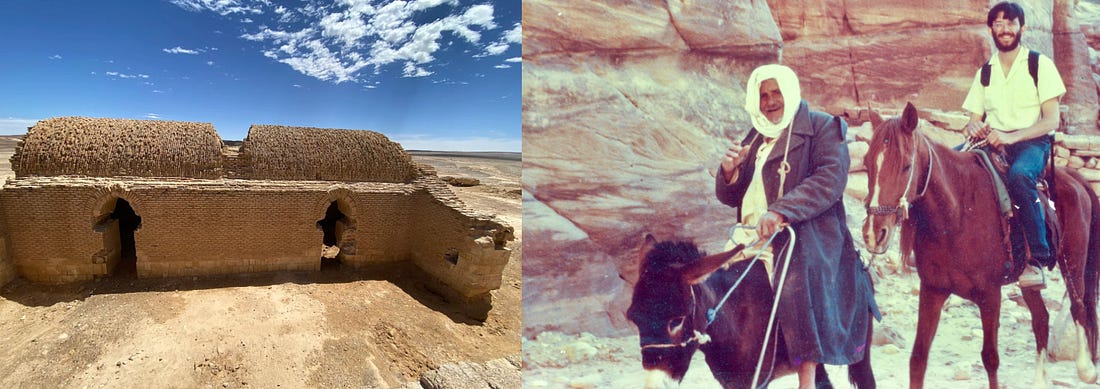
A friendly British architectural historian drove us out to Qasr Tuba following invisible tracks in the desert, which worried me because GPS had not been invented yet. I don’t have any photos of that trip in my archive, but here is a photo from Wikipedia, next to a photo of me from that time about to head into Petra with a guide. (I’m the one on the horse.)
It was such a wonderful trip. And it is painful now to think of the places we visited in Syria that are gone or severely damaged.
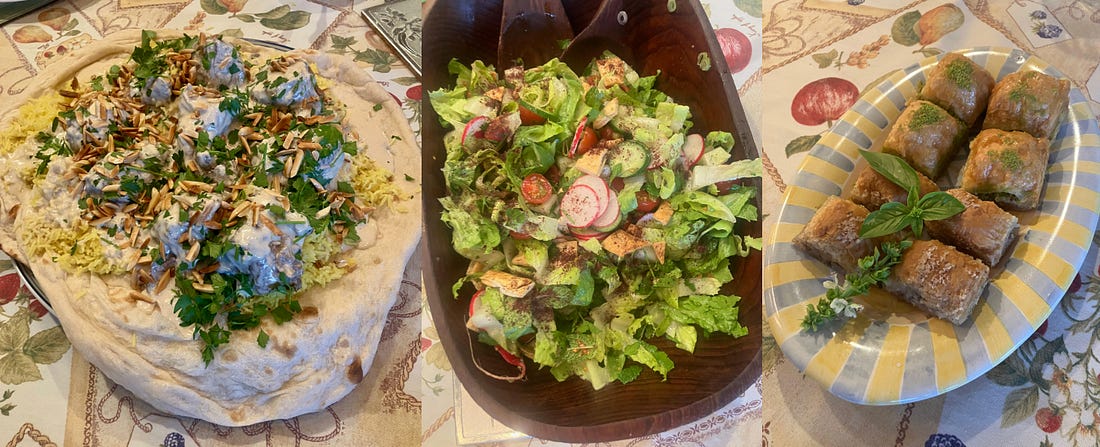
Moving on to this millennium and the VFYW dinner, the national dish of Jordan is mansaf — stewed lamb with jameed (a fermented yoghurt) on a bed of rice and topped with almonds and parsley. I was apprehensive about this dish. When I went to the local Middle Eastern market to find jameed, the shopkeeper asked me, “Have you had it before?” When I said no, he said, “It has a kick to it — if you don’t like the mansaf, bring it to me and I’ll eat it.” Then I found this recipe, with the preamble:
growing up, I never loved mansaf. To be fair, I had only tried it at restaurants. And every time I did, I disliked the slightly fermented flavour of jameed along with a strong gaminess from the lamb.
So I bought some hot dogs as a backup. I needn’t have worried, however. It turned out to be delicious, with a fattoush salad on the side and a dessert of baklava:
P.S. Thanks for offering to give my new substack a mention! Here’s a short blurb you could use or adapt:
The VFYW super-chef has launched a substack called Mathematical Musings — a free, open conversation about how we learn and teach math, from how the youngest kids can discover theorems, to why some things in the math curriculum never die, to more than you wanted to know about fourteen sevenths.
Check it out! Here’s the A2 Team again, with some history:
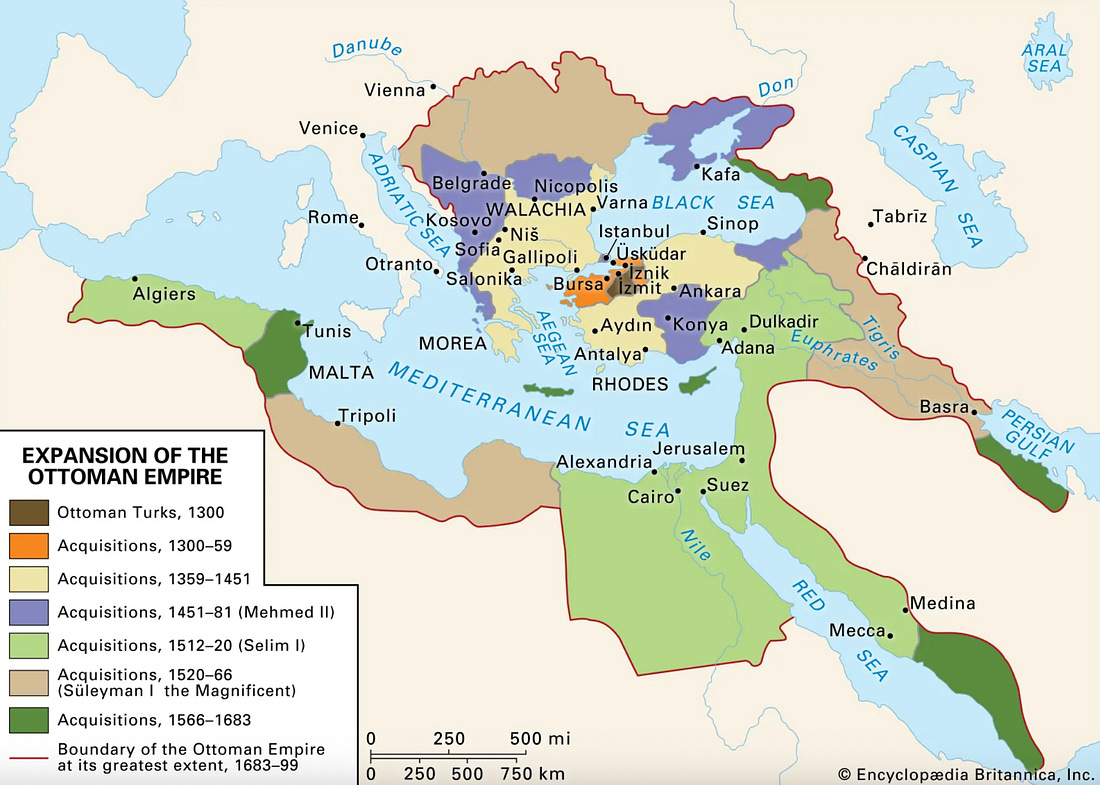
While the area of Amman had been inhabited for millennia, there was no permanent settlement there between the 15th and the 19th centuries. Many will be surprised to learn that Amman — like Zarqāʾ and Ruṣayfa, three out of Jordan’s four largest cities — owe their modern founding in 1878 to Circassians, who were Muslim refugees from the North Caucasus.
The explanation lies in the demographic upheaval caused by the Russian imperial expansion into the Caucasus on one side, and the national movements in the Ottoman Balkans on the other. The Russian Empire spent much effort in the 1860s to bring the Muslim peoples of the Caucasus under control — Circassians, Chechens, Abkhazians, and others — by forcing them to settle in the lower areas, bringing in Christian settlers, and ultimately triggering large waves of emigration to the neighboring Islamic empire, the Ottomans.
Meanwhile, the Greek War of Liberation had already set off large refugee movements; and more occurred during and after the Russian-Turkish War of 1878 (with a prominent role for Count Iosif Vladimirovich Romeyko-Gurko, whom we met in Veliko Tarnovo, in contest #490). Hundreds of thousands of Muslims left the newly independent Christian states of the Balkans in the direction of Asia Minor, at the same time that hundreds of thousands of Christians (and Jews, and Muslims) sought to leave the Ottoman Empire for Europe or the Americas.
The last phase of this demographic reshaping would be the Armenian Genocide in 1915 and the Turkish-Greek Population Exchange in 1924. It was in this context that in 1878, Circassians from the Balkans went to Asia Minor (where they today form the largest ethnic minority in Turkey after the Kurds, estimated at 2-3 million), but, desperate for space to resettle them, the Ottoman authorities also directed many towards the Levant, where the landed in Beirut or Tripoli, and sought to settle in the Golan Heights and parts of Palestine.
Laurence Oliphant — a Victorian traveler who surveyed Palestine in order to promote Jewish settlement — visited the Balqaʾ (the area of Amman) in 1878 and came upon destitute Circassian refugees in the ruins of Amman’s Roman theater mere months after their arrival. But the area soon flourished, with Amman as its center.
The Ottoman state, as part of its policies against nomads, settled the Circassians at the frontier between the Arab nomads of the Jordanian desert and the older agricultural land to the west. Circassians took advantage of the Ottoman land reform to establish themselves as landowners and merchants, integrating Amman into the economic circuits of the Levant.
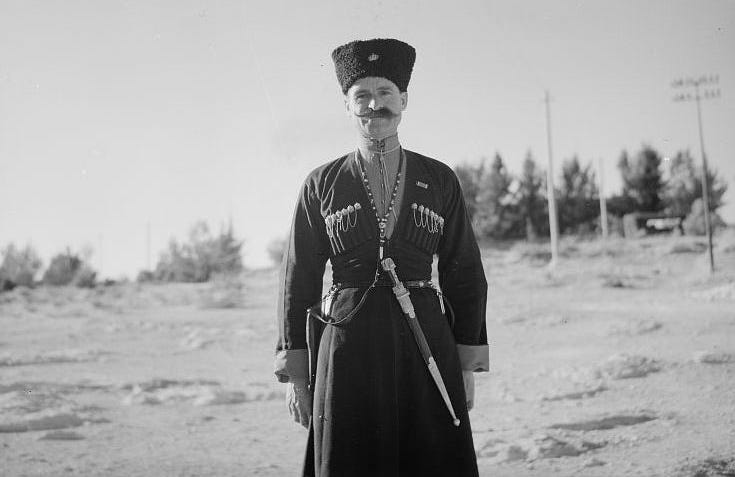
A Circassian guard of Emir Abdullah, founder of the Kingdom of Jordan, 1940
By the outbreak of World War I, Amman was a thriving Circassian town of 3,000–5,000 people. This wasn’t the end of the refugee history of Amman, though. Armenians arrived in 1915–22, Palestinians in 1948 and 1967, Iraqis after 2003, and Syrians after 2011.
The settlement of Circassians was not without conflict or problems. For one, Circassians were used to building with lots of wood, and while giving early Amman a distinct look with their traditional houses, they also stripped the surrounding area of trees within a generation. Land disputes with the Bedouins could turn violent. Also, historians have argued that the Ottoman Empire overextended itself in all the demographic engineering, but in the case of Amman, it was mostly a success story.
Amman today is the largest city in the Levant, having overtaken Tel Aviv, Damascus, Beirut, and Aleppo. Still, Jordan is a rather fragile state, wedged between all kinds of political and social hotspots. Only a few 10,000 Jordanians today identify as Circassians.
I am telling this story in some detail (credit to historian Vladimir Hamed-Troyansky) to show how large population movements were part of the history of the Middle East and beyond, when declining empires and nascent nation states sought to reshape populations of many different ethnicities and religions. While the outcome may look stable and prosperous at the moment, there was so much suffering that is mostly forgotten today. Instead, there is another senseless war going on, which has already displaced hundreds of thousands, and has the potential to send millions more fleeing in all directions.
Here’s a speck of sofa history from the Intrepid Couch Traveler:
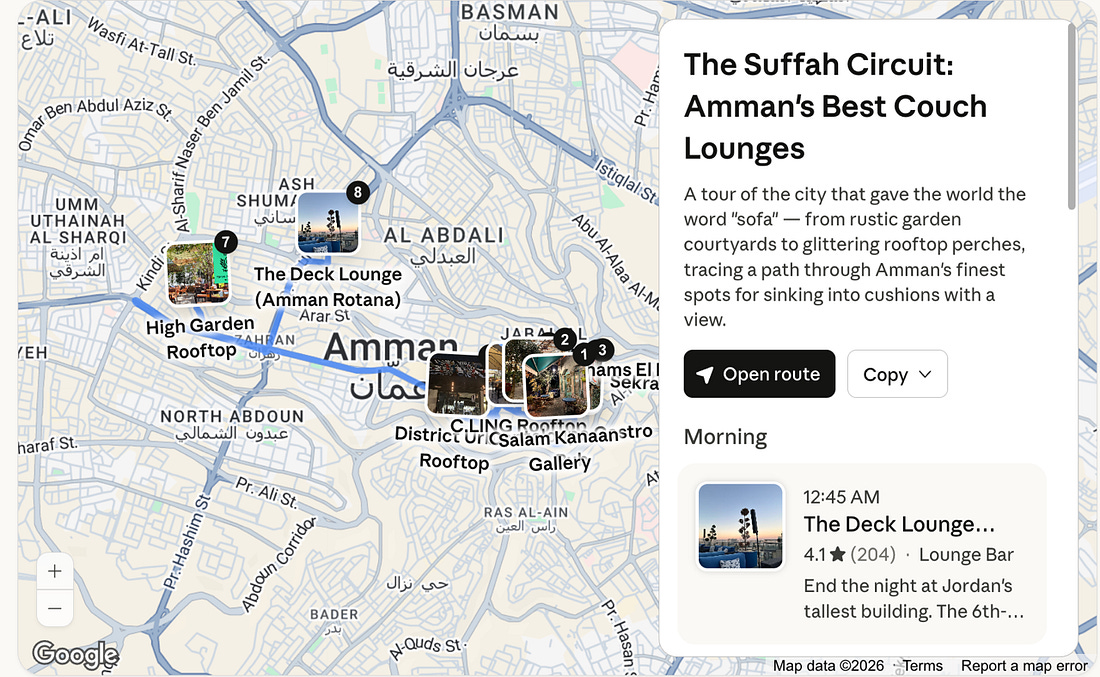
No time this week for a full entry, but I want to note that Amman is the original home of the suffah (aka couch). And it’s still the best place to visit them:
Here’s the architectural report from our expert in NYC:
Back in the spring of 2024, I was in Tel Aviv working on an office renovation project. (Still on hold.) The client put us up in a hotel right on the beach, and all I remember thinking was that eventually, someday, somehow, when the war in Gaza is over and it gets rebuilt, there’s no reason it can’t be like Tel Aviv and all the other beautiful cities along the Mediterranean. I’ve been to the Middle East a few times and even been to the College of Architecture at the American University in Sharjah, so I know there is some top notch architectural talent there. My hope is that one of them has the experience and talent to transform Gaza the way Baron Haussmann transformed the boulevards, squares, and parks of Paris in the 1850s.
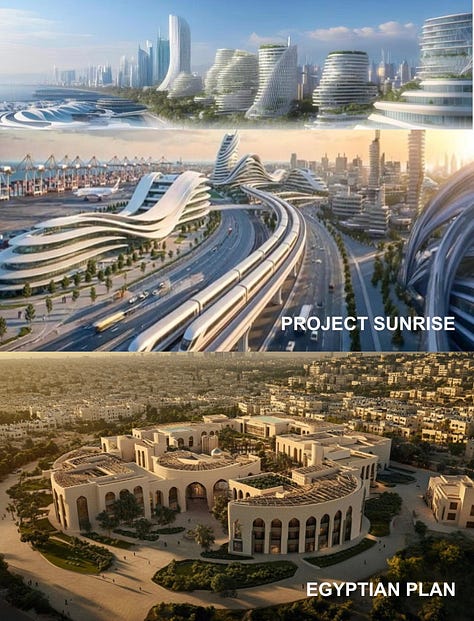
Recently two masterplans have been put forward for the reconstruction of Gaza. The first one, Project Sunrise, was led by Jared Kushner and Steve Witkoff and presented at the recent Board of Peace session at the World Economic Forum in Davos. It seems they actually put together a team of heavy hitters in real-estate development and finance, although no architect or masterplanner was recognized. Their goal is to turn Gaza into a modern smart city featuring luxury hotels, AI systems, substantial industry for full employment, and all tied together by high-speed rail.
It’s a little zooty for my taste, but not entirely out of character compared to a few other cities in the region. There is one kicker, though; the plan is predicated on relocating the two million Palestinians living there to Egypt and Jordan. Not surprisingly, those countries objected and issued their own vision for the renewal of Gaza. The Egyptian Plan was endorsed by Arab leaders at a summit in Cairo. The biggest difference between the plans is that the current residents would continue to live there. Designed by the Egyptian Armed Forces Engineering Authority, it looks traditional and uses materials more in character with much of the Middle East. Clearly, neither masterplan was designed by someone with the vision, taste, and ability of Baron Houssmann … which brings me to Amman.
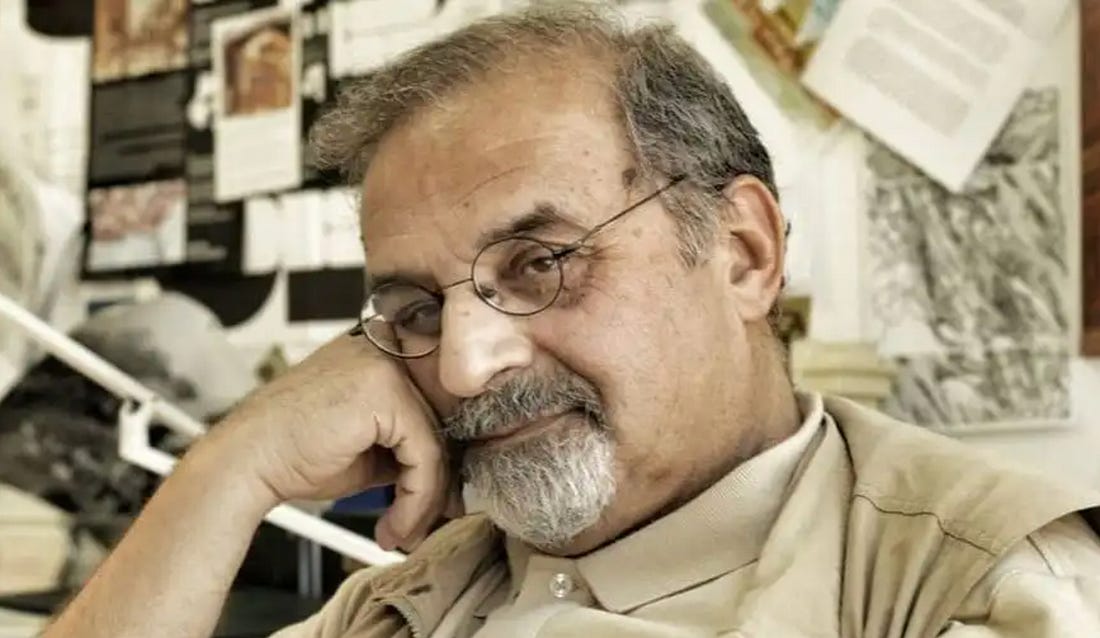
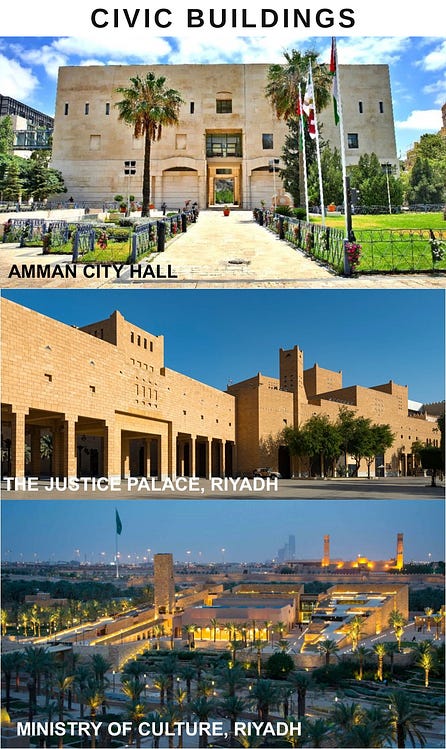
By far the most prominent architect and planner in Jordan is Dr. Rasem Badran, a Palestinian-Jordanian whose office is in Amman. In my opinion, he’s the guy. He’s the architect who should be appointed head of the reconstruction of Gaza. He has the experience, ability, heft, and connections throughout the region to lead the effort.
He grew up in Ramallah, and after studying architecture in Germany he returned to Jordan in 1973. He quickly caught the attention of established architects of the Arab world, particularly after winning the Baghdad Grand Mosque competition followed by numerous commissions to design cultural and religious institutions in Saudi Arabia, Qatar, and Jordan. Dr Badran’s name became synonymous with modern Islamic architecture, and he is largely lauded as its pioneer. Among his many awards, in 2019 he won The Tamayouz Lifetime Achievement Award, which I would describe as the Pritzker Prize for the Middle East and North Africa.
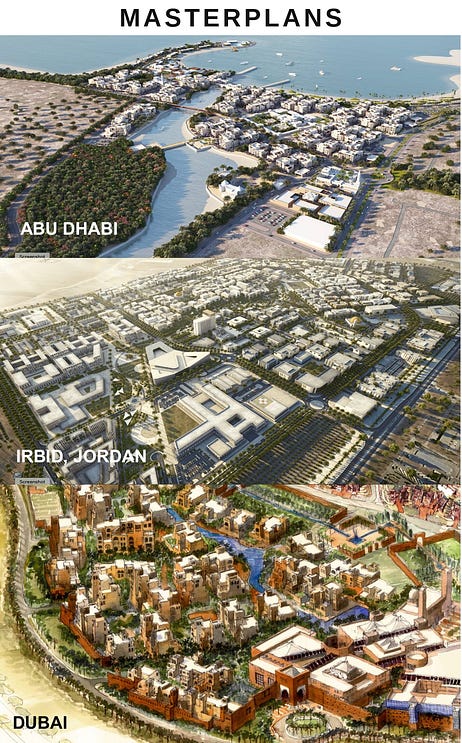
Over his career he has designed over 30 masterplans for locations throughout the Middle East. His goal is to create places deeply responsive to the climate, topography and cultural patterns that feel like they’ve always been there, avoiding overly geometric forms. They typically have strong spatial hierarchies — from major civic landmarks, to secondary centers (souks), to residential clusters, down to intimate courtyards and alleys. Here’s how he puts it: “Architecture is for people, incorporating their history, life and aspirations…not a sculpture away from the needs of the users.”
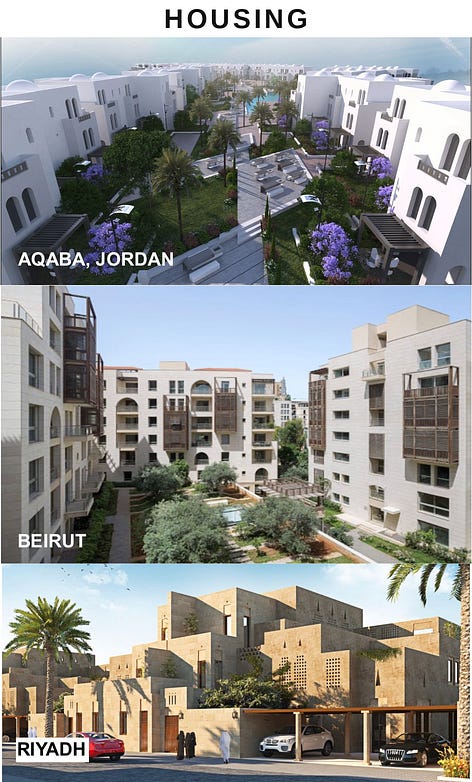
His housing projects are always organized around clusters. Groups of homes share courtyards and small streets which encourages interaction while maintaining privacy. They provide shade and natural ventilation. Also, variety is important to his schemes to avoid monotony. Houses differ in size and arrangement, all-the-while following a coherent architectural language. Visual richness without chaos. The housing is never isolated and is connected to local institutions like mosques, markets and schools. The best developments feel organic, like they’ve evolved over time.
His large-scale civic buildings are placed at the heart of the urban fabric. They define public squares and gathering spaces acting as orientation points within the city. It is hard to tell from the photos but the buildings are designed as spatial journeys with gradual, layered transitions from the city to the plaza, to the courtyard, to the interior. The movement through them almost feels choreographed — through gates, arcades, and shaded passage ways. Local stone is his signature material, especially in Amman. Limestone is typical, as well as other regional stones.
They have the effect of connecting the buildings to local identity; practically they provide thermal mass for keeping interiors cool. Stone also ages beautifully over time. Summing up his legacy he said: “I tried to create homelands for everyone. That was my dream.”
Here’s CO/NJ with his weekly bio:
Ok, Turkey is as close as I have ever been to Jordan, so I have no stories — just a notable person:
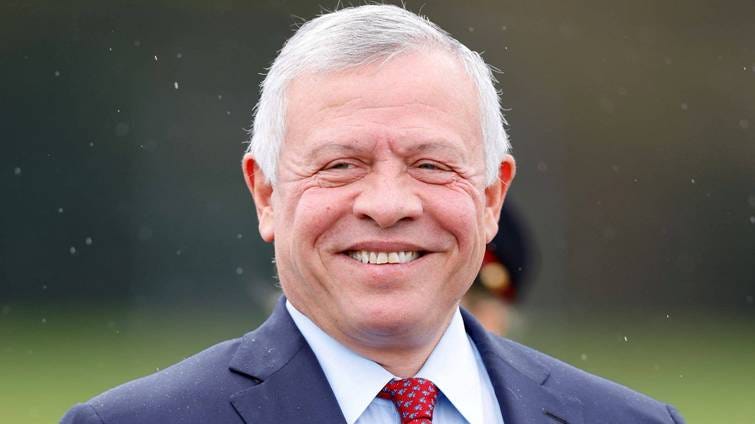
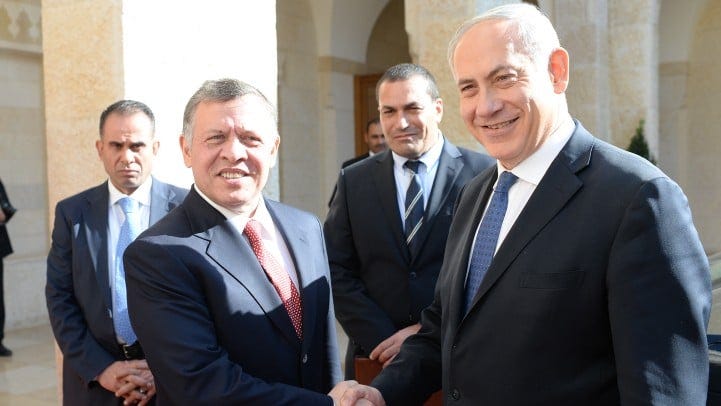
Abdullah II has ruled the Hashemite Kingdom of Jordan since 1999, guiding a small but strategically significant nation through a turbulent era in Middle Eastern politics. Known for his pragmatic diplomacy, military background, and emphasis on modernization, Abdullah II has sought to balance political reform, economic development, and regional stability while maintaining the monarchy’s central role in Jordanian life.
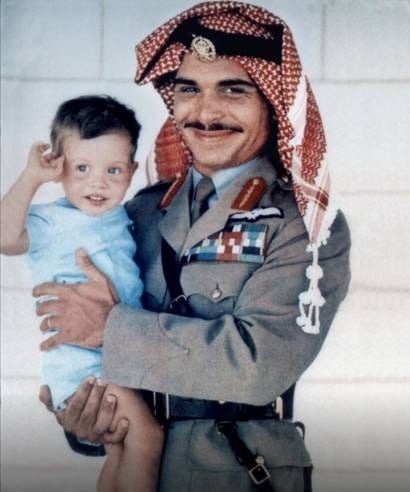
Abdullah was born on January 30, 1962, in Amman, the eldest son of King Hussein and Princess Muna al-Hussein. His father ruled Jordan for nearly half a century and was widely respected for steering the country through numerous regional crises. Growing up as the heir apparent for much of his childhood, Abdullah received a cosmopolitan education and early exposure to international diplomacy.
Abdullah attended several schools abroad, including the prestigious Royal Military Academy Sandhurst in the UK, where he trained as an officer. His education and military training shaped his disciplined leadership style and lifelong interest in defense and security. He also studied at Georgetown, focusing on Middle Eastern affairs and international politics.
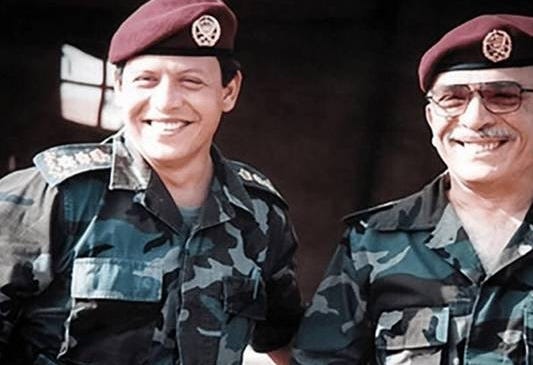
Following his military education, Abdullah embarked on a long career in the Jordanian Armed Forces. He commanded elite special forces units and rose through the ranks, eventually becoming commander of Jordan’s Special Operations Forces. His military career gave him a reputation as a hands-on leader and helped strengthen ties between the monarchy and the armed forces — an institution that plays a crucial role in Jordan’s stability.
Although Abdullah had long been considered the likely successor to his father, Jordan’s line of succession shifted several times. In 1999, shortly before his death, King Hussein formally named Abdullah as crown prince, replacing his brother Prince Hassan bin Talal. When King Hussein died on February 7, 1999, Abdullah ascended the throne as Jordan’s fourth king since the country gained independence.
From the beginning of his reign, Abdullah II emphasized modernization and economic reform. Jordan lacks the vast oil reserves of many neighboring states, making economic growth and foreign investment central to national policy. The king promoted technological development, free trade agreements, and integration with global markets. Under his leadership, Jordan pursued partnerships with Western nations and international organizations to attract investment and support infrastructure and education initiatives.
Abdullah has also attempted gradual political reforms. While Jordan remains a constitutional monarchy in which the king holds significant authority, his government has periodically expanded parliamentary elections and encouraged greater civic participation. These efforts intensified during the regional upheavals of the early 2010s. In response to the Arab Spring, Abdullah introduced constitutional amendments and government reforms designed to address public dissatisfaction while preserving stability.
Regionally, Abdullah II has been a prominent diplomatic figure. Jordan maintains peace with Israel and plays a mediating role in the Israeli–Palestinian conflict. The kingdom has also been deeply affected by wars in neighboring Iraq and Syria, which have brought waves of refugees into Jordan and placed strain on the country’s resources. Throughout these crises, Abdullah has sought international assistance while advocating for regional stability and counterterrorism cooperation.
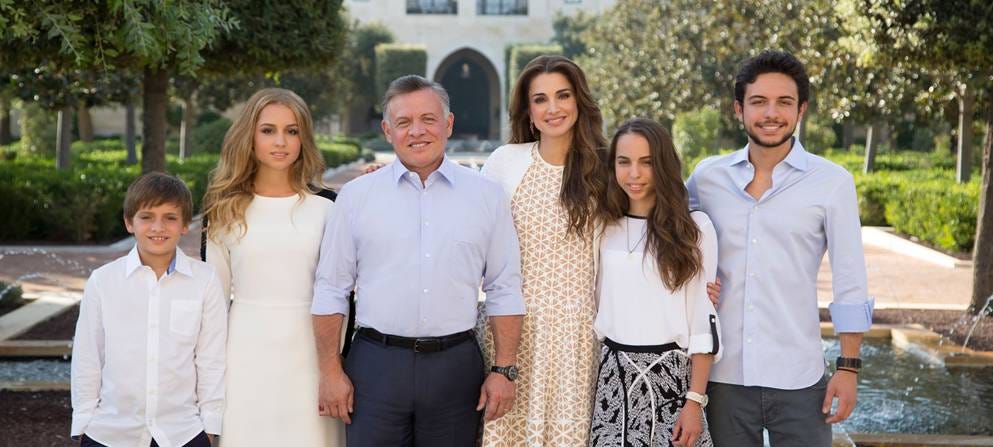
Abdullah is married to Queen Rania of Jordan, who has become a global advocate for education, women’s empowerment, and refugee rights. Together they have four children, including Crown Prince Hussein, who is widely expected to succeed his father. Beyond politics, Abdullah has cultivated a reputation as a modernizing monarch with diverse interests. He has written on Middle Eastern politics, promoted interfaith dialogue, and even appeared briefly in a cameo role on the television series Star Trek: Voyager, reflecting his well-known enthusiasm for science fiction:
More than two decades into his reign, Abdullah II remains a central figure in Middle Eastern diplomacy. Leading a country positioned between some of the region’s most persistent conflicts, he has focused on maintaining Jordan’s stability, strengthening alliances with Western and Arab partners, and navigating the complex political landscape of the modern Middle East.
Speaking of that king, here’s Sagaponack with “a memory from a conference in Amman many years ago during a more peaceful time”:
For the final night, our group was invited to a gala dinner at the home of a prominent local family, with the exciting news that the king, a close family friend, would be in attendance. We Americans were carefully briefed on modesty and protocol, and the wives all arrived dressed conservatively, looking much like they were headed to a Sunday church service.
We quickly realized we had underestimated just how cosmopolitan Amman truly is — and how distinct the rules of a private home are from those of a public assembly. The Jordanian wives had spent weeks shopping in Paris and arrived in full-throttle glamour, with elegant gowns that showed a decent amount of skin, completely out-shining our “respectful” attire in every direction. To this day, our group, and especially the wives, refers to that night as the “Great Jordanian Ambush.”
Here’s some street art via Bethlum:
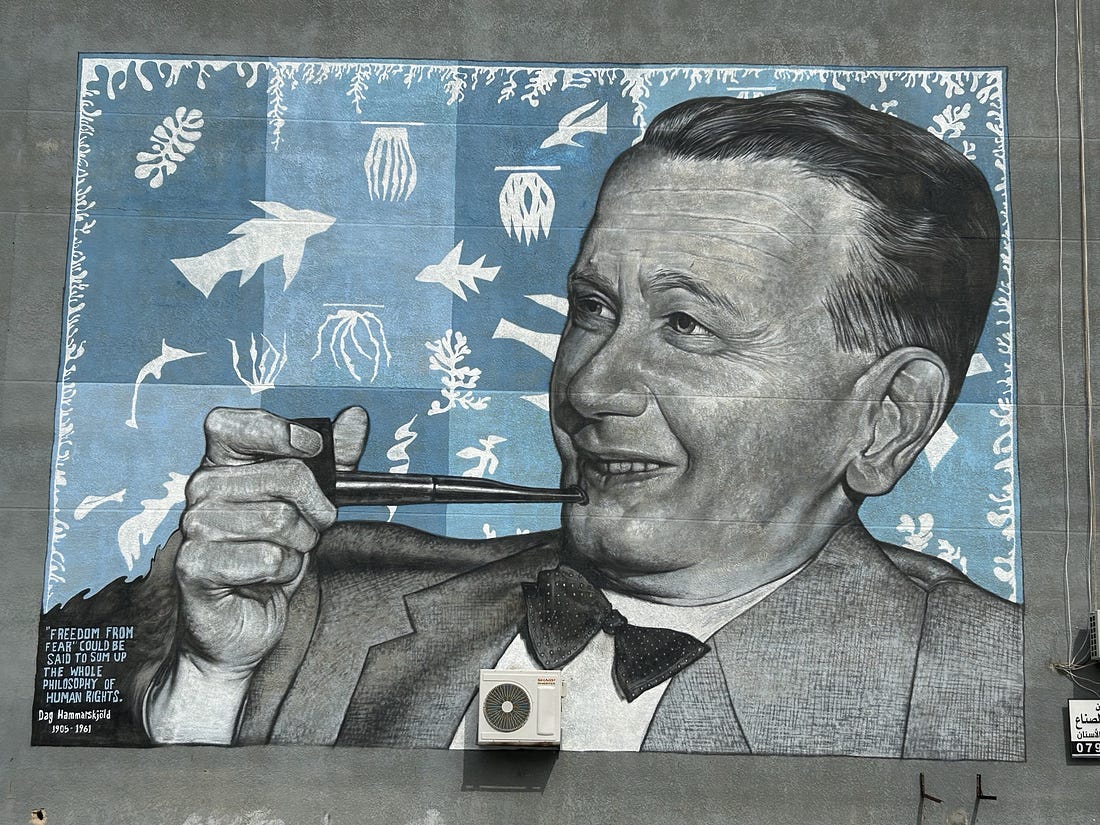
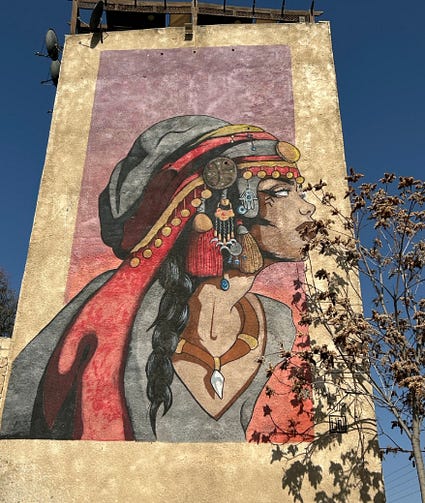
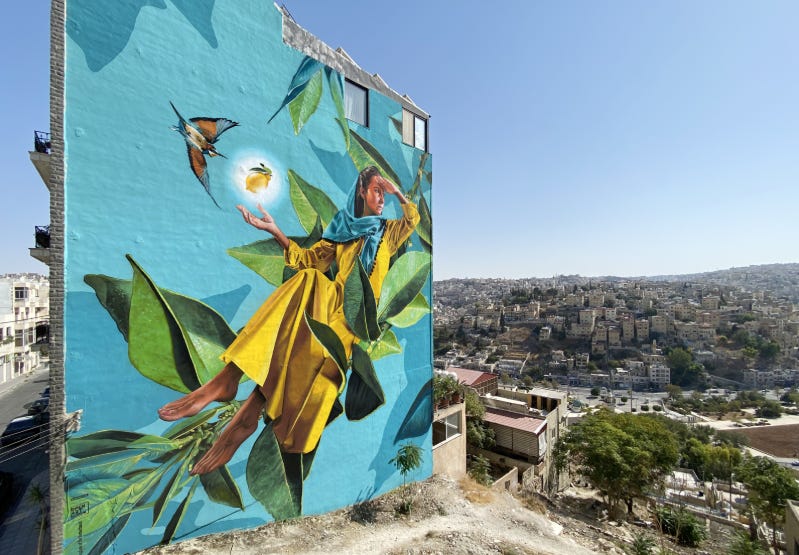
Amman has a substantial amount of vibrant street art — some commissioned and some in the graffiti family. If you head east from the hotel on Zahran Street, you will find more and more works as you get closer to the center of the city.
Starting out with a more political piece this week on Mahmoud Al-Moussa Ubaydat St. This is credited to Gusthaf Engström, and it’s a portrait of Dag Hammarskjöld, which includes his quote: “’Freedom from fear’ could be said to sum up the whole philosophy of human rights.”
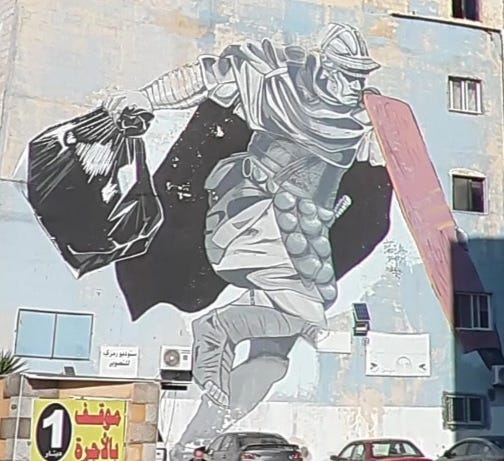
Directly across the street is “Waste Warrior” by Suhaib, completed during the 2020 street art festival as a tribute to the civil workers who keep the country clean:
The next one is “Wonder Woman,” a Bedouin woman in traditional attire by Yazan Mesmar:
Amman is a fairly monochromatic city, and the colors of the mural art can pop out. Here’s “Fruitful Future” by Studio Giftig:
There’s lots more and a map for street art in Amman can be found here.
I think I’ve been entering the VFYW contest since 2014 (Indianapolis), but I was reading Andrew well before that. So, congratulationson creating a consistently intriguing, informative, and long-lived adjunct to Andrew’s main column. Thank you both for the years of engaging writing.
I’ve mentioned before that I intend to use the prior views as inspiration for travel once I have more time. Perhaps someday there will even be a VFYW meetup at one of the sites.
A great thing to aim for! Here’s another piece of public art from our super-sleuth in Warrensburg:
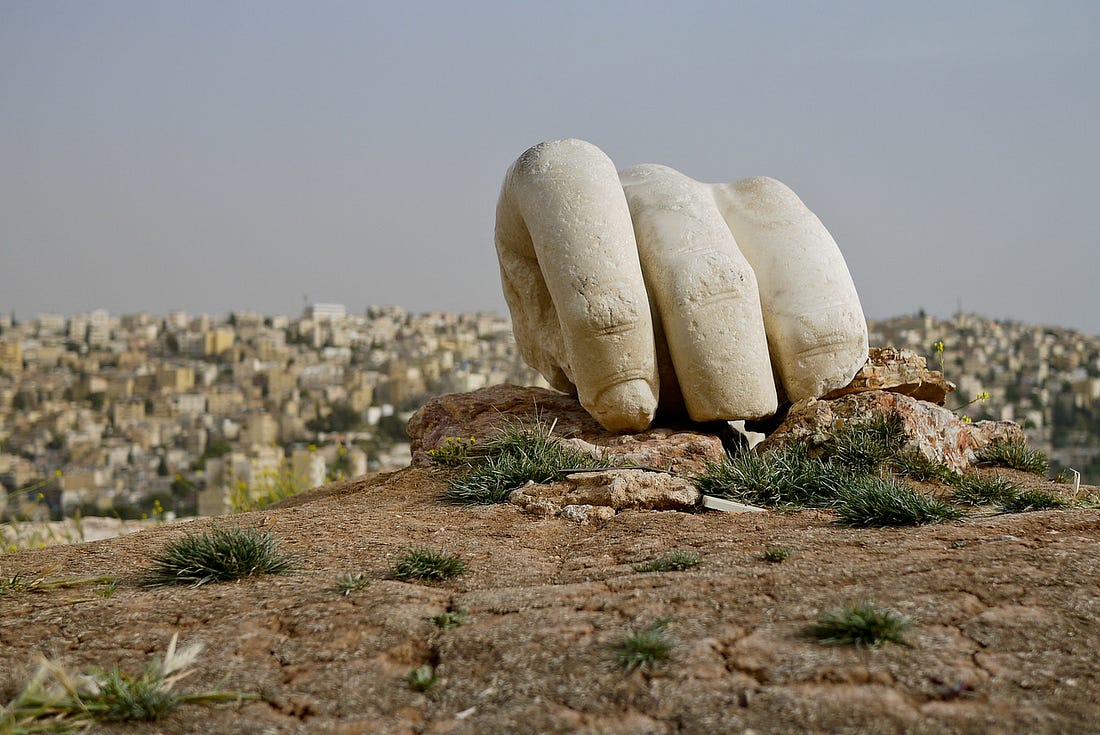
How’s this for a weird find in Amman?
That hand is about all that’s left of an ancient statue, dating back to Roman control of Amman (aka Philadelphia). The hand sits near the ruins of the Great Temple, an unfinished monumental structure constructed during the 160s CE.
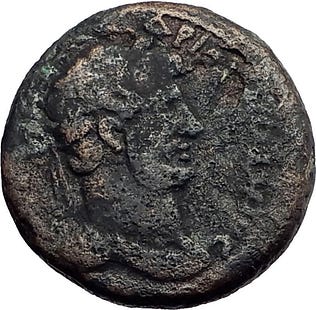
So who’s depicted in the statue? It seems that’s a matter of some debate. The problem is that no fragments have been found to offer a clear identity, including for the temple ruins. That said, many scholars speculate the structure was built for Hercules (or Herakles), the Greco-Roman demigod known for his strength. Roman coins minted in Philadelphia, for instance, often depicted the semi-divine figure, suggesting a connection with the city:
And then there’s the colossal size of the hand; it’s been estimated that the full statue may have stood over 40 feet tall, making it one of the largest marble statues ever created. Surely, then, we’re looking at Hercules’s hand, right? As it turns out, not everyone’s so sure, especially in view of something else found nearby:
The fragment on the right is an elbow, which seems to come from the same statue. And to at least a few scholars, this second piece has a feminine shape. In other words, perhaps this wasn’t Hercules — or any man, for that matter. Indeed, the city also seems to have fixated on Athena, suggesting maybe that we’re looking at the grey-eyed goddess’ manicure.
Another bit of ancient history comes from the DC super-sleuth:
Ptolemy II Philadelphus, the Macedonian Greek ruler of Egypt, captured and rebuilt Amman in the 3rd century B.C., renaming it “Philadelphia” in honor of himself. Here’s a 19th-century painting depicting Ptolemy in the Library of Alexandria, Egypt:
Ptolemy was called Philadelphus because, during his reign, he dumped his first wife and married his sister — an incestuous union that many Greeks found scandalous but apparently endeared him to his Egyptian subjects. “Philadelphus” is derived from a Greek word meaning brotherly love or, more broadly, sibling love. I suspect that Ptolemy’s version of “brotherly love” wasn’t quite what William Penn had in mind when he chose Philadelphia as the name for Pennsylvania’s largest city.
This week’s fauna is a frightening one:
Happy 500! Thanks for giving us all a platform to nerd out on!
I am all prepared with the animal this week, because I follow General Apathy, who specializes in nighttime fauna tours of desert regions. He spent three episodes in Jordan, one of them focused on Camel Spiders:
Apparently for other folks, the military is a big source of information about camel spiders — or at least, the soldiers deployed in the Middle East are:
Some of the information the soldiers have sent home: “dog-sized Camel Spiders could run 25 miles per hour, jump six feet in the air, and disembowel a camel when hungry.” And also : “they carry scorpions on their backs (hence the name camel spider); that they scream as they chase a person and that their bite can cause dreadful damage to human flesh.”
They also cut people’s hair or beards to use as bedding in their nests. And they have a plethora of names: sun spiders, red romans, wind scorpions, wind spiders, camel spiders, jerrymanders (English alternative names); haarskeerders, baardskeerders, rooimanne (red man], jag spinnekoppe (hunting spiders), gift-kankers (poison cancers), vetvreters (fat eaters).
None of it true, not even the names.
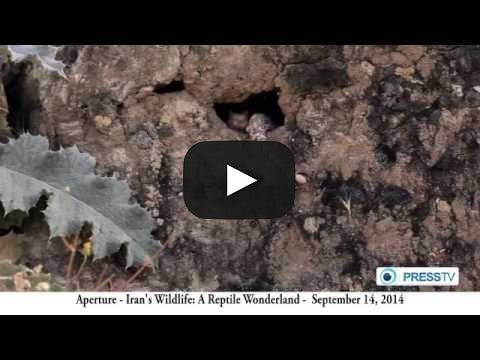
They’re not spiders, scorpions, or romans; they’re solifugids — a separate group in the spider-scorpion lineage. They’ve only been clocked at 10 mph, hardly make any sounds at all, and they have no interest in your hair — though they may pick up shed animal hair, and will run into your shadow to get away from the sunlight. They are not venomous either. General Apathy provides proof, along with lots of close looks at the camel spider (and his finger):
But they are pretty imposing, with toothed jaws that can grind their prey to a pulp in short order:
There are two genera of camel spiders in the Jordanian desert. The one showing off above is one of them, Galeodes, and the other is Othoes.
So, what are they doing out there? Hunting, mostly. They will eat anything small enough for them to catch it. What looks like the first pair of legs are actually pedipalps, with an ability to sense vibrations and, in some species, a suction organ at the tip. And if you flip your camel spider over, you’ll see the malleoli, which allow it to smell — on the underside of its rear legs.
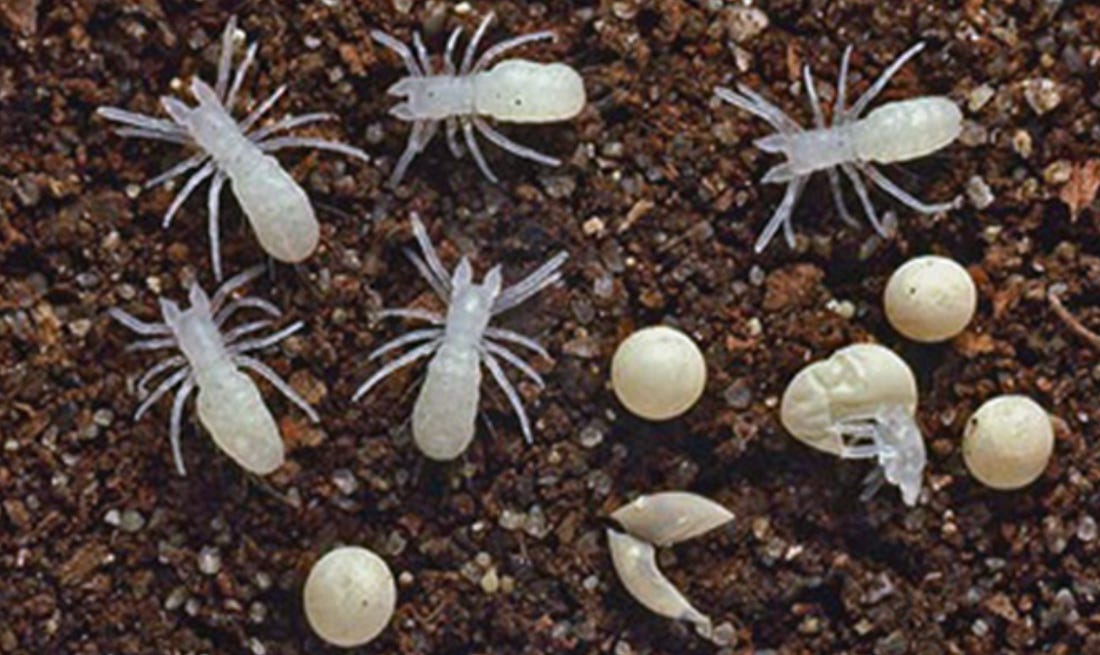
They live solitary lives, meeting briefly to mate, and the babies hatch as cute little replicas of the adults:
They will shed four to eight times as they grow, becoming more aggressive and prone to eating each other with each molt, and perhaps as a result they will disperse over the landscape, taking up their solitary life.
Just as they eat anything they can catch, they seem to be eaten by whatever can catch them. Sometimes this does not work out well, as in this video of the Iranian Spider-tailed Horned Viper:
If you want to see a camel spider without going to Jordan, you can find them in the deserts of the America Southwest. Happy hunting!
Yeah, no thanks — I’ll stick to window hunting. Here’s your cinema report from the indefatigable Berkeley:
It’s been ages since the VFYW’s last (and only previous) visit to Amman (or Jordan at all for that matter). That was contest #167 in the before times of The Daily Dish (August 2013). Because of how long it’s been (and because I was seriously pressed for time this week), I opted to look well beyond Amman’s city limits and found a few movies with scenes that were shot around 170 miles south of our hotel.
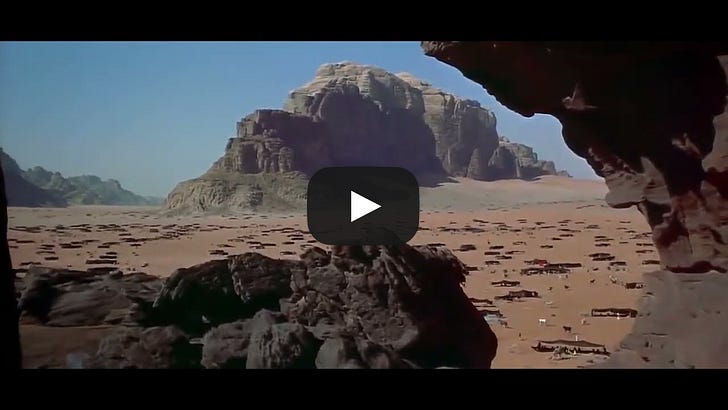
The amazing sandstone tors and iron-oxide reddened desert of Wadi Rum (a protected area in southern Jordan) has appeared in movie after movie since at least the ‘60s when David Lean brought Peter O’Toole, Omar Sharif, Anthony Quinn, Alec Guinness, and the proverbial cast of thousands there to film Lawrence of Arabia (1962). The real Lawrence used Wadi Rum as a strategic base during the Arab Revolt of 1917-18, so of course they’d jump at the chance to film there (although something about this clip looks as fake as Anthony Quinn’s nose):
In Ridley Scott’s The Martian (2015), we saw Matt Damon get marooned on the red planet when his fellow astronauts, thinking he was dead, were forced by a Martian storm to quit the planet in a rush. Mars was portrayed in the film by Wadi Rum:
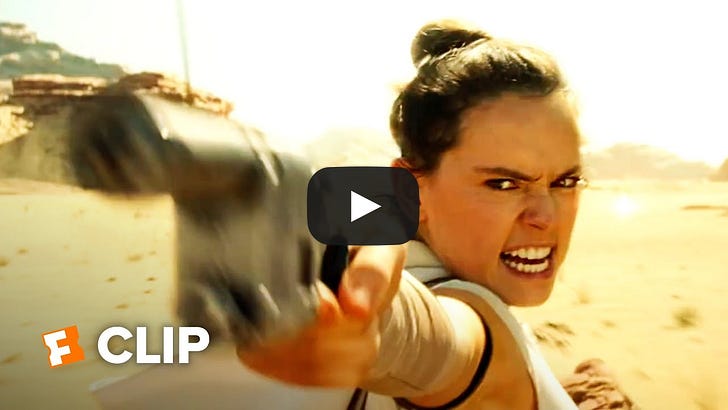
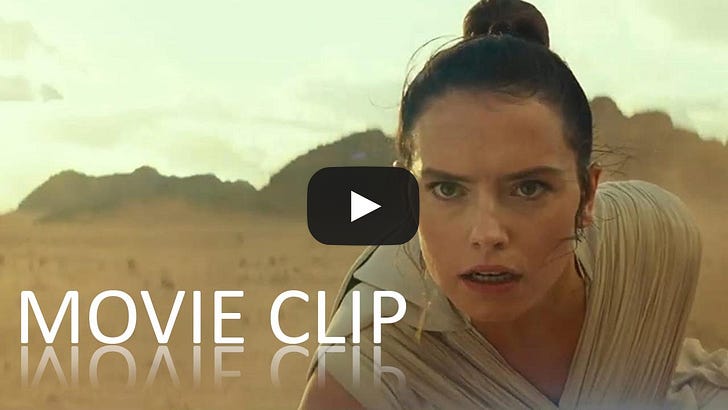
And here’s a scene from no one’s favorite installment of many people’s favorite movie franchise, Star Wars: Episode IX - The Rise of Skywalker (2019). Also filmed in Wadi Rum:
This one too:
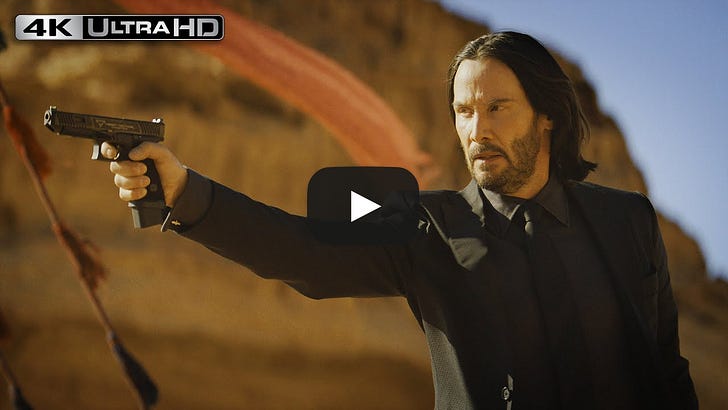
And could I resist including a John Wick clip? No, I could not. John Wick: Chapter 4 (2023) continues the plot line from Chapter 3 (which was featured in contest #494). In the clip below, our boy is still being hounded by hordes of assassins that have been set upon him by the vengeful “High Table.” (By the way, the report for contest #498 almost included another clip from Chapter 3, in which gunmen on motorbikes chase an equestrian Wick on the streets of New York, but I left it out because the scene wasn’t filmed in Manhattan.) Well, he’s back on a horse this week, but now he’s the pursuer, galloping across the red sands of Wadi Rum while plugging away at foes who don’t stand a chance:
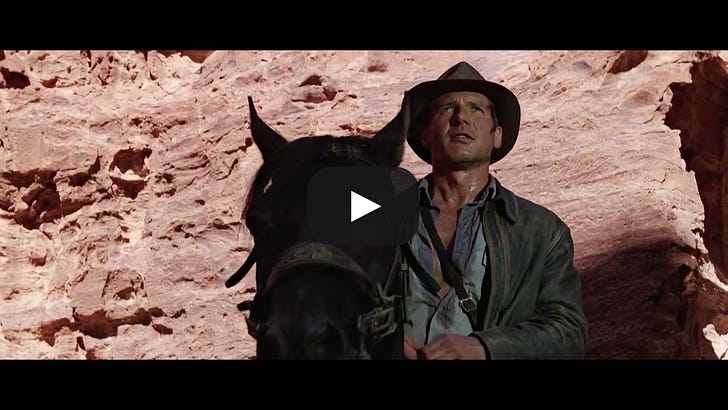
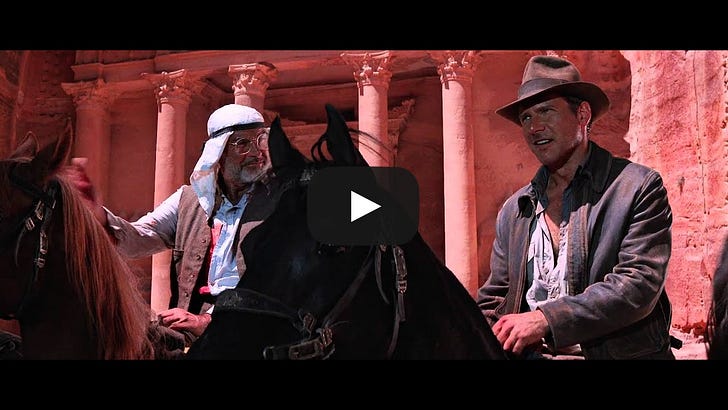
I tried to find a clip from Indiana Jones and the Last Crusade (1989) with Indie and company gallivanting around in Wadi Rum, because supposedly the production did shoot there, but I had to settle for the scene in which they reach the end of their quest in the “Canyon of the Crescent Moon.” The clip below was filmed 115 miles south of our hotel (at least the exteriors were) in Al-Siq — the gorge containing the 4th Century BCE sandstone city of Petra. The exterior of The Treasury — an ancient building carved into the canyon wall — serves as this movie’s version of the last resting place of the most Holy Grail.
I suspect the foursome galloping into the sunset as the closing credits roll in this next clip might be in Wadi Rum, but with no distinguishing features in the shot, who can tell?
Don’t worry, I haven’t forgotten Amman.
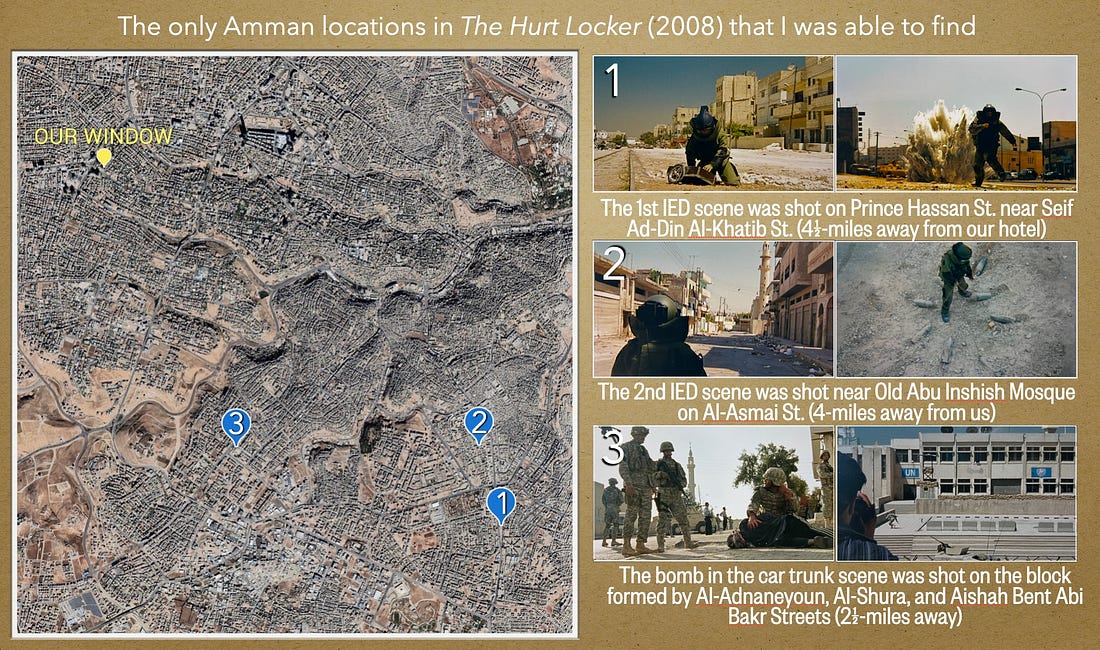
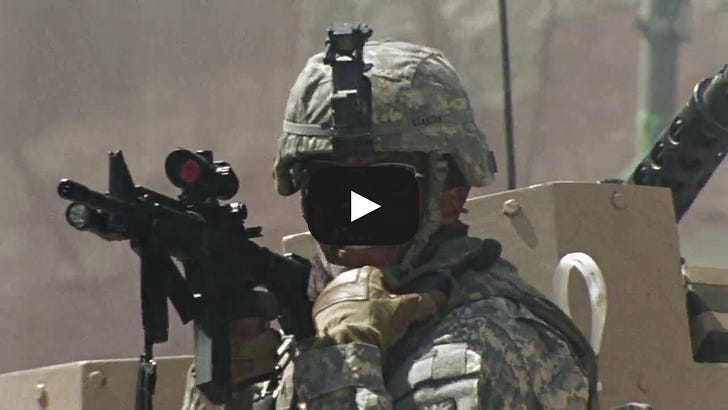
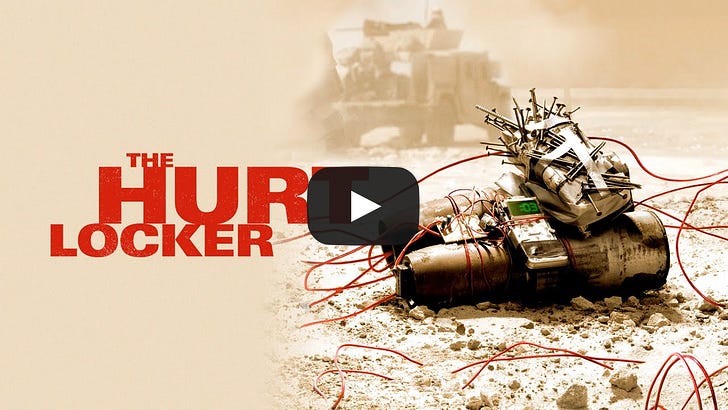
Kathryn Bigelow’s incredible, relatively low-budget Iraq War movie The Hurt Locker (2008) is set in Baghdad but was mostly filmed in Amman. It isn’t the only movie ever to have been mostly filmed there and it probably isn’t even the best, but it’s the only movie fitting that description that I managed to watch with the limited time I had this week. I know, 2026 is a bit late to finally get around to seeing the Best Picture winner for 2010 (which also scored Best Director honors for Bigelow, making her the first woman to take home that award). But I was askeert. I didn’t want to wade into a reputedly very realistic film about soldiers in an Explosive Ordnance Disposal (EOD) team who spend their year-long tour in the war zone disarming and/or detonating Improvised Explosive Devices (IEDs). The movie sounded like a heavy lift.
And it is. Bigelow strove for realism, maybe a little too much, intentionally choosing to film in the heat of a Jordanian August and providing cast and crew with none of the creature comforts that Hollywood types are accustomed to (such as air-conditioned trailers). The pyrotechnicians were tasked with making explosions look the way they really did in Iraq, with sand and dust thrown into the air along with smoke and flame. (I wouldn’t know if they’re truly realistic, having never seen a bomb explode in real life.)
I had a few very minor quibbles about some questionable plot choices, but quite a few Iraq veterans have vehemently objected to several elements they consider to lack verisimilitude (especially a scene in which a member of the EOD team inexplicably demonstrates a serendipitous talent for using a Barrett M82A1.50-caliber sniper rifle (which is a highly specialized skill not normally found among the members of a bomb squad).
I consulted every filming location resource I know of but none offered any info about Hurt Locker that got more specific than “Amman, Jordan” (plus the occasional reference to some unspecified scenes having been filmed at The King Abdullah II Special Operations Training Center (KASOTC)), which is 7½ miles east of us.
So it’s a point of pride that I managed to identify three precise scene locations, all of which appear in the first half of the movie. All of them involve attempts to defuse IEDs or bombs, and all of them are pretty damned fraught. The second scene, filmed near Old Abu Inshish Mosque on Al-Asmai Street, is the one featured in this clip:
The Hurt Locker is currently available on Netflix, but it won’t be there for long. It’s slated to leave on March 30th, so get to it while you can. Here’s a trailer:
The ski nerd adds to the cinema theme:
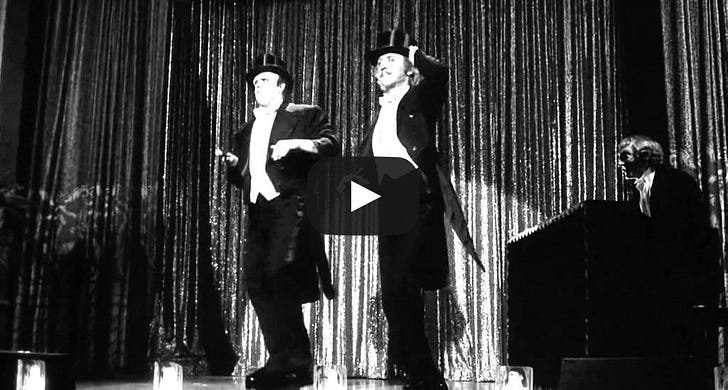
Apropos of Ritz hotels, the best performance of Irving Berlin’s 1927 “Puttin’ on the Ritz” is by Gene Wilder and Peter Boyle in Mel Brooks’ Young Frankenstein (1974):
This version was 84th on the American Film Institute’s 2004 list, “100 years…100 Songs.”
Here’s a band highlighted by our super-sleuth in Indy:
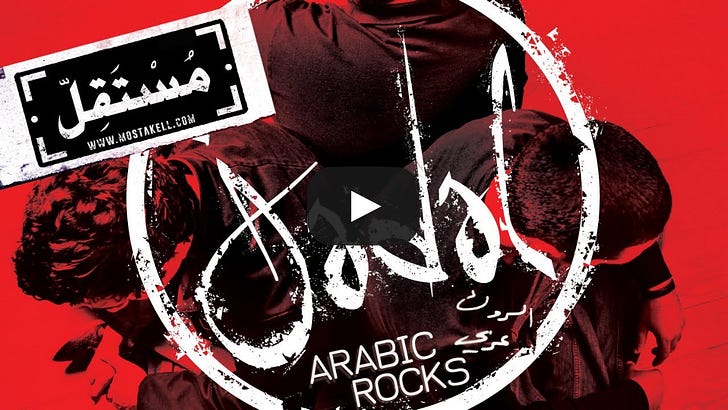
JadaL (”Controversy”) was formed in 2003 by producer/guitarist Mahmoud Radaideh. The other members were Kamel Almani (bass), Rami Delshad (vocals) and Laith Nimri (drums). Their musical style was called Arabic Rock, described as “groundbreaking” due to its blend of rock and Jodanian lyrics. From Ahram Online:
Their music language is pure rock. Their lyrics are in Arabic. They sing about their youth and their international fan base keeps growing. Everywhere they go they create controversy, set the stage alight, and make the audience roar.
In 2009, the band released their first single “El Tobah” (“Repentance”). It was a cover of a song by Abdul Halim Hafez:
This song, as well as their first original single “Salma”, were part of their debut album Arabic Rocks. “Salma” became a radio hit and the band gained many followers:
In 2011, the band released a new single called “Bye Bye 3azizi” (“Bye Bye My Dear”) — included in the album released the following year, El Makina:
In 2016, the band released their third album Malyoun. Here’s “Yumain O Laila”, from that album, performed live in 2023:
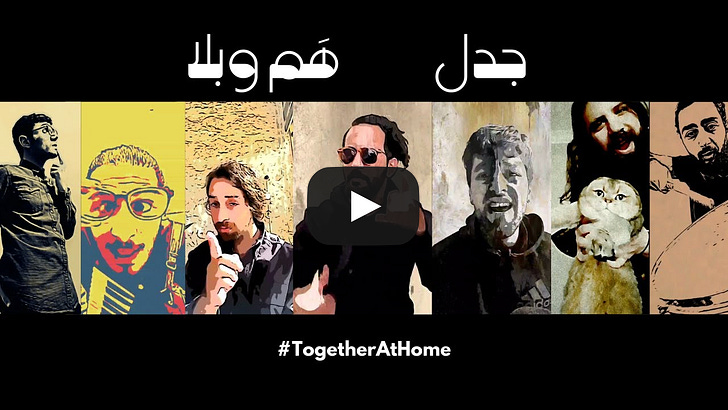
In 2021, the band released their fourth album, La Tlou’ El Daw. Here’s “Hamm O Bala”:
That entire 2023 live performance was recorded, and the band released a live album in 2024 called Live in Tunisia 2023. The following year, they released an EP called Hami Barid. Here’s “Shita Happens” from that album (I couldn’t resist with that title):
Our “a-maize-ing sleuth” in OKC also gets musical this week:
The main thing I know about the region came from Yo-Yo Ma’s recount of how he came up with the idea of the Silk Road Project, a non-profit arts organization that creates music and educational programs to promote cross-cultural collaboration, inspired by historic Silk Road trade routes. During the COVID shutdown in 2020, Ma found time to “write” a short autobiography of sorts, and it became his self-narrated 90-min audiobook Beginner’s Mind. In the middle of Chapter 5, he described his tour of Israel-Petra-Aqaba-Amman in one hectic day:
A few years later, I was in Tel Aviv, playing with the Israel Philharmonic. It was October 1994, the month that Jordan and Israel signed a historic peace treaty. And the day after the treaty was signed, friends in Jerusalem called to invite me to dinner. The next day my friend said, some of us, we are invited to cross the Allenby bridge to Jordan, toward the ancient city of Petra, then have drinks at the residence of King Hussein and Queen Noor, in Aqaba.
“Bring your cello” they said, if the majesty liked us, we would be invited to dinner.
Petra was draw-dropping. ... At the end of our extraordinary visit, we wanted to thank our scholarly guide and give him a gratuity. But he refused: My reward will come when you speak about the wonders you have seen today.
So it was with the mind ablaze we headed to Aqaba. I guess the Husseins must have liked us because we were asked to stay for dinner. At dinner, Queen Noor asked me if I would stop in Amman, on the way back to Israel, to hear some young musicians at a school, of which she is the patroness.
Hearing the young musicians play moved me greatly. But what truly astonished me, was the way they described the music they played in such eloquent, poetic terms, revealing a sensitivity of soul and depths of understanding that one almost never encounters.
Thus, in a 24-hour period of extreme experiences — a historic peace, visiting Petra, being inspired by the poetic depths of two young musicians in Amman — a seed was planted in me. The idea of a culture silk road was born.
(The above is what I transcribed from Audible. The story was told briefly in this interview.)
Here’s Brookline again, on his bookstore beat:
A mere 20-minute walk from the Ritz Carlton, the Resheh Bookstore bills itself as “a boutique bookstore in Amman, offering carefully selected books and gifts that blend culture, creativity, and elegance.”
Located in the upscale Golden Gate Mall, Resheh maintains an active presence on Facebook and Instagram, posting a steady stream of short videos with an approachable homemade feel, the recent ones featuring a young lady (presumably an employee) introducing the shop and its wares in Arabic and English.
Also, a quick shoutout to Venezuela for besting the US in the WBC championship! Gotta love the geopolitical irony!
Here’s a Mideast mocktail via Park Avenue:
I have not been to Jordan — or anywhere (ignoring Dubai/Doha) in the area, although Petra is on the list when one can travel there again. Every time I see Petra in movies or photos, it just inspires me.
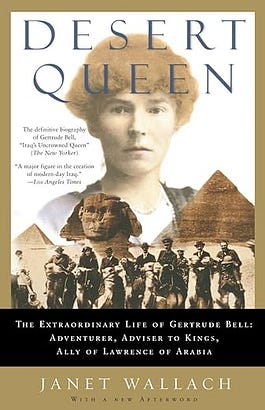
Coincidently, at the moment I’m reading a fantastic biography called Desert Queen by Janet Wallach. It covers the extraordinary life of Gertrude Bell — a British aristocrat who became key figure in Arabia (as the Brits called it) from late 1890s through WW1, and it describes vividly all her travels through the areas and cities we hear so much about these days. Well worth a read. These are age-old battles we are living through, as if anyone needs reminding.
Anyway — since we are in a relatively booze-free environment this week, I thought we could go with a tasty and easy mocktail, loosely inspired by the Middle East:
2 ounces 100% pomegranate juice
2 ounces ginger beer
? ounce fresh lime juice
1 teaspoon apple cider vinegar
Salt to rim half the glass.
This was tasty. I used Goslings Ginger Beer, as you need the assertive ginger, and the apple cider does add to it. Mix in your cocktail shaker with some ice, shake, and serve.
The slopes report:
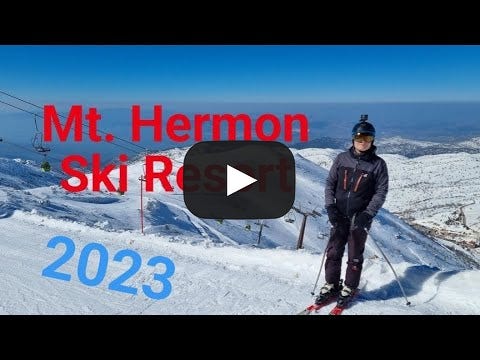
The nearest skiing is at the Mount Hermon Ski Resort, 93 miles north, just a few kilometers inside the Israeli-occupied Golan Heights and less than a mile from Lebanon and Syria. (In contest #437: Another Kind Of Safe Space, I inexplicably missed Mount Hermon, which is 39 miles closer to that view than the resort in Lebanon I described.)
The area around the ski resort was captured by Israel in the 1967 Six-Day War, temporarily regained by Syria in the 1973 Yom Kippur War, and then recaptured by Israel. On the 9232’ Hermon summit is the highest permanently manned UN position in the world, and the IDF maintains a small Alpinist unit near the top of the resort. Most of the resort’s employees come from the nearby Druze Arab villages.
The resort has a top elevation of 6693’, 1444’ vertical, a gondola, five double chairs, four T-bars, a terrain park, but no snowmaking. Large signs warning of landmines discourage off-piste skiing.
The resort is typically open January through March, though currently the web site says, “Due to the immediate and ongoing state of emergency, the site is currently closed.” Reviewers give it a respectable 4 stars on Tripadvisor.
Our CO/NJ sleuth just got back from the slopes:
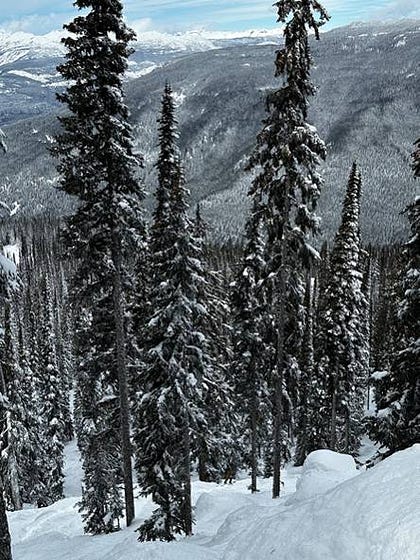
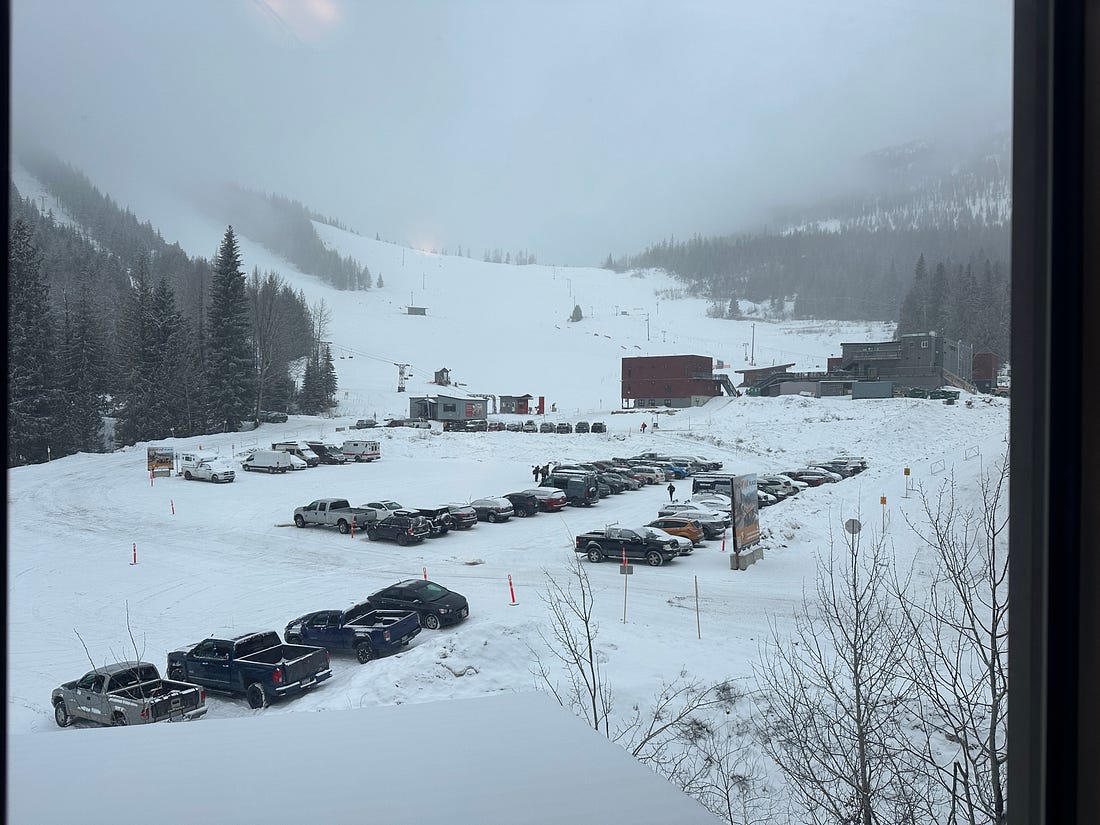
It was a great trip, from the perspective of getting to see my old ski buddies from PA. The skiing was very much a mixed bag, mostly bad. The NW (like a lot of the country) got hit by a very warm spell, which was then followed by frigid cold. We skied Schweitzer in Idaho on Sunday and it was fun — very warm, very soft. We got to Red Mountain in BC that night and that’s when the cold moved in. On Monday, most of the spectacular terrain at Red was utterly unskiable. It was sidewalk concrete.
When I say NOBODY was off-piste, I mean it. So we skied hard icy groomers for three days. Ugh. A scheduled Cat skiing day was cancelled by the company due to adverse conditions. Double ugh. On the plus side, we decided to make lemonade and, on Friday, drove four hours north to Revelstoke, which got pounded the night before. So we had one day of spectacular powder and tree skiing. There I am below, in the trees — can you pick me out?
I took some VFYW shots during the trip and have attached them here. I’m not sure any of them are really contest material, but I thought I would send them along just in case. The one below is the view out of our condo at Red Mountain, showing the base parking lot:
Man, I need to go back there when it’s skiable.
Here’s a brief ecotourism report from our Alaskan globetrotter:
I think the View is in Amman, Jordan, but I can’t quite find it and don’t have the time for a grind-it-out search. If I’m in the right vicinity, the obvious tourism destination is Petra, but be prepared for full-on mass tourism there. It’s supposed to be an amazing place, even if you don’t get to replicate the horse ride out with Indiana Jones, dad, and sidekick.
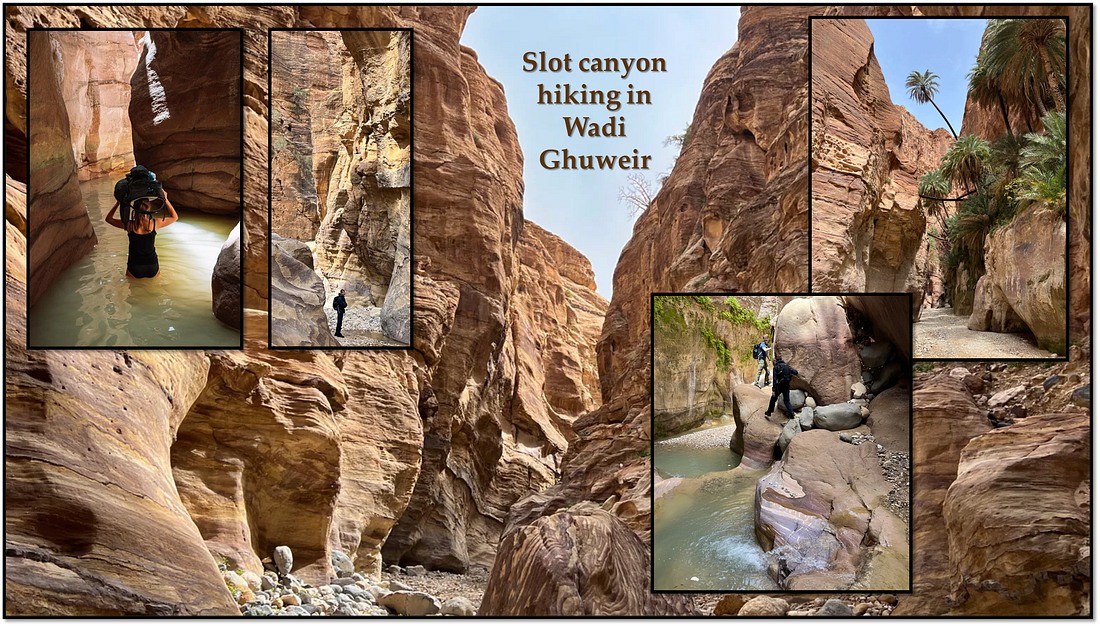
But here’s a possible alternative hike in canyon country about an hour closer to Amman: Wadi Ghuweir. It’s a classic slot hike similar to those in Utah. You’ll need to bring water, a sense of adventure, and be prepared for some climbs and rappels. Thesefolks figured out how to do it without guides and follow-up with a second hike in a broader valley while camping in a bedouin camp in-between. Others choose to go with a guide.
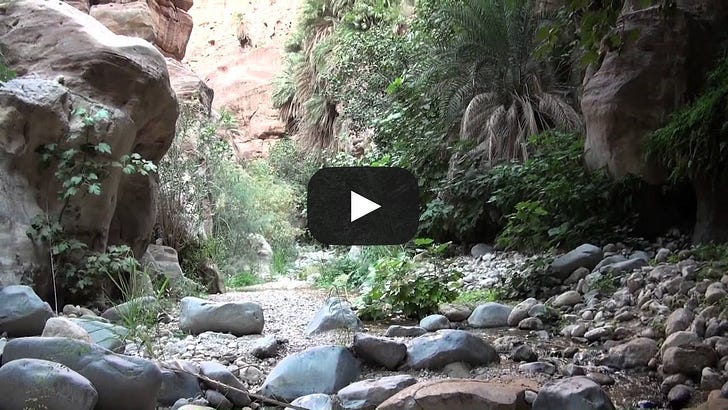
Below is a short video that gives a taste for the scene; a longer one has more detail and includes some discussion of litter and graffiti, which seems like it has followed from its recent discovery and popularity.
And the hot springs report via Yakima:
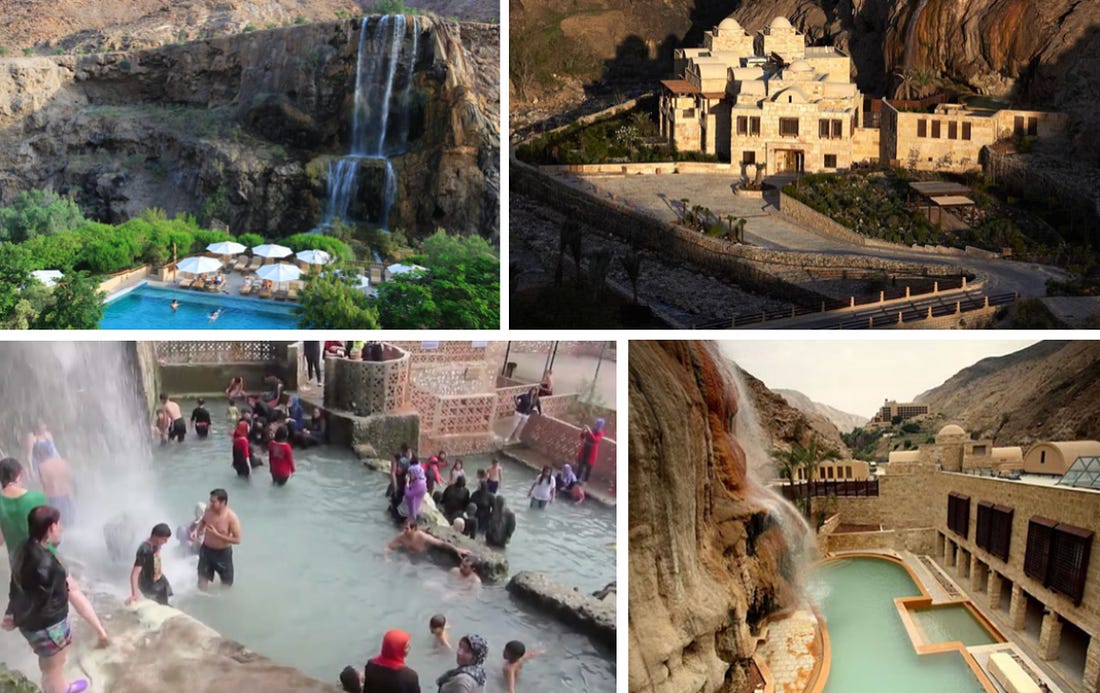
The Dead Sea Rift runs from the Sea of Galilee in the north through the Jordan Valley and the Dead Sea to the Gulf of Aqaba in the south. There the African and Arabian plates have been splitting from each other for the past 30 million years, and most of the hot springs in Israel and Jordan owe their existence to tectonic activity along this fault.
The closest to our view is Ma’in Hot Springs (or Hammamat Ma’in) — 60 km to the southwest of Amman, not far from the Dead Sea. They were known from Roman times for their healing properties and frequented by King Herod. Ma’in is located 264m below sea level, and comprises 63 separate springs (including five waterfalls) from 45 to 60 C. The falls are marked by large tufa deposits. The water is somewhat sulfurous.
Best time to visit is winter when the weather is cooler. In addition to the pools and waterfalls, the Ma’in Hot Springs Resort offers a variety of spa treatments as well and a good Jordanian-cuisine restaurant, but online reviews frequently describe the hotel as rundown. The clientele is mostly local with very few Europeans. Women unless fully covered have reported unsatisfactory experiences. Prices (prior to recent Mideast developments): about $28 US taxi fare from Amman, $14 for a day pass, $100 for an overnight room.
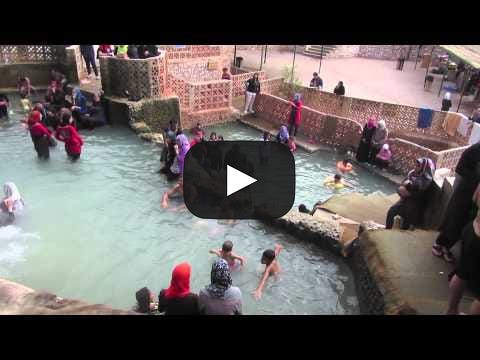
Here’s a very brief video:
A previous winner in Oakland is curious:
You must read and write (and think) incredibly fast! I’m stunned by your ability to compose and produce these wonderful pieces, starting with a voluminous pile of disparate contributions — all between Thursday morning and Friday night.
Inquiring sleuths want to know: How do you pull it off, week after week?
I’d like to sketch out the methodology I use every week to compile the entries, but I’m too exhausted right now, after an especially hectic week (which started with flight delays coming back from Florida to see my dad). But I’ll circle back to this question next week. Thanks for inquiring!
The last word goes to Riverwoods:
Congrats on the #500 VFYW! A mammoth achievement. My first entry was contest #311 in Florence, Italy. Cheers to 500 more!
This week: Amman, Jordan. Next week:
Where do you think? Email your entry to contest@andrewsullivan.com. Please put the location — city and/or state first, then country — in the subject line. Bonus points for fun facts and stories. Proximity counts. The deadline for entries is Wednesday at midnight (PST). The winner gets the choice of a View From Your Window book or two annual Dish subscriptions. The contest archive is here.
(To submit a photo for the contest view, also use contest@andrewsullivan.com. Horizontal photos are preferred, and make sure part of the window frame is showing. Please also send a photo of the building with the window circled, which makes the contest go much smoother. If we select your view, you’ll get six free months added to your Dish subscription.)