
Below is an important message from one of our highly valued sponsors. Please read it carefully as they have some special information to share with you.
Dear reader,
I recently sat down with the famous economist and best-selling author…
Who predicted the biggest stock market crashes of the last two decades…
And he’s now predicting this AI giant is about to go bust…
Trigging a full-blown AI meltdown that could wipe out 80% of the stock market.
The first time I heard about it…
I thought he was talking about Nvidia.
But it’s another company he says is far more important.
Look, the stakes here couldn’t be any higher…
Because this is the same man who predicted the 2008 meltdown…
Just three weeks before Lehman Brothers imploded and the stock market collapsed.
And the same man who predicted the Covid meltdown…
Again just three weeks before the stock market suffered the fastest drop in history.
And now he’s predicting that this coming AI meltdown will be 10 times bigger than Lehman Brothers...
….and it could send a ripple effect through the market that could crater the entire AI industry.
And he’s warning everyone to take five simple steps to prepare.
Click here to see the details.
Regards,
Aaron Gentzler
VP of Research, Paradigm Press
CoreWeave Just Landed a Deal That Signals Where AI Is Headed
Written by Jeffrey Neal Johnson. First Published: 3/5/2026.
Key Points
- CoreWeave's specialized, high-performance infrastructure provides a crucial advantage in the demanding and rapidly growing AI inference market.
- A deep technical partnership with NVIDIA, which includes a coveted industry certification, validates CoreWeave's platform as a world-class solution.
- An extensive backlog of long-term contracts provides significant visibility into future revenue and underpins the company's strategic growth investments.
- Special Report: Elon Musk's $1 Quadrillion AI IPO
A recent partnership sent a clear market signal about the future of artificial intelligence (AI) — and it has less to do with the training hype that has dominated headlines.
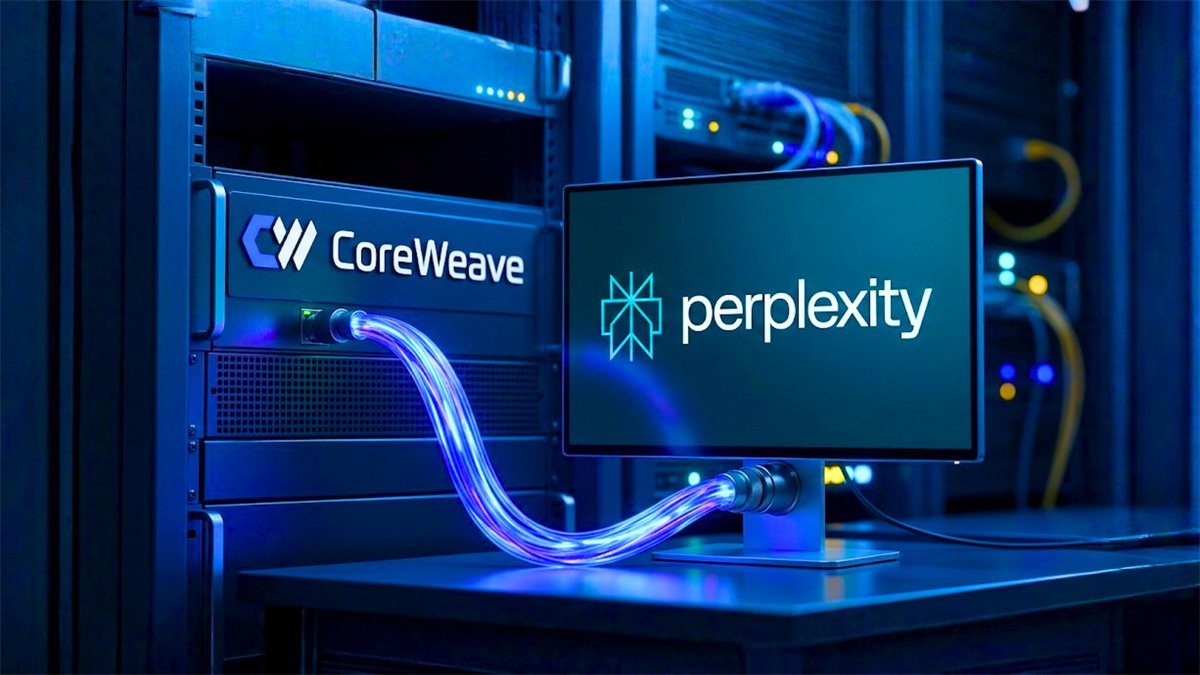
When specialized cloud provider CoreWeave (NASDAQ: CRWV) saw its stock rise after announcing a multi-year deal with AI-native search company Perplexity, it was more than just another customer win.
Elon Musk: This Could Turn $100 into $100,000 (Ad)
What if you could shrink your entire wealth journey from decades down to just 24 hours?
Sounds impossible…
But I'll show you how Elon Musk is about to make it a reality.
This could be the best investment opportunity of the decade.While Wall Street has focused on CoreWeave’s aggressive spending, this alliance may have just illustrated where the real, long-term revenue in the AI revolution will come from.
A Bellwether Deal for the New AI Battleground
Perplexity, a cutting-edge company whose business relies on delivering fast and accurate AI-powered answers, has entrusted its critical workload to CoreWeave — specifically, CoreWeave will power its AI inference operations. That distinction is crucial for investors: it highlights a fundamental shift in the AI market.
For several years the AI narrative centered on training — the initial, computationally massive process of teaching a model on vast datasets, like building a comprehensive library of global knowledge. Training is vital but often periodic. Inference, by contrast, is the continuous, high-volume process of using a trained model to generate answers and predictions for millions of users in real time. It’s the equivalent of everyone checking out books from the library 24/7.
Inference workloads are exceptionally demanding. They require consistently low latency because real users are waiting for responses — any delay degrades the experience. While training is a marathon, inference is a series of never-ending sprints. The decision by a performance-obsessed AI leader like Perplexity to choose CoreWeave over established, general-purpose cloud giants is a bellwether: for demanding, revenue-generating AI applications, specialized infrastructure is not just a preference; it's a necessity.
Built Different: CoreWeave's Performance Edge
CoreWeave’s ability to win critical inference deals stems from a fundamental architectural advantage. The company offers a GPU-first, bare-metal cloud purpose-built for AI. This design gives clients direct access to the underlying hardware, minimizing software layers and operational overhead that can introduce latency.
The specialization creates a clear performance gap between CoreWeave and legacy hyperscalers, whose platforms are designed to be jacks-of-all-trades. For investors, the difference is easy to picture:
- CoreWeave (Specialized): The Formula 1 car of the cloud world — engineered for one purpose: to deliver maximum speed and performance for demanding AI workloads.
- Legacy Hyperscalers (Generalized): The SUV — versatile and reliable for a wide range of tasks like web hosting and data storage, but not optimized for the high-octane racetrack of AI inference.
This performance edge isn't just marketing; it's validated by the industry's most important name: NVIDIA (NASDAQ: NVDA). NVIDIA’s deep partnership with CoreWeave goes far beyond its recent $2 billion investment. It represents a meaningful technical endorsement. CoreWeave has earned NVIDIA's Exemplar Cloud status, a certification that indicates its platform meets high standards for performance, reliability, and security.
For enterprise customers, that stamp of approval de-risks their decision and ensures they are running workloads on a world-class platform. The deep alignment also gives CoreWeave early access to next-generation technology like the Rubin platform, helping maintain its competitive moat for years to come.
Investing in Certainty, Not Speculation
Some market observers remain concerned about CoreWeave’s aggressive spending and current net losses. The company has guided for $30 to $35 billion in capital expenditures for 2026, a figure that understandably raises questions about near-term profitability. But viewing that spending in isolation misses the bigger picture: this is not speculative outlay; it is calculated investment to fulfill a massive, pre-sold pipeline of demand.
The most compelling counterpoint is the company’s $66.8 billion in contractually secured revenue backlog. CoreWeave is not building data centers on a hope; it is manufacturing capacity that has already been purchased through long-term contracts. The quality and length of those contracts — the average now runs roughly five years — provide exceptional visibility and stability for future cash flows.
CoreWeave’s ability to raise more than $18 billion in capital in 2025 while lowering its average cost of borrowing also demonstrates strong institutional confidence in the strategy. That aggressive investment is what helps secure CoreWeave's leadership position for years to come.
What the Market May Be Missing
CoreWeave’s strategic positioning in the inference market directly informs its valuation potential. While the stock currently trades around $79.50, the consensus price target among 30 Wall Street analysts is $124.34, suggesting significant upside from current levels.
That gap implies the market may still be valuing the company primarily on the high costs of its current build-out phase rather than the recurring revenue its infrastructure is set to generate in the inference era.
CoreWeave projects — supported by its backlog — that it will exit 2026 with an annualized revenue run rate of $17 to $19 billion, more than doubling its revenue base in a single year. As the company converts backlog into revenue and announces additional high-profile inference customers like Perplexity, that valuation gap may begin to narrow.
An Essential Cloud for the Inference Era
For investors assessing the evolving AI landscape, the key may be to look past the training headlines and focus on the less-discussed but potentially more lucrative inference market. The companies building the high-performance infrastructure for this next phase are positioning themselves for durable, long-term growth.
The recent deal between CoreWeave and Perplexity is strong evidence that CoreWeave has established itself as a primary contender in this new gold rush.
3 Stocks That Could Be Next to Announce a Stock Split
Written by Chris Markoch. First Published: 3/15/2026.

Key Points
- Stock splits often follow strong periods of growth and rising share prices.
- KLA, Eli Lilly, and McKesson all trade near or above $900 per share, putting them on investors’ split watch lists.
- Strong fundamentals and bullish analyst outlooks could keep these stocks climbing in 2026.
- Special Report: Elon Musk's $1 Quadrillion AI IPO
Stock splits are corporate actions that make shares more affordable to retail investors. They typically follow periods of significant growth and/or innovation.
What is it about stock splits that captures investors' imaginations? After all, the intrinsic value of the company doesn't change. Still, investor psychology is a major driver of a stock's short-term performance. It can be hard for retail investors to consider buying a stock trading at $500, let alone $1,000.
Have $500? Invest in Elon's AI Masterplan (Ad)
What if you could claim a stake in what's set to be the biggest IPO ever… starting with just $500?
Everyone is talking about Elon Musk's SpaceX IPO.
Click here to get the details and I'll show you how to claim your stake…Investors with limited funds often find lower-priced shares more accessible because they can buy more of them. But sometimes you get what you pay for: stocks that have seen strong share-price growth typically have solid fundamentals to back them up.
For example, Costco Wholesale Corp. (NASDAQ: COST) has been on many analysts' lists of companies that could potentially split its stock for years. As of this writing, COST stock trades for just over $1,000 per share. That's pricey, but the stock has delivered share-price growth of more than 200% in the last five years. Investors who shied away at $500 missed that gain, which doesn't include the company's dividend.
By contrast, Walmart Inc. (NYSE: WMT) announced a stock split in January 2024. The stock hasn't missed a beat, climbing over 45% in the last 12 months and more than 175% in the last five years, not counting the company's dividend.
The takeaway for investors is that quality matters. Owning companies with strong growth can make a stock split an additional benefit—not a gimmick that excuses buying a weak business. Here are three companies that could split their stock in 2026.
Semiconductor Leader KLA Approaches $1,400 Per Share
KLA (NASDAQ: KLAC) designs and manufactures equipment, software, and services used by chipmakers for process control and yield management applications. It's not surprising that KLAC stock has jumped more than 375% in the last five years, and over 100% in 2025.
Even as KLAC trades above $1,400 per share, it's still about 13% below its consensus price target of roughly $1,600. After a strong run as part of the artificial intelligence trade, a stock split could be on the table.
But investors may have to wait. KLA hosted an Investor Day on March 12 where it announced several shareholder-friendly moves, including a $7 billion share-repurchase program and a 21% increase to its dividend—the 17th consecutive year it has raised the payout.
A company can announce a stock split at any time, and KLA reports its Q3 earnings for fiscal 2026 on April 29. But after the March announcements, the board may choose to hold off. Still, with the share price above $1,400, investors will keep wondering when a split might come.
Eli Lilly's GLP-1 Leadership Keeps the Growth Story Strong
Eli Lilly & Co. (NYSE: LLY) isn't part of the technology sector, but the stock has behaved like one. LLY is up more than 350% in the last five years. However, like many high-growth names, the stock has been leveling out recently—it was up about 18% in 2025 and is down roughly 9% through March 12.
LLY trades for just under $1,000 as of this writing, and analysts' consensus price target implies roughly 25% upside. That outlook is supported by expected earnings growth of about 35% over the next 12 months.
But it's the reason behind the growth that fuels the split conversation. Eli Lilly is the clear market-share leader in the GLP-1 weight-management market.
The company could extend that lead if the U.S. Food & Drug Administration approves its oral GLP-1 candidate in 2026.
Those prospects may encourage a wait-and-see approach on a split. Another consideration: shareholders recently received a 15.3% dividend increase announced in December 2025.
McKesson's Quiet Rally Pushes the Stock Near $1,000
McKesson Corp. (NYSE: MCK) is a leading healthcare distributor. McKesson delivers medicines and medical supplies to hospitals, pharmacies, and doctors' offices, helping ensure patients receive the care they need.
MCK is up more than 400% in the last five years and 47% in the last 12 months, including a 15% gain in 2026 as of March 12.
In its most recent earnings report, management raised guidance for FY2026: revenue growth of 12% to 16% and adjusted earnings-per-share growth of 17% to 19%. The EPS guidance topped analysts' projections of about 11% growth.
The MCK share price is above $900 and is pushing the top of its 52-week range. Unlike the other names on this list, MCK is trading roughly in line with its consensus price target.
Analyst sentiment remains bullish, however, with many price targets above $1,000. That includes JPMorgan Chase & Co., which has the highest target at $1,107.
This email communication is a paid advertisement from Paradigm Press, a third-party advertiser of The Early Bird and MarketBeat.
If you have questions or concerns about your account, please email MarketBeat's U.S. based support team at contact@marketbeat.com.
If you no longer wish to receive email from The Early Bird, you can unsubscribe.
© 2006-2026 MarketBeat Media, LLC. All rights protected.
345 N Reid Place #620, Sioux Falls, SD 57103. United States..



