Zaid is a young center-left journalist (after the young center-right journo we had on last week, Jason Willick). Zaid worked as a reporter for The Intercept and as a reporter-blogger for ThinkProgress, United Republic, the Progressive Change Campaign Committee, and Alternet. He’s now on Substack at “The American Saga” — subscribe!
An auto-transcript is available above (just click “Transcript” while logged into Substack). For two clips of our convo — on what the Dems should do on immigration, and whether Ossoff and Buttigieg could be strong contenders for the presidency — head to our YouTube page.
Other topics: his parents immigrating from Pakistan; born and raised outside Atlanta in Newt Gingrich country; growing up Muslim in the South; tithing and agape; starting a student magazine at UGA; Mamdani and affordability; higher taxes on the rich; universal childcare; Ossoff and “the Epstein class”; the Dems’ denialism over Kamala; identity politics killing the party; how Dems should respond to AI; data centers hiking energy bills; Waymo; Trump’s success at closing the border; asylum reform; the left crying wolf over racism; Stephen Miller the wolf; Eric Kaufmann’s Whiteshift; pushing left-racism on a racially tolerant public; Jasmine Crockett; Dem leaders cowed by activists; transqueer ideology; Bad Bunny; Israel and the Dems; foreign aid; Tom Massie; Ro Khanna; gerontocracy; Obama’s success in red states; rumors of Stacey Abrams being closeted; AOC; Warnock; Newsom’s left-wing baggage; the silo of Bluesky; Renee Good; and the indoctrination of kids on gender.
Browse the Dishcast archive for an episode you might enjoy. Coming up: Sally Quinn on the WaPo and silent retreats, Michael Pollan on consciousness, Jeffrey Toobin on the pardon power, Derek Thompson on abundance, Matt Goodwin on the UK political earthquake, Jonah Goldberg on the state of conservatism, Tom Holland on the Christian roots of liberalism, Adrian Wooldridge on “the lost genius of liberalism,” Tiffany Jenkins on privacy, and Kathryn Paige Harden on the genetics of vice. An abundance of riches! And a lot of reading for yours truly! As always, please send any guest recs, dissents, and other comments to dish@andrewsullivan.com.
From a fan of last week’s pod on the courts under Trump:
I really enjoyed your conversation with Jason Willick. He was so smart and articulate in his arguments.

Maybe I missed it, but did you guys forget that there had been a bipartisan-negotiated border immigration bill in 2024 that Trump torpedoed?
I haven’t forgotten. But the bill was never serious about really restricting immigration. It was more about facilitating it more efficiently.
A quick dissent:
I was disappointed that you didn’t challenge Willick on the rank corruption that epitomizes Trump and his family and friends. If this is what passes as the reasonable center-right, I am more convinced than ever that I made the right choice in calling myself a former Republican.

I try to make up for that in the column this week. Another on that pod writes, “I was struck by the contrast between the moral seriousness you bring to trans questions and the mostly pragmatic way you tend to approach immigration”:
On trans issues, you have made thoughtful, forceful — and ultimately moral — arguments about how we should treat children who say they are trans medically and societally, and how we should balance the rights of adult women in single-sex spaces and sports with the rights of trans women. I don’t always agree with you, and I sometimes find your phrasing unnecessarily snarky, but your approach to these hard questions is rigorous and grounded — not just in pragmatism, but in moral consideration.
When it comes to immigration, though, your posture often seems almost entirely instrumental: excessive immigration, especially illegal immigration, has been bad for the US and bad for Europe, and these countries must take care of their own first. What I rarely hear — especially from someone so willing to talk in moral terms elsewhere — is sustained engagement with the moral reality of the people trying to come: those fleeing gang violence, political repression, and extreme poverty; those seeking asylum; those trying to save their families from lives of deprivation that most Americans can barely imagine. Nor do you often seem moved to reflect on brute luck — your own good fortune in being born British, and then being able to become an American citizen.
I’m not arguing for open borders. In fact, I’m not even confident I could describe a fully humane immigration policy, because we have never had a politician of either party — at least as far as I know — who has articulated one that is both workable and morally serious. But I do think any honest discussion has to wrestle with two things at once: the legitimate obligations a state has to its citizens, and the undeniable moral claims of human beings in extremis.
That is why one moment in your conversation with Willick landed as particularly ironic. You spoke as if liberals refuse to engage seriously with the hard realities of immigration, claiming they summarily dismiss immigration pragmatists as “bad people.” Yet what seems missing from your own framework is precisely the kind of moral engagement you demand in other debates: a willingness to inhabit the migrant’s perspective long enough to acknowledge that — even if the policy answer is still “no” — the impulse to leave can be understandable, brave, and deeply human.
Can you imagine, for a moment, that you were born in a country torn by gang violence, with no educational prospects, and real danger attached to freely expressing your sexual orientation? What would you do for yourself and your family? Even if you conclude you would pursue only legal avenues, wouldn’t you at least recognize why someone might feel driven to cross a border unlawfully when lawful routes are functionally closed?
Many thanks for this thoughtful criticism. I confess I have not sympathetically examined at any length the moral case for mass migration. The Pope would agree with you. But here’s what I’d say: of course I understand the moral dimension, since I’m an immigrant myself. But I immigrated legally — and it was a grueling, long, expensive process. I support others doing the same. But illegally? That changes things, doesn’t it? We have to balance the moral claims of foreigners with the interests of citizens. And in a democratic society, the citizens come first. They pay taxes; they vote; they have no obligation to open the borders, but they have and they still do.
Where are we in 2026? We have the highest proportion of foreign-born people in American history — and by far the highest numbers of all time. Many of the newcomers are culturally alien and here in vast numbers; 200,000 Haitians, for example, arrived under Joe Biden in one fell swoop — an act of staggering recklessness. As a result of this massive, unregulated influx, we have a populist revolt, a Trump second term, and a surge in neo-fascist movements. In those circumstances, ending illegal immigration, securing the border and cutting legal immigration is, in my view, the moral as well as the pragmatic imperative. It allows us to digest the historically unprecedented influx, integrate newcomers better, defuse racist reactions, and defang populist rage. As the domestic economy could drastically shift with AI, we need more prudence in calming the triggers for populist revolution, and in directing them constructively. Controlling immigration is essential to that project.
Another listener has a few reading recs:
You asked Jason Willick about who he liked to read. I suggest you should read Nassim Taleb’s Incerto series. I’ve read each book as they came out, and they have stood the test of time. Like you, he is a fan of Oakeshott.
For current economic news, I suggest you read Oren Cass and his Commonplace newsletter. I usually read people’s past posts to see if they still hold today. Imagine all those “economists” who predicted doom, gloom, and inflation about Liberation Day only to not remember the basic difference between general inflation and a single price shock. (Hint: under Biden we had general inflation, which saw prices for goods and services rise 27% during his one term, and food rose 50%) Every year the average American spends about 10% of their annual expenditures on foreign goods. Oren wrote about it, and a year later everyone is still waiting for the “inflation” to arrive.
The latest inflation figures would seem to confirm that. Here’s a guest rec for the pod:
Matthew Hooten is one of New Zealand’s most authoritative right-wing commentators, going back at least three decades. As a liberal, I’ll listen to anything he says, because he’s better than anyone else on the airwaves. (For clarity, I’ve never met or communicated with the guy.)
He’s recently completed a doctorate at Oxford, more or less on the thesis of “what is conservatism?” In discussing his thesis, he gives several conservative perspectives on decision making, giving voice to inherent conservative understandings that liberals like myself rarely hear. Here’s a recent interview:
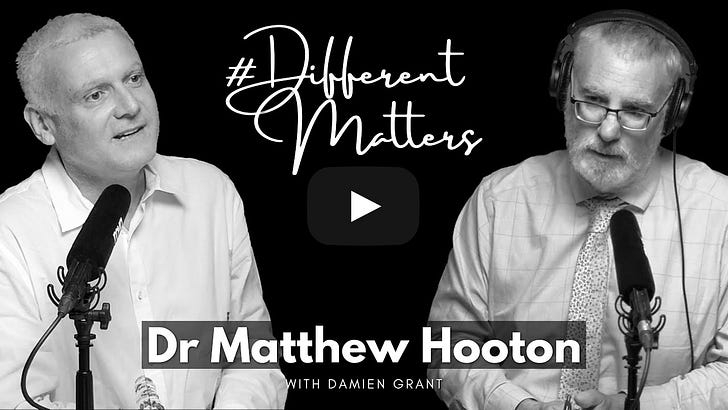
This is no doubt fairly common grist for your mill, but Hooten approaches the topic in ways I haven’t heard you do. He’s a lively guest and takes no prisoners, and happily — and justly — accuses his own side of racism. He frequently agrees with his opponents in his search for truth. I am equally interested in how he’d interpret the latest travails in the US, and I believe he’s the exact sort of guest you would enjoy getting into nuts and bolts with.
Thanks so much! Will watch. Next up is the full response from Steven Pinker previewed on the main page, responding to my mention of him in last week’s column on Epstein:
You asked “What was Steven Pinker thinking?” with the implication that I was a willing associate of Epstein. I know the question was rhetorical, but let me answer it.
I disliked Epstein from the moment I met him, judging him to be a sleaze and an impostor. I never sought his company, never solicited or accepted funding from him, was never invited to his mansion or island, and would not have accepted. But as we know, Epstein was an obsessive collector of celebrities, including academic celebrities, and he was tight with an astonishing number of my close colleagues, making it difficult to escape associations with him. These included my Harvard colleague and co-teacher Alan Dershowitz; my PhD advisor, department chair, and dean Stephen Kosslyn; my Harvard colleagues Lawrence Summers, Lisa Randall, and Martin Nowak; my former MIT colleague Noam Chomsky; my literary agent John Brockman; and the Director of the ASU Origins Project, Lawrence Krauss. I am astonished that these smart people took Epstein seriously. On the two occasions when I was forced into his company, I found him to be a deeply unserious and attention-deficit-disordered smart-ass.
Nowak, Brockman, and Krauss were prolific impresarios of academic conferences covertly funded by Epstein, and he would often show up unannounced. At one Harvard conference someone snapped a photo with me and Epstein in the frame; it has plagued me ever since. On another, Krauss begged me to allow Epstein to join my meal table for a chat, and the resulting photo has also been endlessly circulated to smear me. In a forthcoming article in a major online magazine, Krauss publicly apologizes for forcing me into that situation. Epstein was also a donor to other Harvard projects, not all of them public.
It’s also important to keep in mind the timeline. I did join a group of TED speakers and attendees (including Brockman, his wife and agency president Katinka Matson, Richard Dawkins, and Dan Dennett) whom Brockman had invited to fly on Epstein’s plane to the conference in Monterey, California. This was in 2002, many years before any of Epstein’s crimes came to light. Nothing suspicious took place on the flight.
My other association with Epstein came when Dershowitz asked my advice, as a psycholinguist, on the natural interpretation of the wording of a statute which, it turned out, Epstein had been accused of violating. Alan and I were colleagues who had just co-taught a course, and he often asked me for advice on the linguistic interpretation of laws and constitutional amendments. Dershowitz is, of course, famous for legally defending odious defendants such as O.J. Simpson and Mike Tyson on the Sixth Amendment principle that even the most despised defendants have a right to vigorous legal representation. I was not a paid expert witness but was doing a colleague a favor. Still, I deeply regret this, because while Dershowitz is willing to apply his professional efforts to push this principle to the limit, I am not. (Note, too, that in 2007 the full extent of Epstein’s crimes were not known.)
Epstein was a sociopath and, we now know, a heinous criminal. He also was a maniacal collector of famous people who knew how to slosh around enough money to gain entrée into prestigious circles. Perhaps I was too polite to run away on occasions when I should have, but it was almost impossible for me to escape being associated with his far-flung social web.
Here’s another dissent:
The Dish has been my intellectual candy store for going on five years now, but — and I say this with nothing but the spirit of constructive criticism — it’s becoming a bit monotonous. Nearly every column, podcast episode, and Notes post is about Trump...



%26stroke%3Dnone%26strokeWidth%3D3.6)