Hey readers,
It's Marina here.
The Trump administration's scientific agenda has been widely characterized — rightly so — as a war on scientific progress. But, hear me out here: There is more to the story.
This administration's science policy is being shaped not solely by anti-science ideologues, but also by a motley coalition of players who have distinct criticisms of the status quo and are united by their willingness to part ways with established orthodoxies. They include animal advocates, some of them scientists themselves, who quite reasonably hope to advance science beyond its current dependence on animal experimentation.
Research animals — from mice, to rabbits, to monkeys — still underpin much of medical research. But their usefulness as models for humans has always been limited. As Harvard bioengineer Don Ingber told me last year, "Everyone admits that animal models are suboptimal at best, and highly inaccurate more commonly." The ethical problems with experimenting on animals are also immense, and meanwhile, new, animal-free research technologies are proliferating.
Following on this line of reasoning, the National Institutes of Health (NIH), chief underwriter of university biomedical research in the US, last year under the leadership of director Jay Bhattacharya announced its intent to prioritize animal-free methods and reduce the use of animals in the science it funds. And, together with a major US biomedical research university, it just took a major step toward that goal.
This week, the board of Oregon Health and Science University (OHSU), which runs the nation's largest university center for biomedical research on primates, voted unanimously to begin negotiating with the NIH about the agency's proposal to end experiments on the primates and turn the center into a sanctuary for the animals. Many opponents of animal research hope this can create momentum for a phaseout of experimentation on our primate cousins. |
|
|
A primate center under pressure
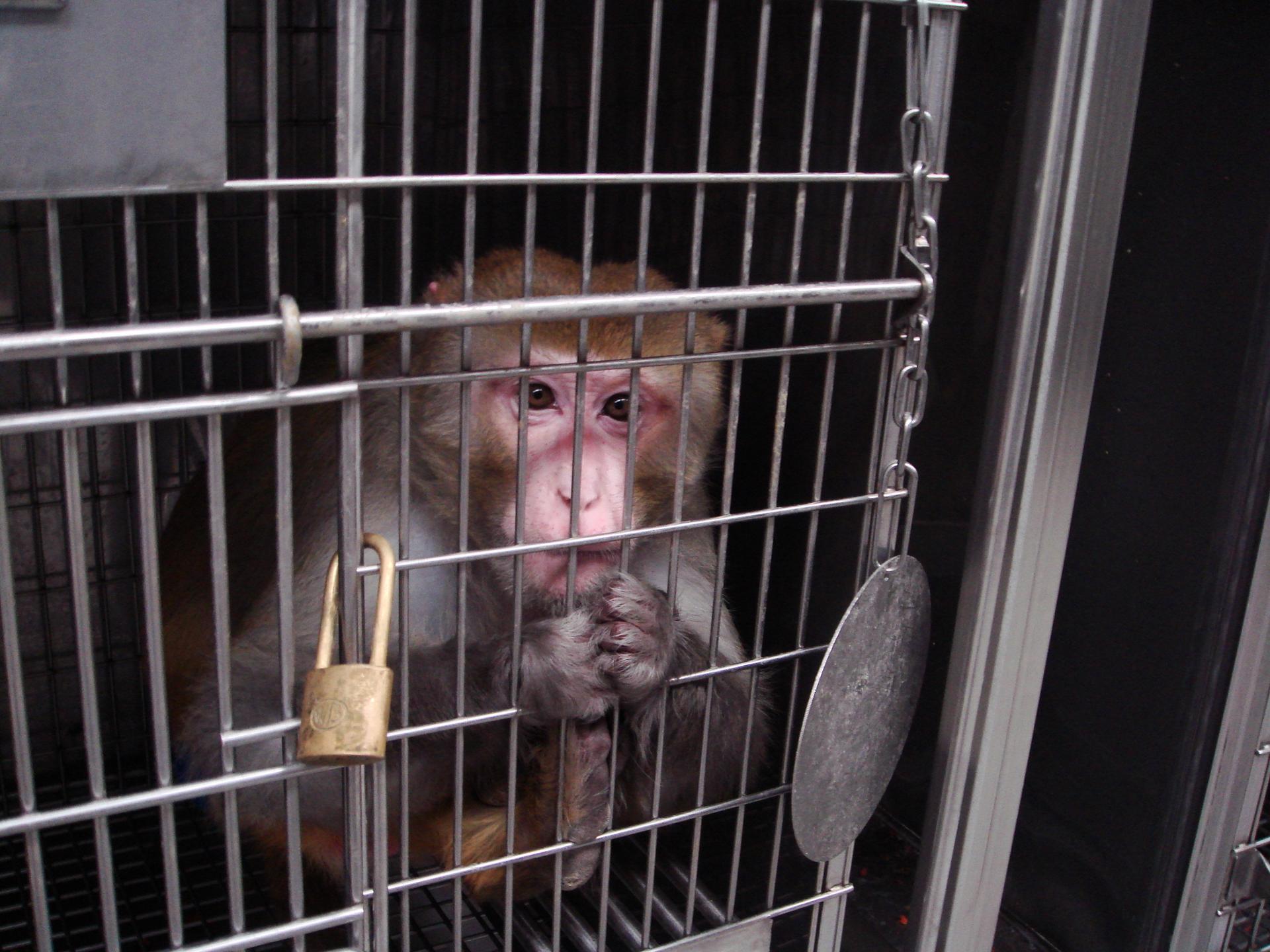
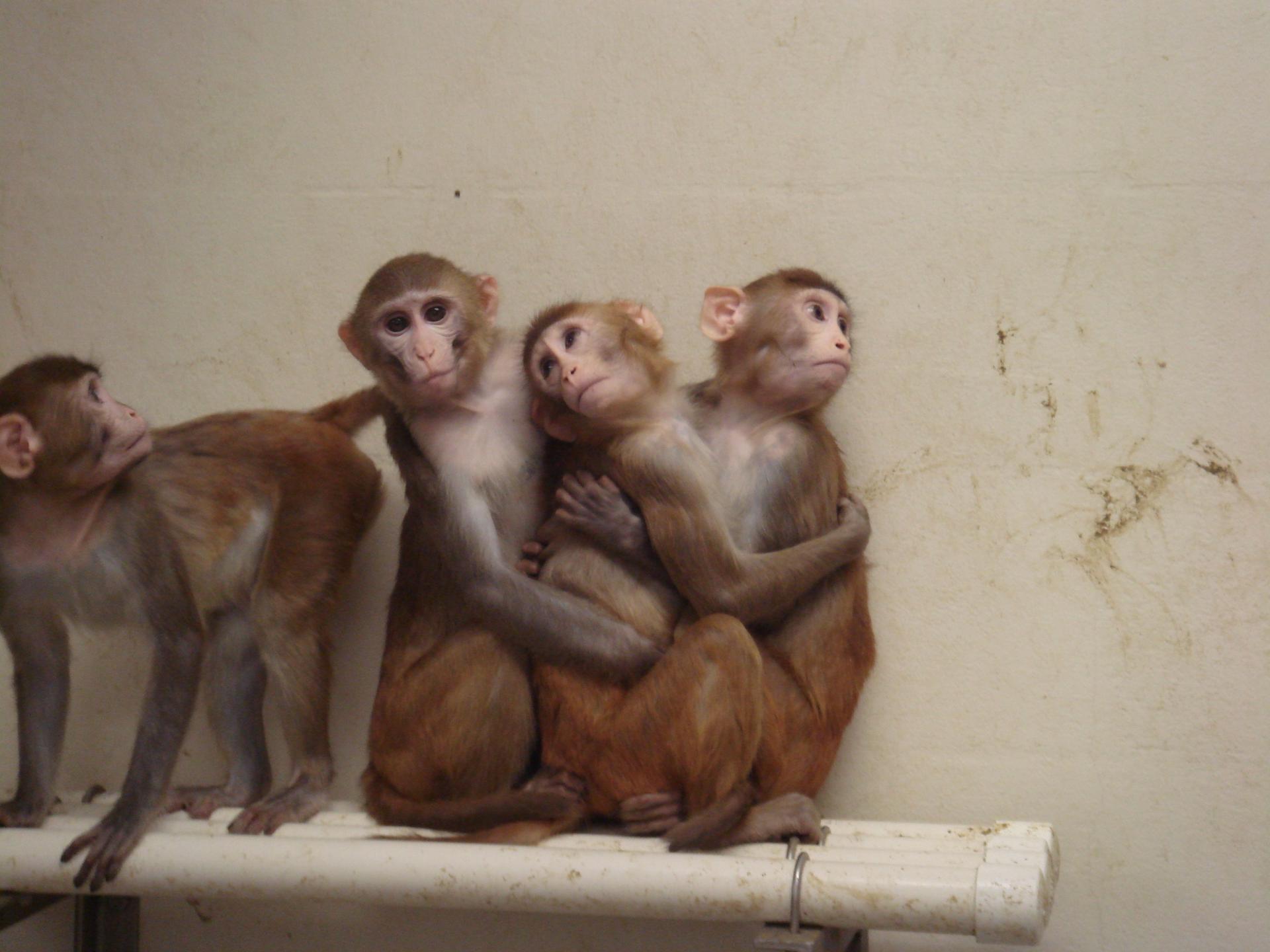
OHSU's primate research center, one of seven such federally funded centers still running at universities across the country, houses about 5,000 monkeys of various species — about 5 percent of all research monkeys in the US — including rhesus macaques, Japanese macaques, baboons, and squirrel monkeys. As part of the resolution reached this week, the center will stop breeding new monkeys, except as required by current experiments, while it discusses a potential plan with the NIH over the next six months to evolve from a primate breeder and experimentation facility to a sanctuary.
OHSU has been dogged by controversy over conditions for animals there, including dozens of citations for violations of federal animal welfare law over the past few decades. Two monkeys died in 2020 after a worker accidentally placed them in a cage-washing machine, while, in 2023, a newborn monkey was killed after being hit by a falling sliding door, to name a couple examples. "[OHSU's] record is one of the worst I've seen," Delcianna Winders, a professor and director of Vermont Law and Graduate School's Animal Law and Policy Institute, told me. "They just have negligent death after negligent death." (Disclosure: In 2022, I attended a media fellowship program at Vermont Law and Graduate School.) At a public meeting on Monday, researchers at the university's primate center, along with others from the university and members of the general public, fiercely debated the proposal to end research at the center. "Past research in primates might have contributed to the advancement of medicine, but it is evident that the advanced methods now available have rendered it virtually obsolete," said Michael Metzler, an emergency physician at Pioneer Memorial Hospital in Oregon. These include a new generation of research technologies, including lab-made organoids, organs-on-chips, and advanced computational modeling. Supporters of the primate center, meanwhile, condemned the university's "immediate surrender to a hostile administration over political pressure," as Cole Baker, a PhD student in biomedical engineering at OHSU, put it at the hearing. OHSU is no doubt under pressure to cooperate with the NIH, which, as of fiscal year 2023, provided the majority of the university's research funding, and the White House has shown that it's perfectly willing to punish universities that don't comply with its wishes. But calls to close the center predate the Trump administration, and it is hardly just a Republican priority. Oregon's Democratic governor Tina Kotek has urged the primate center's closure, citing the example of Harvard University, which closed its own primate research center in 2015 amid controversy over its treatment of monkeys. Harvard's decision itself is a noteworthy signal of where medical research is headed. One of the world's top biomedical research institutions apparently determined — more than a decade ago — that the medical science coming from its primate research center wasn't worth its continued financial, reputational, and ethical costs. |
Why do we experiment on primates at all?
Primate research, like most things in science, is the product of path dependency and historical circumstance. In the 1960s, the US created a system of federally funded primate centers, like the one at OHSU. The NIH at the time "thought primate experiments were the future," Winders told me, and it has shaped the way lots of medical science is practiced to this day. But today, the sight of caged lab monkeys looks more like a relic of the past.
It now appears, beyond doubt, that at least some of what primates are used for in US labs is of extremely limited value, particularly research that aims to model complex mental health conditions in humans, like depression, by inducing them in monkeys. And their very captivity alone might make results even less translatable to humans. For example, neuroscientist Garet Lahvis, a former professor at OHSU has argued that extreme confinement in cages stunts the health of lab animals and skews the psychology of monkeys to such a degree that they can hardly be seen as sound proxies for healthy humans. Former NIH director Francis Collins also acknowledged as much in 2014, when he referenced "the pointlessness of much of the research being conducted on non-human primates" in a private email that was obtained by PETA as part of a lawsuit. While proponents of primate research cite its use in human drug development, like therapies for HIV, the mere presence of primate data in the evidence chain for a medical treatment does not prove that that research was indispensable. And given the high moral stakes of research on social, cognitively complex animals, and the substantial opportunity costs of devoting resources and careers to primate labs, merely being sometimes useful does not seem like sufficient justification for subjecting monkeys to lifelong captivity and invasive experiments. The NIH deserves credit for acting on this perspective. And there is precedent for phasing out research on a class of animals. The federal government a decade ago ended biomedical research on chimpanzees, although other primates are more deeply embedded in such research than chimps were. So, the NIH now faces the challenge of winding down that research enterprise in a way that respects researchers' careers; building a credible off-ramp to animal-free research tools; and, in its proposal to fund a primate sanctuary, providing some measure of justice for the animals harmed in federally funded science. That would be no small task for even a normal administration — and for one that has wrecked its credibility with the scientific community, it will be even harder. Consider it a test case for whether the Trump administration can, amid its ruthless cuts to research, contribute to at least one positive paradigm shift in science. |
|
|
| Marina Bolotnikova Senior reporter |
|
|
| Marina Bolotnikova
Senior reporter |
|
|
AI's threat to white-collar jobs just got more real |
You've become increasingly replaceable. |
Harun Ozalp/Anadolu via Getty Images |
It sure feels like February 2020 again, meaning we might be on the very brink of something very big — at least if you listen to the AI crowd. And if your job lives in a browser tab like mine, you should listen. In a new piece, senior correspondent Eric Levitz argues we've crossed into the "agentic" era: AI systems that don't just answer prompts, but can take a goal, use tools, test their own work, and keep iterating until they're done. The upshot is simple: These models are starting to feel less like chatbots and more like junior staffers. Claude Code doesn't just generate code — it can run it, watch it fail, debug, and try again, inside the same software ecosystem where most white-collar work happens. What does that mean for the world of work? Let's take one example Eric cites: Two CNBC reporters with zero coding experience told Claude Code to recreate the huge project management platform Monday.com. They got a working clone up and running in under an hour; Monday's stock then fell roughly 20 percent. Investors are now asking the question nobody wants to hear: if an AI agent costs $20 a month, why pay for a lot of software, consulting, and — yes — people? Levitz isn't claiming instant apocalypse. AI agents still make serious mistakes, adoption is slow, and regulation will matter. But he points to evidence that capability is improving fast — the kind of curve you ignore until it's too late. Read it now, while "preparation" is still an option. — Bryan Walsh, senior editorial director |
|
|
The Vox Membership program is getting even better with access to Vox's Patreon, where members can unlock exclusive videos, livestreams, and chats with our newsroom. Become a Vox Member to get access to it all. |
|
|
CAN'T STOP THINKING ABOUT... |
|
|
I am in full Olympics superfan mode. I am pacing around my apartment listening to Andrea Bocelli, sipping espresso, and armchair-judging speed skating collisions, ice dance drama, snowboard spins, and men who have the audacity to…well, see for yourself. But there is nobody that I will judge harder than whoever it was at Milano Cortina HQ who decided it was okay to use artificial intelligence to sully their Olympics aesthetic with a bombardment of tacky, soulless slop. An animation in the opening ceremony featured gibberish writing, dead-eyed athletes, and discolored Olympic rings. A series of official graphics depicting curling stones as blocks of cheese and ski slopes as gelato appear to be a blatant AI rip-off of the photographer Tatsuya Tanaka's miniature masterpieces. Not to be outdone, a Czech ice dancing duo skated to an AI-generated knock-off Bon Jovi music mix that, listeners beware, nearly made my ears bleed. This is happening in Italy, the literal home of the Renaissance. These Olympics should have been an absolute aesthetic feast for the senses, an artistic testament to human exuberance to match the Games' electrifying, often superhuman athleticism. Instead, they served slop. |
|
|
⭐ ONE WAY TO DO GOOD THIS WEEK |
Happy almost Valentine's Day! What better way to celebrate tomorrow than with a date, distraction, or donation that gives back? Who wants drugstore flowers, when you can plant a tree or tulips in your Valentine's honor instead? Hallmark cards are fine and all, but sending your own Valentines to older adults is way more fun. You could also spend the day with your sweetie (or yourself) going on a volunteer date to your local animal shelter, food bank, or blood donation drive. And alternatively, if all of this gets you feeling a little bit bitter, then feel free to name a roach at the zoo after your ex instead. XOXO —Sara Herschander, Future Perfect fellow |
|
|
Want more Future Perfect in your inbox? Sign up for more newsletters here. Need advice? Submit a question to Sigal Samuel's advice column Your Mileage May Vary. |
| |
It's Izzie Ramirez here. If you're reading this, I just wanted to say thank you for being a Future Perfect newsletter subscriber. I've been editing and building this bad boy for almost four (!!!) years. I've loved reading your questions and getting to know you better all these years. But today is my last day here at Vox! I'm passing the reins on to Seth Maxon, who also edited and produced today's newsletter. Trust me, you're in good hands. <3
|
|
|
|